The end of the year is approaching.
That wonderful time of year when everyone is trying to squeeze the last bit of revenue out of 2026 while the targets for 2027 are still in their wonderfully optimistic Excel phase.
So, how do we best understand what airline executives are currently worried about and what is likely to shape their strategic priorities for next year?
You guessed it: earnings calls.
Regular TNMT readers will know that we have a soft spot for earnings calls. (Yes, listening to CFOs being grilled about unit costs is our idea of quality content.)
Earnings calls provide an incredibly rich source of intelligence on how airline executives and Wall Street think about the state of the industry, particularly when it comes to the commercial relevance of emerging trends and technologies.
- After all, it’s one thing to talk about innovation on a conference stage.
- It’s another to explain to a banking analyst how it will actually make your company money.
If you remember our earnings-call analysis from earlier this year, one finding stood out in particular.
- Across the S&P 500, executives had started mentioning the word “AI” more often than the word “earnings” during, well, earnings calls.
- In the airline industry, however, the picture looked remarkably different.
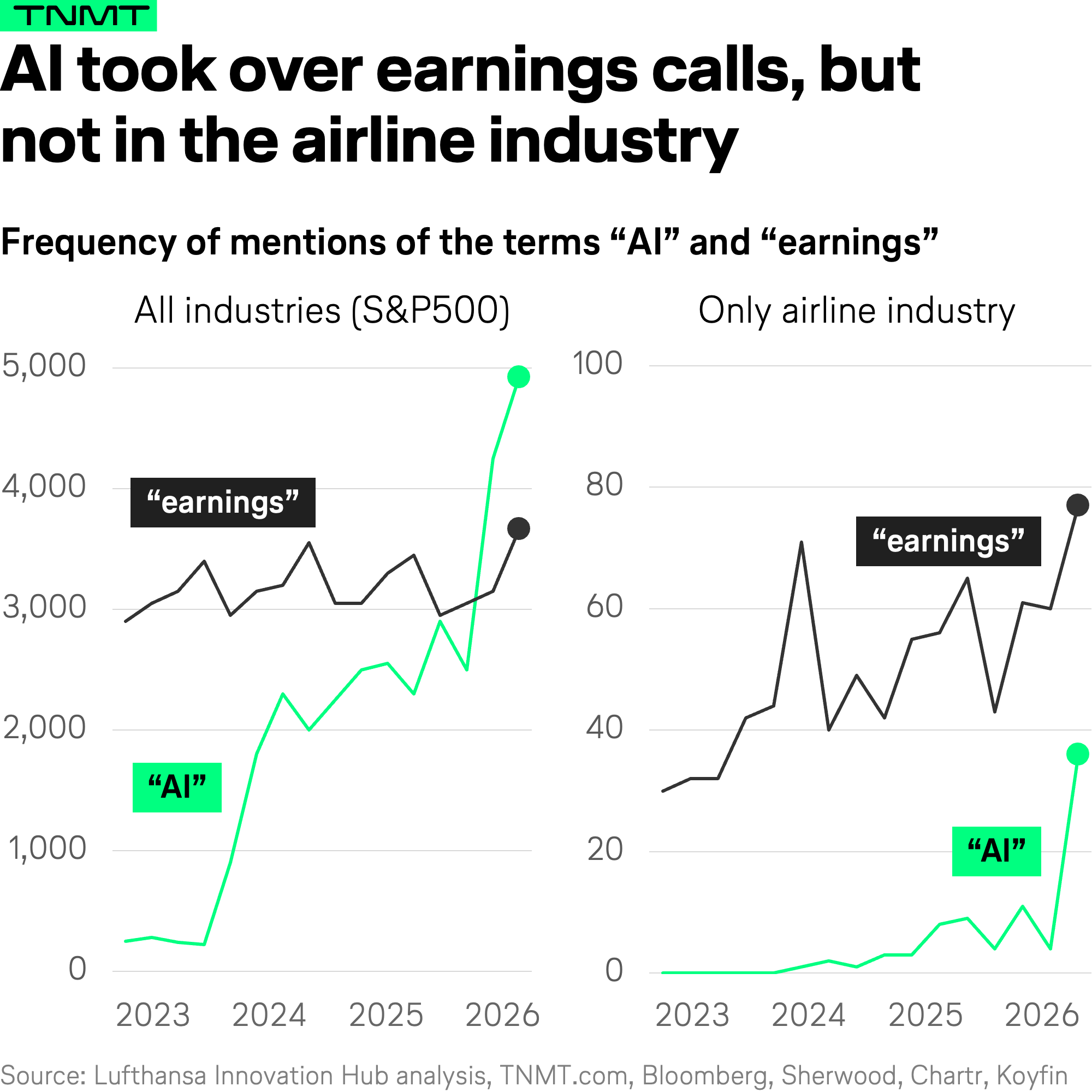
At the beginning of the year, AI was still very much a niche topic in airline earnings calls.
Instead, the usual suspects of airline economics dominated the conversation. Think network planning, revenue management, fleet strategy, and loyalty.
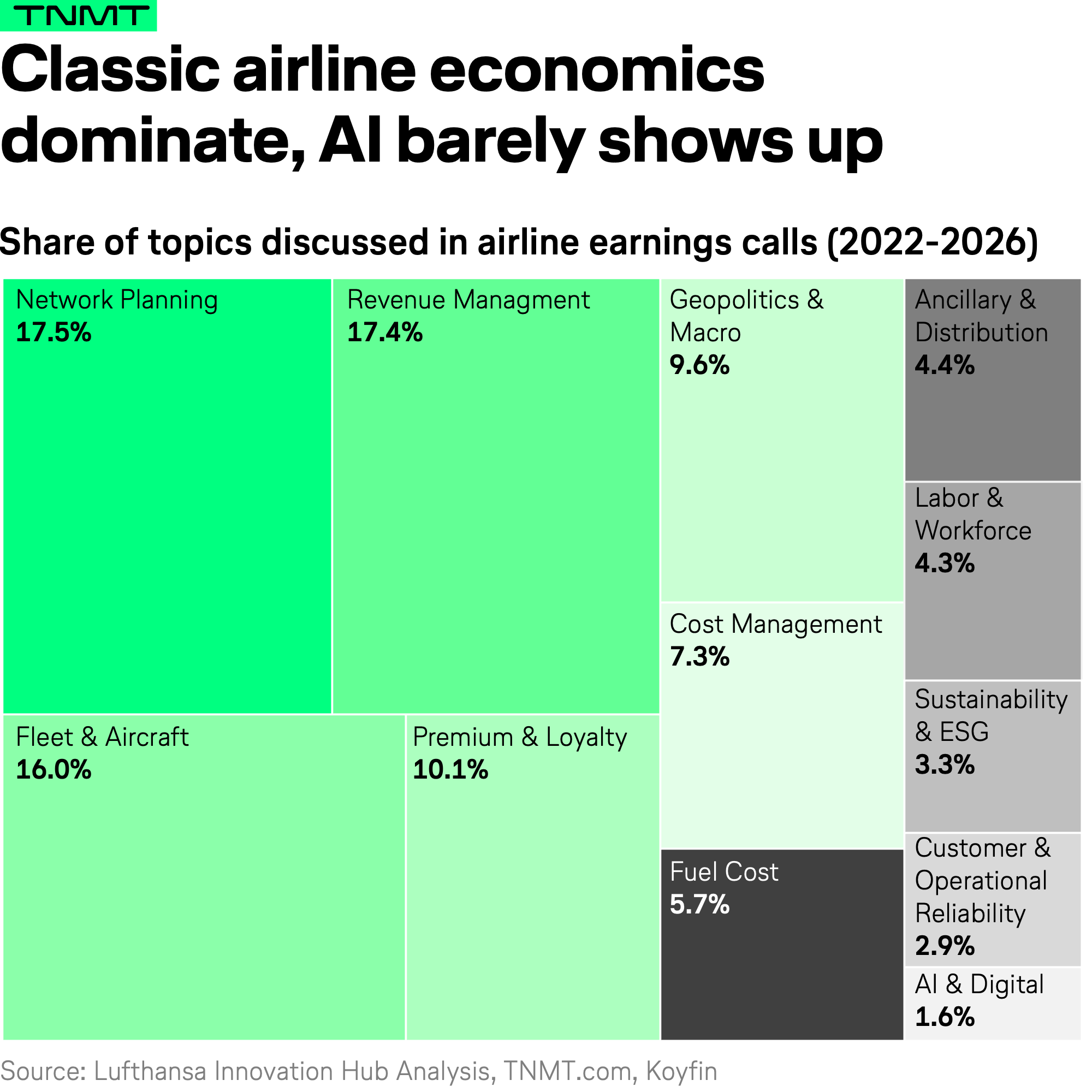
At first glance, this seemed to confirm a familiar pattern: the airline industry is arriving somewhat late to the latest technology party. For all the hype surrounding AI, its relevance to airline earnings was still barely being discussed.
But what does the picture look like now, as airline executives prepare for 2027?
Well, we’ve been back in our beloved earnings-call transcripts.
And things have changed.
How airline strategy is shifting as we head into 2027
Let’s not waste any time and get straight to the core of our analysis.
As in our previous research, we analyzed the earnings calls of 10 of the world’s largest publicly listed airlines that hold their earnings calls in English.
- We organized the major strategic themes discussed across these calls into 12 topic clusters, each defined by a curated set of keywords and phrases, with the clusters kept as mutually exclusive as possible.
- Each topic was then expressed as a share of all tracked mentions, allowing us to compare how the focus of airline earnings calls has shifted over time.
What we wanted to find out this time:
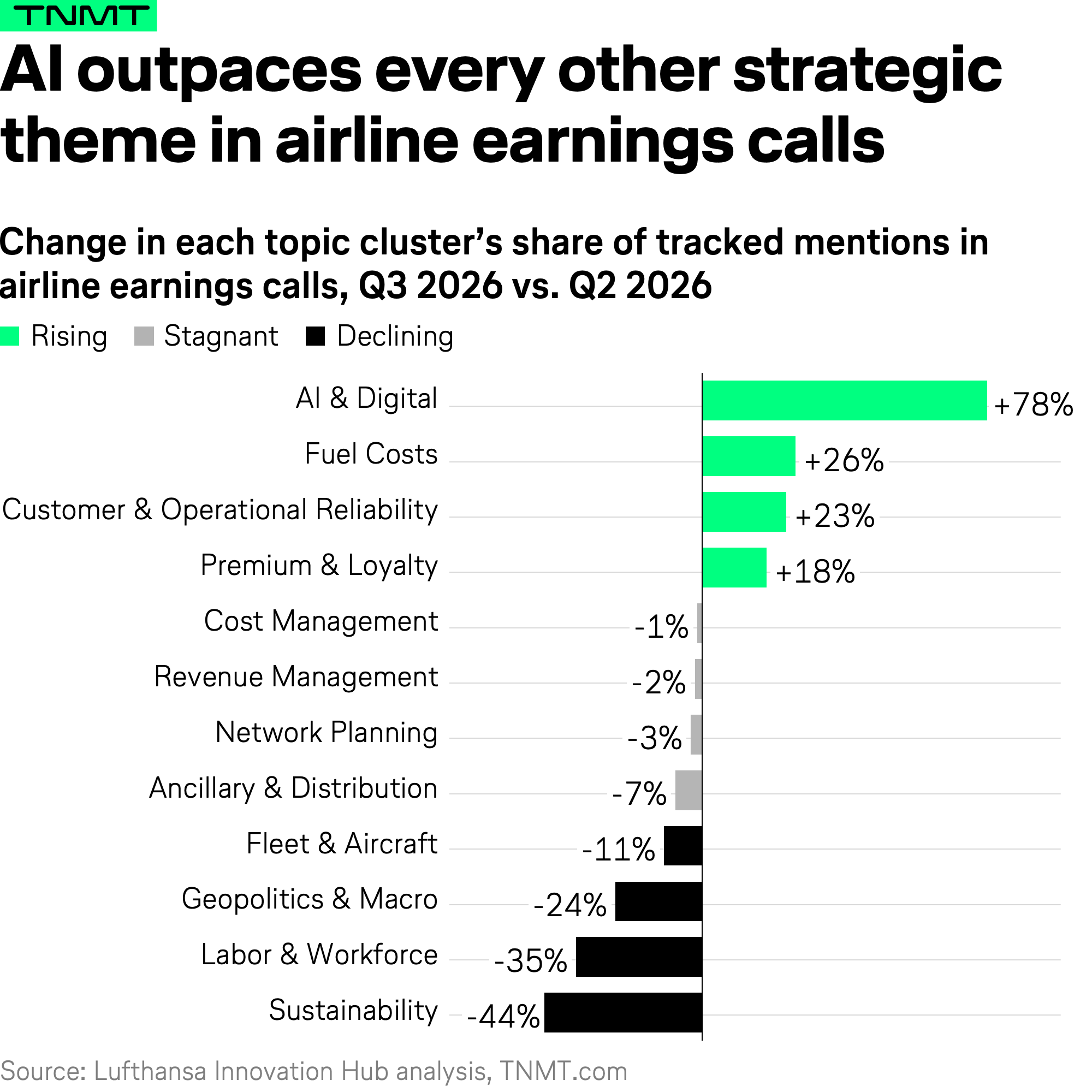
Which strategic themes gained the most attention in Q3 2026 (the latest reported quarter) compared to the previous quarter?
As you can see below, four of our 12 strategic themes gained ground.
And much to our surprise, a topic that had consistently ranked near the bottom of our earnings-call analysis in the past now tops the growth ranking.
AI & Digital has seen a 78% quarter-over-quarter increase in its share of tracked mentions.
It looks like AI has finally made its way onto airline boardroom agendas.
Let’s unpack what we can learn from this overview in more detail.
1. The agentic debate reaches airline boardrooms
First, a quick clarification about our AI & Digital cluster.
It covers explicit mentions of AI as well as broader digital topics, including online distribution, digital sales channels, and AI agents. Naturally, there is some thematic overlap with our Ancillary & Distribution cluster, particularly when it comes to how and where travelers book their flights.
And it is precisely this question that drove much of the growth in Q3: Who will control flight distribution in an increasingly agentic world? Regular TNMT readers will be familiar with this debate. Most recently, we explored why airlines’ NDC and agentic commerce strategies are increasingly converging.
Interestingly, much of the growth in AI & Digital mentions can be traced back to just two airlines, Delta and Southwest, whose executives appear to be taking quite different positions on the matter.
Delta is playing defense
During its earnings call, CEO Ed Bastian made it clear that Delta would be cautious about which AI players it grants access to its flight inventory. At the same time, he positioned Delta Concierge, now available to all SkyMiles members, as “our Agentic solution to taking care of our best customers.”
His bigger concern? AI agents that “continue to try to compete us all against ourselves.”
In TNMT words, Delta wants to participate in the agentic era while protecting its direct customer relationships and avoiding a world in which third-party AI agents reduce airlines to easily interchangeable suppliers.
Southwest, meanwhile, appears more willing to experiment
Southwest, on the other hand, recently became the first U.S. airline to make flight shopping available through ChatGPT.
CEO Bob Jordan acknowledged during the earnings call that usage numbers were still too small to draw meaningful conclusions. But understanding where airline distribution might be heading in the age of AI agents was precisely why Southwest launched the integration in the first place.
These contrasting positions look particularly interesting in light of what has happened since the Q3 earnings calls. Although outside the scope of our quarterly analysis, November alone has delivered plenty of additional fuel for the agentic debate.
- On November 12, United moved to block third-party AI agents from booking and managing reservations, citing risks ranging from the exposure of sensitive customer information to unintended purchases and the use of MileagePlus miles.
- That same week, OpenAI acquired Odessia, the IATA-accredited AI travel agent founded by Sonder co-founder Francis Davidson.
So, expect this debate to feature even more prominently in upcoming airline earnings calls.
But back to our Q3 analysis.
Beyond distribution, most of the AI & Digital conversation revolved around a much more familiar airline management priority, namely bringing down costs.
This was particularly apparent among European carriers:
- Ryanair sees the increased use of AI as a way to improve productivity across its operational and back-office functions, helping offset its rising fuel bill.
- IAG lists the increased use of technology and AI alongside tighter recruitment and reduced consultancy spending as part of its cost mitigation efforts.
- Broader digital transformation efforts followed a similar logic. Our parent company, Lufthansa Group, linked automation and digitalization to its turnaround program and improved Cargo margins.
- Delta highlighted its cloud migration as a significant source of efficiency and productivity savings.
- United, meanwhile, pointed to its six-year technology modernization program, involving hundreds of millions of dollars in investment to move away from legacy systems, as a source of competitive advantage.
So what is our biggest takeaway?
The 78% growth figure is striking. But arguably even more telling is what sits behind it.
AI is increasingly being discussed in the context of two of the most fundamental questions of airline economics:
- How do we protect our revenues?
- And how do we bring down our costs?
That is perhaps the strongest indication yet that AI is becoming an earnings-relevant topic for airline execs.
But before we get too carried away by the AI excitement, let’s turn our attention to the other three growth areas, all of which touch on more fundamental aspects of airline economics.
2. High fuel prices are already shaping 2027 plans
The second-largest growth theme in our Q3 analysis comes as considerably less of a surprise.
- Fuel mentions grew by another 26% quarter over quarter, accounting for 14.1% of all tracked mentions, up from 11.2% in Q2.
- In percentage-point terms, this represents the biggest shift across all 12 strategic themes.
Given the ongoing geopolitical uncertainty surrounding Iran and Ukraine, and fuel prices featuring prominently in the run-up to the U.S. midterm elections, this hardly comes as a surprise.
What stood out in the Q3 earnings calls, however, was how much of the conversation was already focused on managing fuel costs well beyond 2026.
- Southwest, for example, is “planning against fuel prices staying up in 2027.”
- United aims to “recapture 100% of the price of oil in 2027.”
- And Ryanair is already discussing its fuel bill for the 2028 financial year.
Clearly, airline executives are building their plans for next year around the assumption that elevated fuel costs could be here to stay.
3. From managing the summer peak to winning over passengers
The third growth theme, Operational Reliability, also follows a somewhat predictable pattern.
After all, Q3 covers the busiest travel period of the year, when the aviation system is regularly stretched to its limits.
Naturally, a substantial part of the earnings-call conversation revolved around how airlines prepared for and managed the summer peak. Think more robust flight schedules, better crew and aircraft allocation, faster disruption recovery, and additional operational buffers to prevent delays from cascading across the network.
Beyond operational performance, however, much of the conversation focused on improving the broader passenger experience.
The major U.S. carriers, in particular, had plenty to announce.
- Southwest promised fleet-wide Starlink connectivity, in-seat power, and its first airport lounges by this time next year.
- American announced plans to open ten lounges through 2027, including its largest Admirals Club in Charlotte, and reported improvements in its on-time NPS in six of the past seven quarters.
- United, meanwhile, expects to remain “the only global U.S. airline with Starlink at scale” throughout 2027 and 2028.
It is this last point, in-flight connectivity, that we find particularly interesting.
Back in September, we argued that airlines should increasingly think of high-speed in-flight connectivity as a platform for new commercial opportunities.
- At the time, we counted approximately 6,750 aircraft either equipped with or committed to next-generation satellite connectivity.
- That number has since grown to 8,256 aircraft, representing 27.5% of the global commercial aircraft fleet.
But the Q3 earnings calls revealed another potentially powerful commercial benefit of high-speed connectivity: its ability to attract customers away from competing airlines.
- United explicitly described Starlink as “a motivating factor for customers to choose which airline they fly.”
- According to the carrier, customers previously “brand-loyal to other airlines” have “switched to a United flight solely because of Starlink.”
And perhaps most importantly, United claims that “once they try us, they stick with us.”
If this early customer behavior holds at scale, high-speed in-flight connectivity could become one of the few new airline product features in recent years capable of actively shifting market share and breaking established loyalty patterns.
4. Airlines are making a long-term bet on premium demand
Last but not least, the theme we call Premium & Loyalty also gained ground in Q3.
Of all four growth themes, this one arguably reflects the most fundamental shift in airline economics, because it goes right to the heart of how airlines make money. Across the industry, airlines are increasingly reconfiguring their aircraft to accommodate more premium economy and business-class seats.
Two recent examples from the UK illustrate just how far airlines are willing to go:
- British Airways is turning the entire upper deck of its A380s into business class as part of its broader £7 billion transformation program.
- Virgin Atlantic plans to increase the number of premium seats it offers by 30% over the next four years, reconfiguring its aircraft accordingly.
What makes these investments particularly interesting is that they come at a time when elevated fuel costs are already putting upward pressure on ticket prices.
The commercial logic behind these decisions is closely linked to what economists call the K-shaped economy, particularly evident in the U.S.
While more price-sensitive consumers are tightening their belts, wealthier households continue to spend on travel and are willing to pay extra for comfort.
The composition of premium demand is also changing.
- Historically, expensive cabins were primarily designed around corporate travel demand.
- Today, airlines are increasingly targeting leisure travelers willing to pay for premium economy or business class out of their own pockets.
But perhaps the most interesting aspect of this premiumization trend is the investment horizon.
British Airways, for example, decided on its A380 cabin overhaul two years ago and expects the investment to pay off over the next 10 to 15 years.
Think about that for a moment.
- An airline can adjust its ticket prices in a matter of seconds.
- Changing the physical composition of its cabins effectively locks in certain assumptions about future passenger demand for well over a decade.
For the economics to work, airlines will need to sell more premium tickets at prices that justify the cabin investments, compensate for the economy seats removed, and help absorb higher operating costs.
Airlines are essentially betting that the growing willingness to pay for comfort is a structural shift in consumer behavior.
Outlook: The airline industry’s biggest bet for 2027
And if our earnings-call data is anything to go by, airline executives are feeling increasingly confident about that premium bet.
The Q3 earnings season, typically falling in October and November, is particularly interesting because it offers one of the last opportunities of the year for airline executives to share their expectations for the year ahead with analysts.
So we decided to take our analysis one step further:
Which strategic themes are airline executives most optimistic about heading into 2027?
To find out, we extracted every passage from the Q3 earnings calls that referred to the year ahead, mapped these passages to our 12 topic clusters, and classified their sentiment as positive, negative, mixed, or neutral based on the tone and language used.
We then plotted the 12 themes along two dimensions:
- Relevance (x-axis): Each topic cluster’s share of all forward-looking passages.
- Optimism (y-axis): The share of passages within each topic cluster classified as positive.
Interestingly, only one of our 12 strategic themes sits in the upper-right quadrant, combining a high degree of executive attention with a high degree of optimism: (again) Premium & Loyalty.

If our earnings-call analysis is any indication, the shift toward premium is a long-term bet.
Executives are committing billions to a future in which passengers are expected to pay more for comfort, year after year.
Whether consumer demand will live up to that level of corporate conviction is the billion-dollar question.