It’s mid-September.
Which means even the very last summer returnees should now be back at their desks.
- The out-of-office replies have finally stopped multiplying.
- Temperatures are dropping.
- The summer mood has officially left the building.
And suddenly, Q4 is almost here.
That made us pause for a moment.
How much meaningful technology progress has the travel industry actually delivered in 2026 so far?
And perhaps more importantly: Where should the industry focus during the final months of the year?
To find some answers, our TNMT team revisited the 10 Wishes for Travel in 2026 that we published at the beginning of the year.
A quick reminder for anyone whose January reading list has since disappeared beneath several hundred unread emails:
We deliberately called them wishes, not predictions.
How come?
Predictions mostly ask what we think will happen.
Wishes force us to take a clearer position on what should happen
They make us ask what the travel industry could deliver but still hasn’t, and which problems deserve more attention, even if they are less fashionable than the latest AI product announcement.
In case you want to revisit the full list, you can download the mini report here:

Of the ten wishes we originally published, four now feel particularly critical.
Today, we’ll revisit the first of those four and assess how much progress the industry has made so far.
The remaining three will follow across our next few newsletter editions.
Apparently, even a wish list needs a performance review.
The first wish we want to revisit was also the first one in our original report:
Airlines should treat in-flight connectivity as more than faster Wi-Fi. They should treat it as a platform shift.
One recent story captures the difference perfectly.
- On a Buenos Aires-to-Barcelona flight in July, one passenger bought the onboard Wi-Fi, stood at the front of the cabin, and held his laptop above his head so the other 187 passengers could watch Argentina come back from 0–2 down to beat Egypt 3–2. The improvised watch party quickly went viral.
- The airline remained anonymous. But as OutKick dryly observed, it was clearly a carrier that didn’t exactly spoil passengers with reliable live television.
Now compare that experience with Emirates.
- During the World Cup, the airline carried all 104 matches live through Sport 24 on its ice entertainment system. The full broadcast schedule was even printed in the seat-pocket magazine.
- Etihad, Qatar Airways, Turkish Airlines, Singapore Airlines, and Cathay Pacific offered similar live coverage.
These airlines kind of built a stadium in the sky.
The other relied on a guy with a laptop.
That gap captures the essence of our wish.
In our view, high-speed satellite connectivity is not simply another (paid) amenity that lets passengers stream Netflix more smoothly.
Instead, it gives airlines the infrastructure to rethink the entire in-flight experience through live entertainment, personalized service, real-time commerce, operational communication, and shared moments that were previously impossible at 40,000 feet.
Our core thesis is this:
- A fast internet connection is the infrastructure.
- What an airline builds on top of it is the actual product.
So how much progress has the industry made on this wish so far in 2026?
The connectivity layer is finally scaling
Good news first: the infrastructure side of our wish is (finally) moving fast.
- Satellite Wi-Fi has been discussed for years, while actual rollout remained painfully slow.
- Over the past three years, that changed.
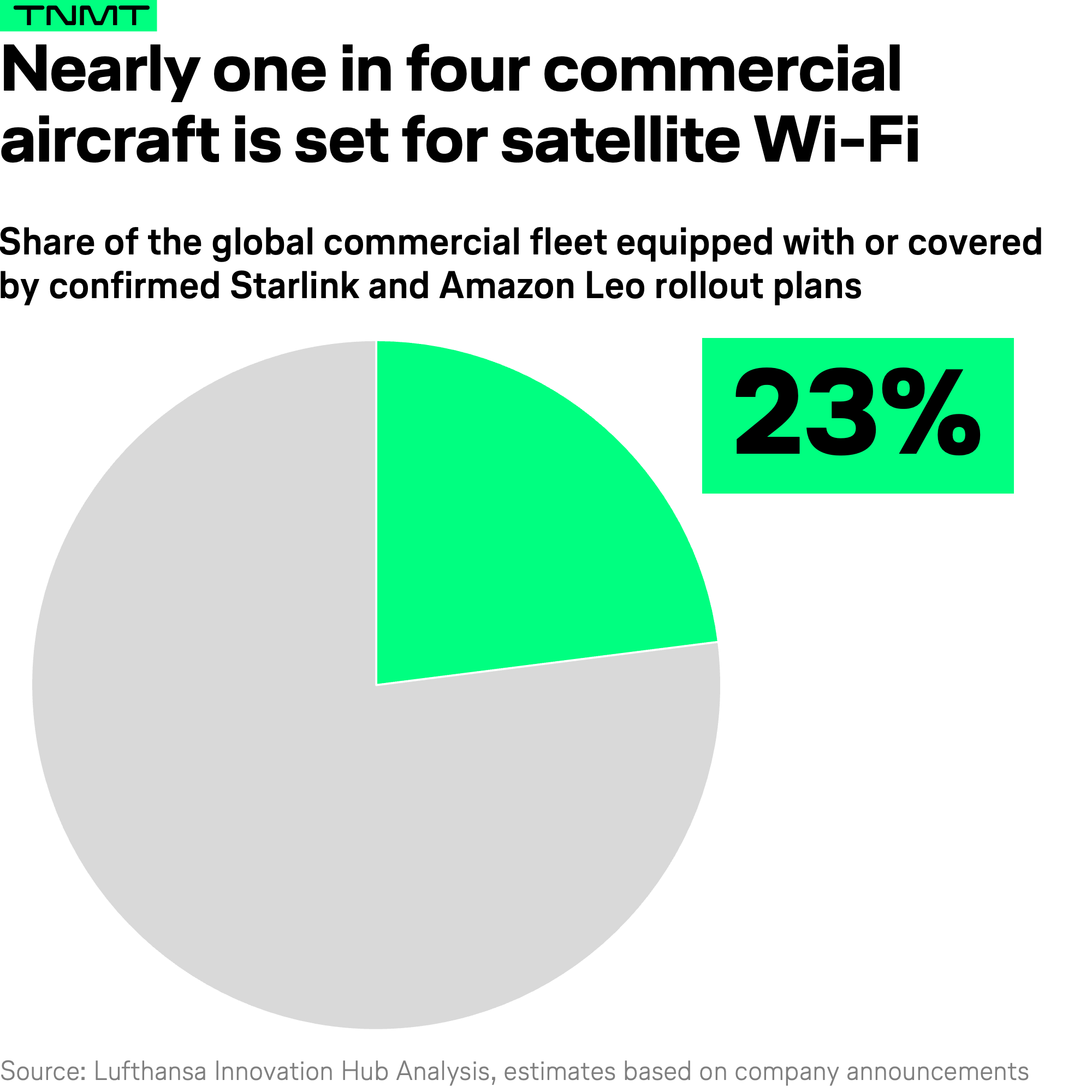
Based on our TNMT estimate, which combines public airline announcements with current fleet sizes, around 6,750 commercial aircraft globally are now either equipped with next-generation satellite Wi-Fi or covered by confirmed rollout plans.
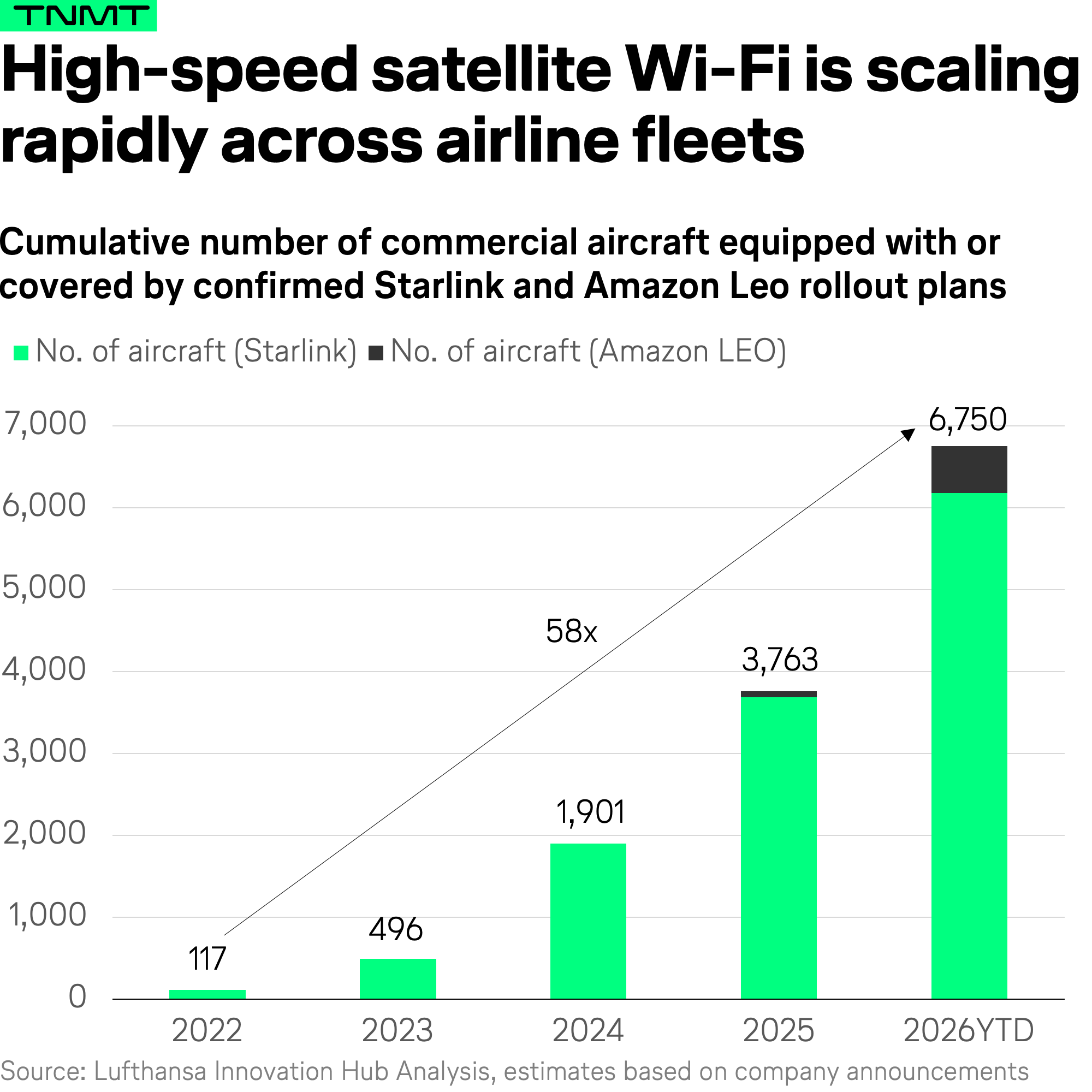
Most of that momentum comes from Starlink. Amazon Leo is also beginning to build a future aviation pipeline, including a commitment to equip 500 Delta aircraft from 2028 onwards.
To put that number into perspective:
- Against a global commercial fleet of roughly 25,000 to 30,000 aircraft, about one in four are now part of a high-speed satellite connectivity program.
- That’s still a minority. But definitely no longer a niche experiment.
Recent rollouts have pushed the 2026 figure up significantly.
- United had already activated Starlink on more than 400 aircraft by late June and expects to reach about 1,000 equipped aircraft by year-end. Its first Starlink-enabled transatlantic widebody also entered service this summer.
- Closer to home, Lufthansa operated its first Starlink flight on August 19, with the full Lufthansa Group fleet of roughly 850 aircraft scheduled to follow by 2029.
- IAG, Air France, Emirates, and Qatar Airways have also made major fleet commitments. Qatar alone reported 150 Starlink-equipped widebody aircraft by August.
Interestingly, passenger expectations are moving just as quickly.
In our scan of public traveler comments across major review platforms, more frequent flyers are starting to describe reliable high-speed Wi-Fi as a booking criterion, especially on daytime long-haul flights where connectivity can turn several hours in the air into a normal working day.
Some are even asking booking platforms to add filters showing which specific flights offer high-speed connectivity.
That would certainly help.
For now, the experience still resembles an aircraft lottery. You can choose the right airline and route, yet discover only after boarding whether your particular tail number has entered the connected era.
So the rollout momentum is real.
The infrastructure is finally arriving.
Whether airlines are already turning that connectivity into the broader platform shift we wished for is a more complicated question.
The product thinking is still catching up
One reason airlines haven’t moved much beyond better Netflix streaming is simple: cost.
- In all fairness, the pipes are not cheap.
- Skift estimates that installing Starlink on a Boeing 737-800 costs around $500,000 USD, followed by roughly $180,000 USD in annual fees. Larger aircraft cost even more.
That leaves airlines with a still-unresolved business-model question: Who pays?
Many early Starlink adopters have made access free, often tying it to loyalty membership.
- Copa Airlines broke with that model in July. Business-class passengers and top-tier ConnectMiles members receive complimentary access, while most other travelers have to pay.
- Ryanair has gone further and rejected Starlink altogether. Michael O’Leary argues that fewer than 10% of passengers would pay for it, while the annual cost to the airline could reach €150 million to €250 million.
This cost focus helps explain why we have seen relatively few ambitious product ideas so far.
Still, a few airlines are beginning to show what the next product layer could look like:
- airBaltic turned its Starlink portal into a global shopping platform. AirMall gives passengers access to more than 20,000 brands, personalized recommendations, loyalty points, and delivery after landing.
- Admittedly, a shopping mall in the sky could not fix the balance sheet on the ground. airBaltic filed for Chapter 11 this past week.
- But the underlying product logic remains interesting: use connectivity to create new revenue rather than treating it purely as another cost item.
Virgin Atlantic took a more experiential approach:
- In May, the Sugababes performed inside The Loft of an A350 while the full set was streamed live through Instagram and TikTok.
- Fans on the ground could even submit questions and song requests in real time.
- This might feel like a gimmicky PR stunt (which it surely is), but it sparks our imagination about what onboard entertainment could look like in the future.
The same goes for United Airlines.
- The carrier used Starlink to turn an aircraft cabin into a television studio.
- ESPN host Tyler Fulghum joined a live, two-hour Fantasy Football Draft broadcast from 35,000 feet.
And British Airways opened the door to FaceTime, WhatsApp, Zoom, and Teams calls on Starlink-equipped flights. (Whether that’s truly inspirational when an entire sales team suddenly discovers in-flight video conferencing is a different debate).
In any case, these are all still isolated experiments.
But they point toward a much broader opportunity around live entertainment, personalized commerce, social participation, and entirely new service formats that were previously impossible in the air.
Virgin Atlantic summarized the shift better than we could:
“This isn’t just about introducing Wi-Fi; it’s about showing what it can do.”
That is exactly where our wish stands today.
The connectivity infrastructure is finally scaling.
The platform thinking has only just begun.
Three products waiting to happen
Speaking of potential platform plays.
Here are three spontaneous ideas from our side.
And no, we haven’t fully worked through the monetization logic yet either.
1) Sell togetherness
- Imagine a synchronized watch party with family and friends on the ground, cabin-wide trivia, or a fan flight to a Champions League final that already feels like a flying fan zone.
- High-speed connectivity allows airlines to turn shared moments into a premium product, especially around event travel.
2) Start disruption recovery before landing
- Imagine passengers rebooking from their seats, speaking to a video or AI service agent, arranging onward transport, or even completing parts of the immigration process before touching down.
- If passengers only begin solving their disruption after entering the arrivals hall, the aircraft is still operating like a disconnected island.
3) Turn the seat into a media and commerce channel
- Live auctions, limited product drops, destination offers, and real-time retail could work particularly well with an affluent, captive audience facing several hours of dwell time.
- United Airlines’ Kinective Media offers the clearest existing blueprint for turning airline-owned attention into a new revenue stream. Surprisingly few carriers have followed thus far.
Those are our first three ideas. We’re sure you can do better.
What is your favorite imaginable Wi-Fi-powered airline product?
Email newsletter@tnmt.com and let us know.
And yes, you really should start thinking about this now.
Here is the part we are willing to call a prediction rather than a wish:
The winners will treat the connected cabin as a platform. The laggards will treat connectivity as a cost center and sell passengers access to a pricey pipe.
- One group will ask: What can we build once every seat is online?
- The other will ask: Who will pay for the Wi-Fi?
We know which conversation we would rather be having.