Over the past few weeks, we’ve revisited several wishes we made for the travel industry at the beginning of 2026.
If you’ve followed along, you’ll remember that we’ve already looked at three big questions:
- Will airlines finally start treating in-flight connectivity as a platform rather than just another ancillary add-on?
- Will airlines stop treating NDC and agentic commerce as separate roadmaps?
- And will airline loyalty programs finally start creating genuine loyalty again?
Today, we turn our attention to travel inspiration.
More specifically, to one of the industry’s most influential, yet still surprisingly underused commercial channels: social media.
At the beginning of the year, our wish was straightforward:
- Someone should finally build the missing link between the travel inspiration people discover on platforms like TikTok and Instagram and the ability to actually book what they see.
- And by “book,” we don’t just mean identifying the beautiful hotel featured in a viral video and linking to its booking page.
We mean something much more ambitious.
Think less “here’s the hotel you saw” and more “here’s the trip that video made you want.”
So, more than ten months into 2026, how much closer are we to making that vision a reality? One small spoiler: AI plays a role here, too. At this point, who’s surprised?
But let’s start at the beginning.
Travel inspiration has gone social; booking hasn’t
In case you’re wondering whether social media has really become a major source of travel inspiration, the answer couldn’t be clearer.
Yes. And by quite some margin.
- According to research by Expedia and Beautiful Destinations, more than two-thirds of travelers start their travel planning journey on platforms like Instagram, TikTok, and YouTube.
- That’s more than twice the share of travelers who begin their inspiration phase on traditional online booking platforms.

So, social media has clearly established itself as one of the most influential channels for travel inspiration.
But there is a catch.
While travelers increasingly discover their next vacation through social media, very few actually book their trips there.
The numbers illustrate just how big that gap remains.
- Social commerce, meaning purchases completed directly through social media platforms, accounts for less than 1% of online travel sales globally.
- Compare that with e-commerce more broadly, where an estimated 10% of global online sales already happened directly through social platforms in 2025.
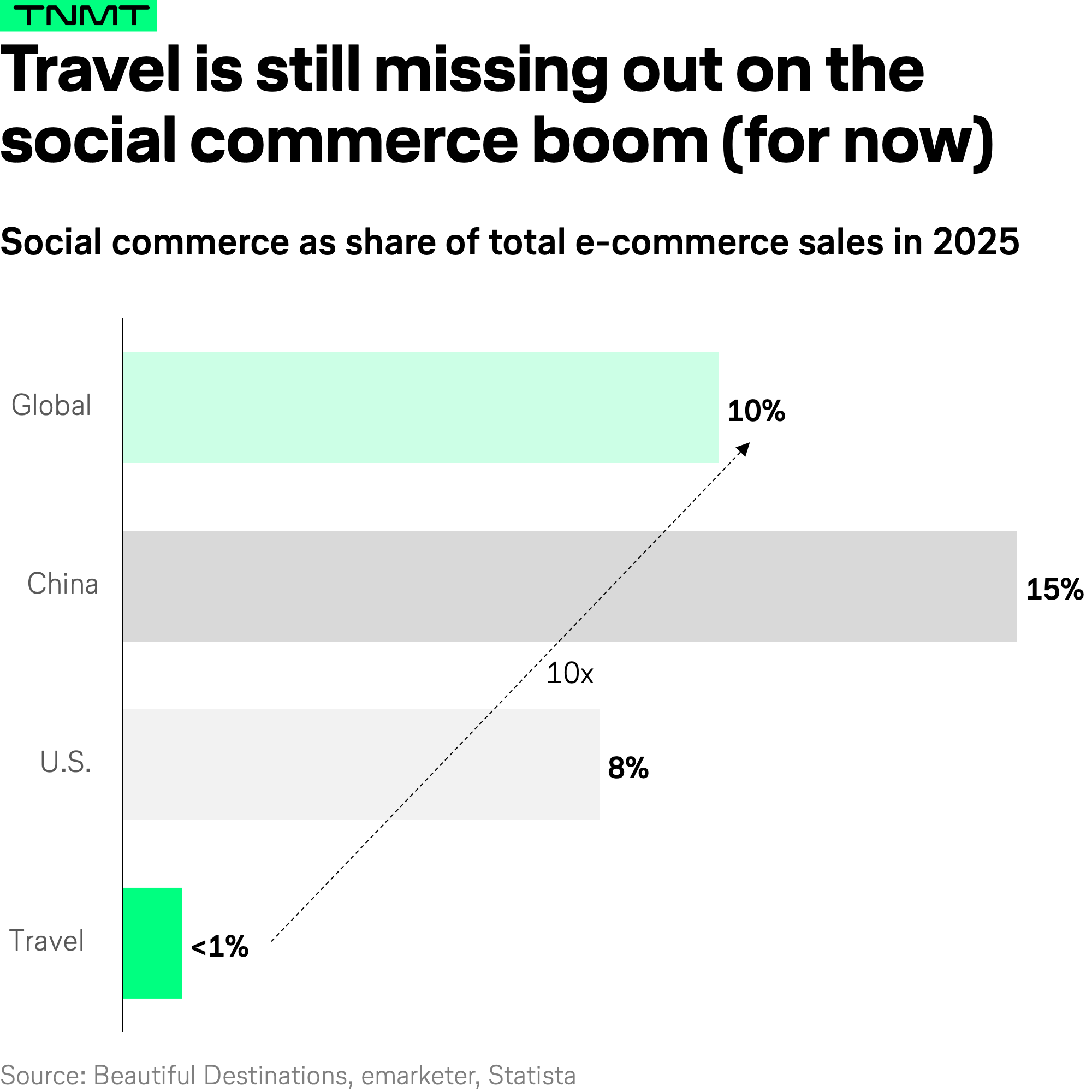
In TNMT words, social media has become a major starting point for travel demand, but the travel industry has barely figured out how to convert that inspiration into bookings without sending travelers elsewhere.
That’s a remarkable disconnect.
So, has anything changed over the past ten months?
Let’s look at what 2026 has delivered so far.
TikTok Go is the clearest proof point so far
If we look for the biggest step forward over the past ten months, one development stands out above all others: TikTok Go.
- Launched in May 2026, TikTok Go connects bookable travel inventory directly to TikTok’s US user base of more than 200 million people.
- The inventory currently comes from a broad set of travel partners, including Booking.com, Expedia, Viator, GetYourGuide, Tiqets, and Trip.com.
What makes TikTok Go strategically important is not just the inventory itself. It is the booking flow.
- For the first time at meaningful scale, travelers can move from inspiration to transaction without leaving the social platform.
- A user watching a hotel video, searching for “boutique hotel Lisbon,” or browsing a location page for Lisbon can tap into a product detail page, compare room types, prices, and availability, and complete the booking in just a few steps, all inside TikTok.

That matters because it removes one of the biggest weaknesses of social travel discovery so far: too much friction between seeing something desirable and acting on it.
TikTok also did something equally important on the supply side.
It created a viable model not just for travelers, but also for creators.
- Eligible creators, meaning users aged 18 and older with at least 1,000 followers and an account in good standing, can connect their content directly to bookable inventory.
- They can browse a marketplace of hotels and experiences, see the commission attached to each listing, and publish content directly from there.
- If a booking happens through their post, they earn a share of the OTA’s commission.
In TNMT terms: TikTok has turned travel content monetization into something much more scalable than traditional one-off brand deals.
Hotels and experience providers also benefit.
The booking happens inside TikTok, but the inventory and transaction still sit with the travel provider. That lowers the barrier to participation. The caveat, of course, is that a hotel or activity can only be booked if it is already distributed through one of TikTok’s OTA partners.
And the US is not the only market where this model is live. Similar travel marketplaces have already launched in Indonesia, in partnership with Tokopedia, and in Japan, where bookable inventory comes from players such as Rakuten Travel, Agoda, Trip.com, Traveloka, Asoview!, and KKday.
We see this as a highly positive development.
For the first time, social travel booking on a major Western platform is beginning to resemble what social commerce has looked like in China for years.
There, inspiration-to-booking has long since become a mainstream travel behavior.
Douyin, TikTok’s sister app, already sells hotel vouchers, attraction tickets, and package offers directly from short videos and livestreams to more than one billion monthly users.

In short: TikTok Go is the clearest signal yet that social media is no longer just inspiring travel demand. It is starting to capture the transaction as well.
Two big disappointments remain, though:
- TikTok Go isn’t available in Europe yet.
- And airlines are still missing from its bookable inventory.
Social booking is here, but will travelers actually use it?
For all the excitement around TikTok Go, we should make one important distinction.
At least in some parts of the world, the technical infrastructure connecting social media inspiration directly with travel bookings is finally in place.
But whether travelers actually use it to book at meaningful scale remains an open question.
So far, hard numbers are surprisingly difficult to find.
- TikTok and its OTA partners have shared little publicly about actual booking volumes or conversion rates.
- One could even argue that things have been suspiciously quiet.
Of course, that doesn’t necessarily mean performance is disappointing.
OTAs might simply be reluctant to promote a booking channel that potentially shifts more customer traffic and ownership toward TikTok, rather than their own websites and apps.
- Expedia, for example, described social media alongside AI-powered search as two of its fastest-growing channels during its Q2 2026 earnings call.
- Yet it provided no specific figures on TikTok Go’s booking performance.
And there are good reasons why converting social inspiration into actual travel purchases might remain difficult.
After all, booking a hotel stay or an entire vacation is a very different purchase decision from buying a discounted H&M T-shirt while scrolling through TikTok. Travel is more expensive, requires coordinating dates and other trip components, and often involves considerably more research before committing.
Even China’s much more mature social commerce market illustrates these challenges.
- On Douyin, much of the travel business is driven by discounted vouchers for hotel stays and experiences.
- These can often be purchased without selecting actual travel dates, making them particularly attractive for impulse purchases and bargain hunters.
But buying a voucher doesn’t necessarily mean taking the trip.
- Industry estimates suggest that only around 50–60% of vouchers purchased across Douyin’s broader local-services business were actually redeemed, with redemption rates for travel products often even lower.
- In other words, the model can generate considerable purchasing activity without necessarily translating into the same level of actual travel consumption.
Some hotel operators have also raised concerns about teaching price-sensitive customers to stockpile discounted stays rather than book at regular rates.
That doesn’t make the Chinese model unsuccessful. But it highlights how different social commerce can be from traditional travel booking, where a purchase usually comes with a specific destination, date, and intention to travel.
So, while TikTok Go represents a major step forward, it is still too early to call it the holy grail of social travel commerce we’ve been waiting for.
But there’s another interesting development.
Over the past ten months, a second potential path toward closing the inspiration-to-booking gap has emerged. And this one doesn’t necessarily depend on social platforms becoming booking platforms themselves.
We’re talking, of course, about AI.
Social media has a new rival for travel inspiration
What if the real opportunity isn’t just about making social media content bookable?
What if the way travelers discover their next trip is changing more fundamentally?
Because social media isn’t the only source of travel inspiration gaining relevance.
As we all know, AI is catching up. And it’s doing so fast. According to Phocuswright, nearly four in ten U.S. travelers had already used generative AI to research a trip in the previous 12 months, through platforms like ChatGPT or Google’s AI Mode.

More recent data from Adobe confirms the momentum.
- In July 2026, AI-driven traffic to U.S. travel websites increased by 119% year over year.
- And in Adobe’s consumer research, 43% of respondents cited getting travel inspiration as one of their reasons for using AI.
What this means: AI is quickly becoming a serious contender in the travel inspiration game, even if social media still dominates when it comes to visual discovery.
But the two channels work quite differently.
- Social media is particularly good at creating spontaneous travel desire.
- You see a beautiful beach, a unique hotel, or an experience you never knew existed, and suddenly you want to go there.
AI, on the other hand, is particularly powerful when travelers already have some intent. It can turn vague ideas into personalized recommendations, considering preferences, budgets, travel dates, and other practical constraints.
So where does that leave us?
- Will AI eventually challenge social media’s dominance in travel inspiration?
- Or are we moving toward a world where the visual appeal and engagement of social content merge with the convenience and personalization of AI-powered trip planning?
We would argue that the latter is already well underway.
The dark side of AI-powered travel inspiration
So what does this growing convergence of AI and social media actually look like in practice?
Let’s start with a development that’s not particularly encouraging.
- Generative AI is making it remarkably easy to create travel content that looks real but isn’t.
- Beautiful hotels, spectacular attractions, and even entire destinations can now be invented in minutes, with images and videos convincing enough to fool unsuspecting travelers.
Unfortunately, some travelers are already finding out the hard way.
Consider these recent examples.
- In Malaysia, an elderly couple drove more than 230 miles to experience the “Kuak Skyride,” a spectacular cable car attraction they had seen in an online news video. The problem: neither the cable car nor the television report was real. The entire attraction had been invented by AI.
- In Australia, an AI-written travel blog promoted the “Weldborough Hot Springs” in Tasmania, describing a peaceful retreat with natural mineral pools. Travelers actually made the journey, only to discover there were no hot springs to be found.
- And in China, images of a spectacular glass-roofed underwater tunnel in Dalian went viral this summer. The pictures showed marine life swimming directly above passing cars. Families drove there with their children, only to discover that the tunnel had a perfectly ordinary concrete roof. Local authorities confirmed that the images were digitally fabricated.
These are three travel experiences that existed only on screens.
And the worrying part is that spotting these fakes is becoming increasingly difficult.
- A 2026 survey commissioned by the Tennessee Department of Tourist Development found that only 5% of travelers could correctly identify all the real destination photos when shown alongside AI-generated alternatives.
- Even automated AI-detection systems are far from reliable, while social platforms continue struggling to identify and label synthetic content consistently.
This brings us back to TikTok Go.
In August, Skift uncovered a particularly concerning example involving Ambiente Sedona (a luxury resort in Arizona).
- One TikTok video with more than 315,000 views featured AI-generated imagery that did not match the actual resort experience.
- According to the property’s owner, the content was misleading, and even one of the creators appeared to be AI-generated.
What makes this especially problematic is TikTok Go’s underlying business model.
Remember, creators can attach booking links to their videos and earn commissions without necessarily having any direct relationship with the property. And they don’t even need to have visited it. Why spend money traveling to a resort and filming authentic content when AI can produce a picture-perfect vacation video in minutes, potentially earning the same booking commission?
The incentives for producing low-cost, AI-generated travel content are enormous. And the broader social media ecosystem already has an authenticity problem.
- TikTok reported removing 14.6 million fake accounts in Q2 2026 alone.
- Not all of these accounts are AI-generated, of course, but the scale illustrates how difficult policing platform authenticity has become.
Meanwhile, even legitimate travel brands are experimenting with entirely artificial influencers.
- Germany’s national tourism board, for example, launched Emma in October 2024, an AI-generated travel influencer who can interact with followers in more than 20 languages.
- In India, the virtual influencer KYRA has attracted hundreds of thousands of Instagram followers with fashion, travel, and lifestyle content, despite not being a real person.

To be fair, these are openly disclosed virtual personalities. There is nothing inherently misleading about using AI to create marketing content. But they illustrate just how quickly the boundaries between authentic travel experiences and synthetic inspiration are blurring.
And that creates a fundamental challenge for social travel commerce.
Social media has always rewarded eye-catching imagery, emotional storytelling, and content that generates clicks. AI simply makes producing that content cheaper, faster, and easier to scale, regardless of whether the experiences being promoted actually exist.
If travelers can no longer trust that the hotel, beach, or experience they see in a video actually exists as advertised, why would they trust the booking link attached to it?
In simple TNMT words: AI could end up undermining the very inspiration-to-booking opportunity it is supposed to help unlock.
But fortunately, this is only one side of the AI-social media convergence.
Let’s look at the more encouraging side of the story.
The promising side: AI is connecting travel inspiration with actual booking
Fortunately, there’s a much more encouraging side to the growing overlap between AI and social media.
And this one brings us considerably closer to the wish we made at the beginning of the year. Over the past few years, several companies have started experimenting with a simple but powerful idea:
What if AI could take the inspiration travelers discover online and turn it into a personalized, bookable trip?
One of the earlier pioneers was Layla.
- Launched in 2023 with around $3 million USD in seed funding, the Berlin-based startup combined conversational AI with travel content from creators on Instagram, including videos from the Beautiful Destinations network.
- Travelers could chat with Layla, asking about destinations, weather, things to do, and the best time to visit. The assistant would respond with recommendations, inspirational videos, and relevant flight and hotel options.
- Essentially, Layla tried to connect the emotional appeal of social media with the practical intelligence of an AI travel planner.
While the standalone product never became a mainstream travel platform, the underlying idea certainly attracted attention.
- In July 2026, Expedia acquired Layla, with plans to combine its conversational planning technology with Expedia’s global travel inventory and booking capabilities.
- That’s a meaningful development. One of the world’s largest OTAs is effectively betting on an AI-native interface that connects travel inspiration, planning, and transactions.
But to see what this model could look like at scale, we need to return to China.
Remember Douyin, TikTok’s Chinese sister app?
Its parent company, ByteDance, is also behind Doubao, China’s most popular ChatGPT-style AI assistant. And Doubao has reached remarkable scale. According to QuestMobile, the app recorded 419 million monthly active users and 181 million daily active users in September 2026.
What’s especially interesting for travel is how quickly Doubao is evolving beyond simply answering questions.
- Initially, users could already book hotels and restaurants through its integration with the broader Douyin ecosystem.
- Then, in September, ByteDance expanded the assistant’s capabilities to include flight and train bookings, taxi reservations, and navigation.
- A user can now simply ask Doubao to book a flight from Beijing to Shanghai tomorrow, and the assistant can help execute the transaction through connected travel service providers.
- The platform also introduced a dedicated travel section that recommends destinations, hotels, restaurants, and activities.
What that means: The same AI assistant can inspire a trip, help plan it, and increasingly handle the booking.

And there are early signs that consumers are responding. During China’s October Golden Week holiday period, hotel orders placed through Doubao increased by more than 56% compared with the preceding period. Of course, that growth comes from an undisclosed base, so we should not mistake it for proof of mass-market adoption just yet.
Trust also remains a major obstacle.
- A Chinese travel industry survey found that 66% of consumers still return to traditional booking platforms to verify AI-generated travel recommendations.
- Only 15% said they trusted those recommendations enough to book directly.
Still, the direction is promising.
ByteDance is starting to connect two enormously powerful consumer behaviors: discovering things through social content and organizing everyday life through conversational AI.
And that could become a very compelling combination for travel.
The good news is that Western technology companies are not standing still either.
One particularly interesting newcomer is Instinct, a personal AI assistant launched in 2026 that recently raised an astonishing $1 billion USD funding round at a $10 billion USD valuation. Unlike traditional travel chatbots, Instinct aims to become an AI assistant for everyday life.
- Users can connect it to services such as email, messaging, calendars, and other digital tools, allowing the assistant to complete tasks on their behalf.
- Need to organize a trip, find flights, compare hotels, and make reservations? In principle, the assistant can handle much of that work without requiring users to jump between multiple websites.
Whether handing an AI agent access to so much personal information is a good idea deserves a separate discussion.
But the travel opportunity appears significant.
- In a September interview, Instinct founder Noah Shinn claimed that more than 50% of transactions handled by the platform were travel-related.
- That’s a remarkable statement for a general-purpose AI assistant that was never designed exclusively for travel.
And Instinct is far from alone.
Meta’s Muse is pursuing a similar vision of a personal AI agent capable of handling everyday tasks, including travel bookings. Meanwhile, dedicated travel AI specialists such as Mindtrip, Miso, and Soar are building more focused solutions around travel discovery, booking, and servicing.
Which approach has the better chance of winning?
- Interestingly, SKY VC recently tested general-purpose assistants against specialized travel agents by asking them to complete the same flight-booking task.
- The specialists, Miso and Odessia, reached checkout faster than Instinct and Meta’s Muse.
Of course, one booking experiment is hardly a comprehensive performance benchmark.
But it illustrates an important trade-off.
- General-purpose AI agents have the advantage of being part of a consumer’s broader digital life. They can potentially use personal context from calendars, emails, and other applications to make better recommendations.
- Specialized travel agents, meanwhile, can go deeper into the complexities of airline distribution, booking, payments, and post-booking servicing.
One offers breadth. The other offers travel expertise. And the competition between the two is becoming increasingly interesting.
But just as we were putting together this article, something happened that could change the competitive landscape yet again.
On November 10, OpenAI acquired Odessia, a specialized AI travel agent founded by Francis Davidson, the former co-founder and CEO of Sonder.
- Odessia had only been launched earlier this year, backed by a $6 million USD funding round led by Sequoia Capital.
- Its ambition was to build an AI travel concierge capable of organizing and booking entire trips, rather than simply recommending destinations or comparing hotel prices.
- According to Davidson, the platform had already helped early adopters plan travel worth millions of dollars.
Now, the company has been acquired by OpenAI, with Davidson joining the team to work on the future of travel.
Interestingly, Odessia’s standalone service has already been shut down as part of the transition. OpenAI has not yet announced a specific travel product resulting from the acquisition. But the strategic signal is difficult to ignore. One of the world’s largest AI platforms has just brought a specialized travel agent and its founder into its own organization.
Our interpretation is that general-purpose AI platforms increasingly recognize how complicated travel actually is. Understanding what a traveler wants is one challenge. Turning that intention into a real booking, across multiple suppliers, payment systems, and servicing requirements, is another. Acquiring specialized expertise could be one way to close that gap.
And that brings us back to our original wish.
We wanted someone to connect the beautiful travel content people discover on social media with the ability to book the trip that inspired them.
Ten months later, we are seeing progress from two directions.
- Social platforms like TikTok are embedding booking capabilities directly into their content.
- At the same time, AI assistants are becoming increasingly capable of turning inspiration into personalized trip plans and actual reservations.
These developments have not fully converged yet. But the technology pieces are beginning to fall into place.
Perhaps the future of travel inspiration will not be decided by social media platforms or AI assistants alone, but by whoever manages to combine the best of both.