Let’s review the state of airline loyalty.
At the beginning of 2026, we wanted airlines, hotels, and other travel brands to stop optimizing loyalty programs primarily for enrollment and start optimizing them for trust.
- Recognize travelers as individuals, not segments.
- Make redemption intuitive, not transactional.
- Design for loyalty that is genuinely earned, not merely counted.
So how much has changed over the past nine months?
Let’s be fair: nine months is not a particularly long time to reinvent programs that have been built and optimized over several decades.
And our data confirms that no revolution has taken place yet.
We analyzed more than 500 news articles published in 2026 across 18 airline loyalty programs, representing full-service and low-cost carriers in the U.S., Europe, and Asia.
When we categorized them by topic, the same three traditional themes continued to dominate:
- Status levels and tier changes
- The rewards and benefits members can earn
- New co-branded credit cards with banks and financial institutions
Together, these three areas accounted for more than half of all airline loyalty press coverage.
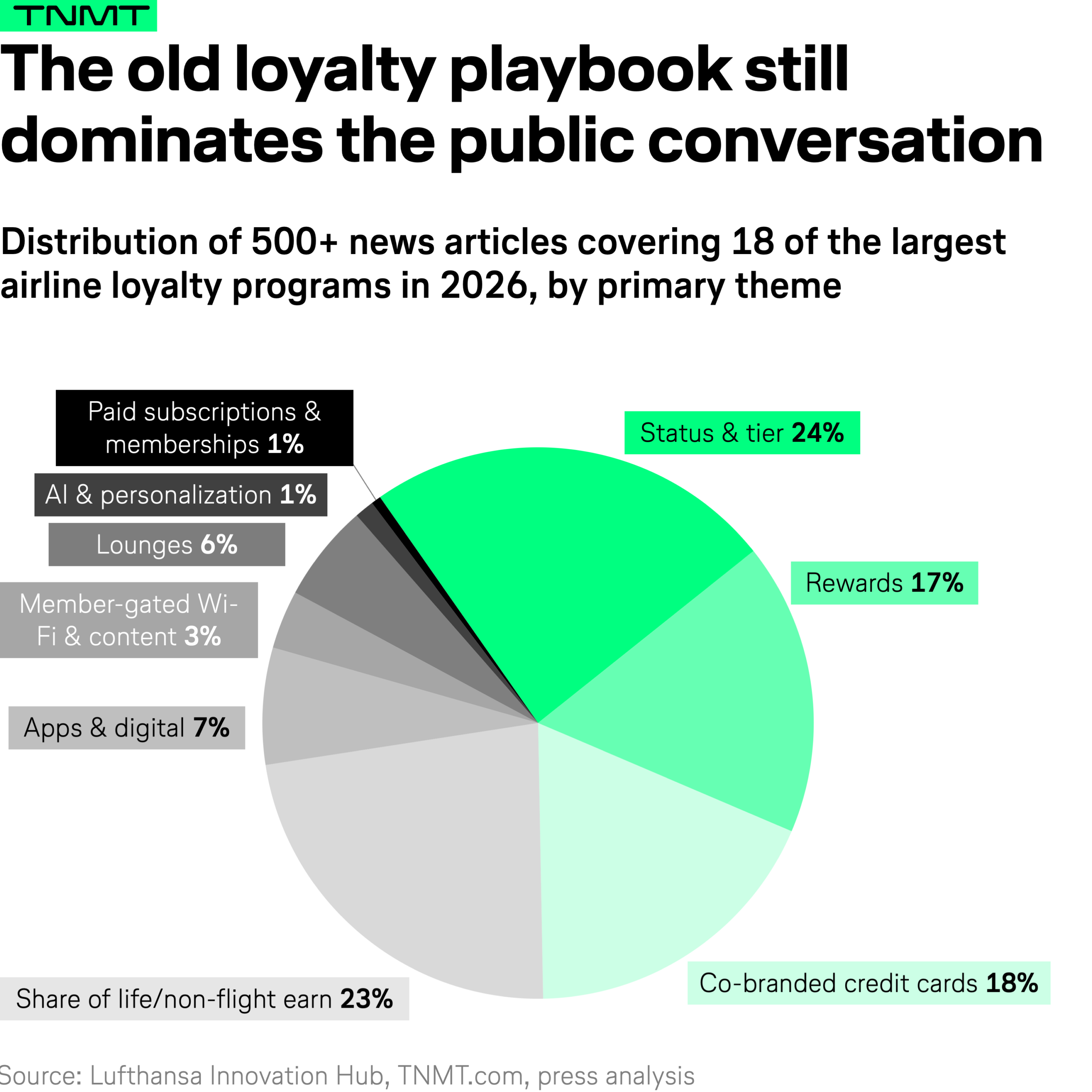
What that means: new cards, revised tiers, and additional ways to collect points still drive most of the conversation.
At the same time, the member perspective tells a less flattering story.
- Travelers keep complaining about the structural devaluation of loyalty currencies.
- Reward flights require more points, dynamic pricing makes redemption value harder to understand, and benefits that once felt attainable increasingly move out of reach.
Status is also being repriced.
- More programs are shifting away from rewarding miles flown or trips taken and toward rewarding the amount of money spent.
- From an airline economics perspective, that is understandable.
- From a traveler perspective, it can make “loyalty” feel less like recognition for repeatedly choosing one airline and more like another spending threshold.
In simple TNMT terms: programs may be becoming financially more sophisticated while becoming emotionally less rewarding.
And that is worth pausing on because trust is difficult to build when members feel that the value of their points can change faster than they can earn them.
So at a high level, the airline loyalty playbook still looks remarkably familiar, and in some cases even more transactional than before.
But the aggregate view hides a more interesting development.
When we looked more closely, we found three areas where loyalty programs are beginning to move in a genuinely more innovative direction.
And those are what we’ll explore next.
Positive development #1: AI is putting loyalty data to work
The first positive development is still relatively small, but strategically important: AI is beginning to connect loyalty data with the actual customer experience.
Two airlines deserve particular credit here: Alaska Airlines and Delta.
Both are using AI to turn loyalty data into more useful, personalized customer experiences.
Let’s look at each initiative one by one, starting with Alaska.
- “Alaska Inspires” (launched in 2024) connects natural-language trip inspiration directly with Alaska’s Atmos loyalty program.
- Recommendations can reflect a member’s points balance, status, travel goals, and previous preferences, turning loyalty data into an input for destination discovery rather than something travelers see only after booking.
The product itself is not new.
But its relevance in 2026 comes from the measurable results now available.
- Alaska reports a 7% conversion rate, compared with 5% for its standard booking widget
- Alaska also reports 90% user satisfaction and a 75% reduction in trip-planning time
“Delta Concierge” provides the more recent scaling signal.
- Delta first introduced the AI assistant in beta, then expanded it to all SkyMiles members in August 2026.
- Inside the Delta app, members can ask about upcoming trips, baggage, disruptions, eCredits, mileage balances, and Medallion status.
- They can also take actions, such as rebooking or canceling eligible flights, through the conversation.
The two products address different parts of the journey. Alaska focuses more heavily on inspiration and conversion. Delta focuses on service and trip management.
But the underlying shift is the same.
- Airlines have traditionally stored loyalty data in separate systems and used it mainly to calculate status, points, and eligibility.
- These two tools bring that information into the main digital customer interface, where it can shape recommendations and actions in real time.
That is what makes this development relevant.
Alaska and Delta offer a credible blueprint for airlines looking to make loyalty feel more personal, more useful, and more closely connected to the actual travel experience.
Positive development #2: Loyalty is expanding beyond the flight
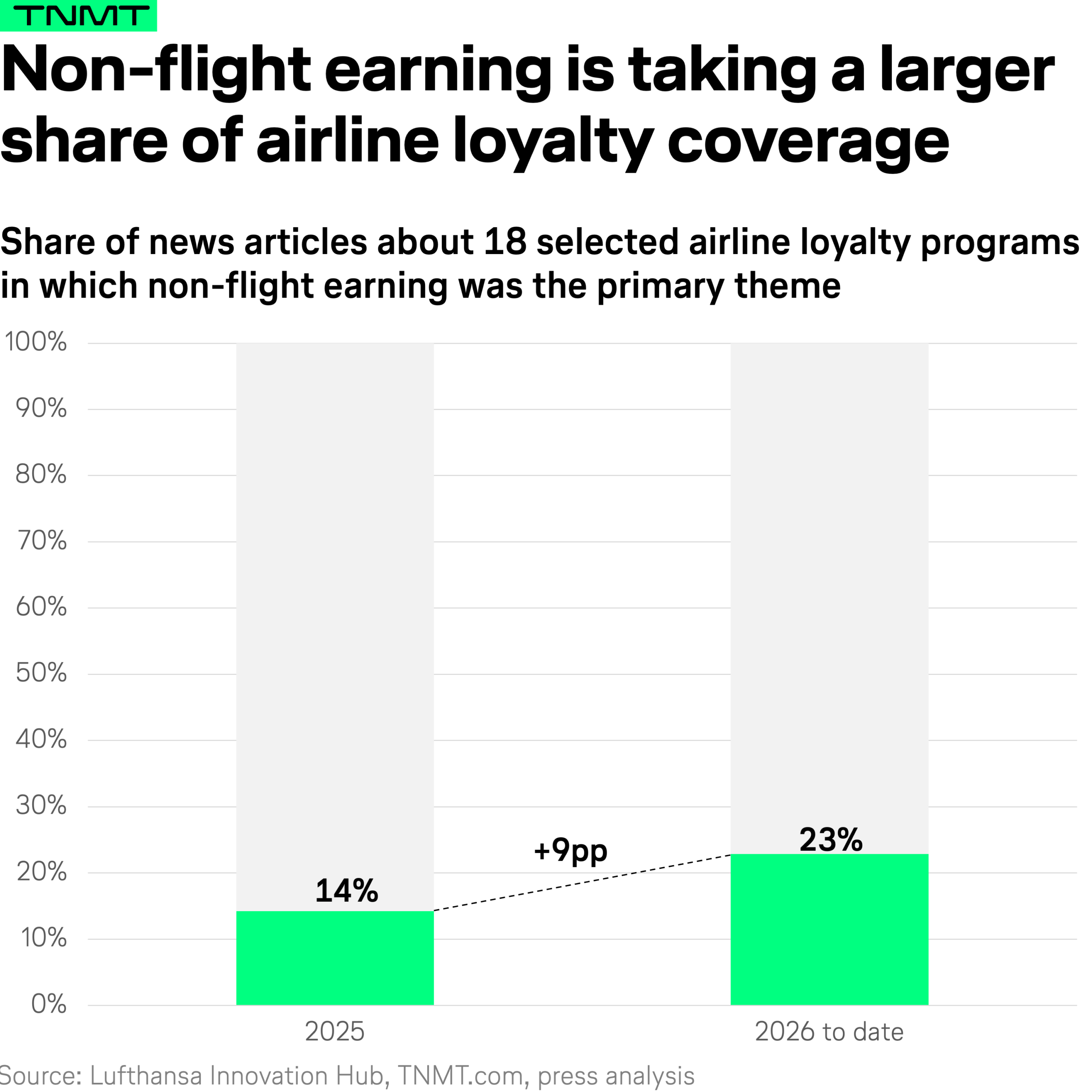
The second positive development is the growing focus on earning and redeeming outside of flights.
The idea itself is not new.
Airlines have spent decades extending loyalty into everyday spending through co-branded credit cards, which remain major revenue drivers.
But several developments in 2026 suggest that airlines are beginning to think more broadly.
- The ambition is no longer just to increase card spending.
- It is to make loyalty relevant across more of the traveler’s journey and daily life.
One visible shift is the closer connection between airline and hotel programs.
- In July, Japan Airlines and Marriott Bonvoy expanded their existing partnership through reciprocal status recognition and additional cross-program benefits.
- The collaboration lets members progress faster through both ecosystems and receive recognition across flights and hotel stays.
Delta and Hyatt announced a similar strategic partnership in September.
Once launched, eligible elite members will be able to earn World of Hyatt points on qualifying Delta flights and SkyMiles on qualifying Hyatt stays.
And in India, IndiGo BluChip and ALL Accor introduced reciprocal point conversion, allowing members to move loyalty value between flights, hotel stays, dining, and experiences.
These partnerships address a key weakness of traditional airline loyalty.
- A traveler who flies only three or four times a year may not interact frequently enough with a stand-alone airline program to build a meaningful relationship.
- Connect that program to hotels, dining, mobility, and experiences, and you suddenly have many more opportunities to earn, redeem, and stay engaged.
Beyond cross-program partnerships, a second way loyalty is expanding beyond the flight is through experiential rewards.
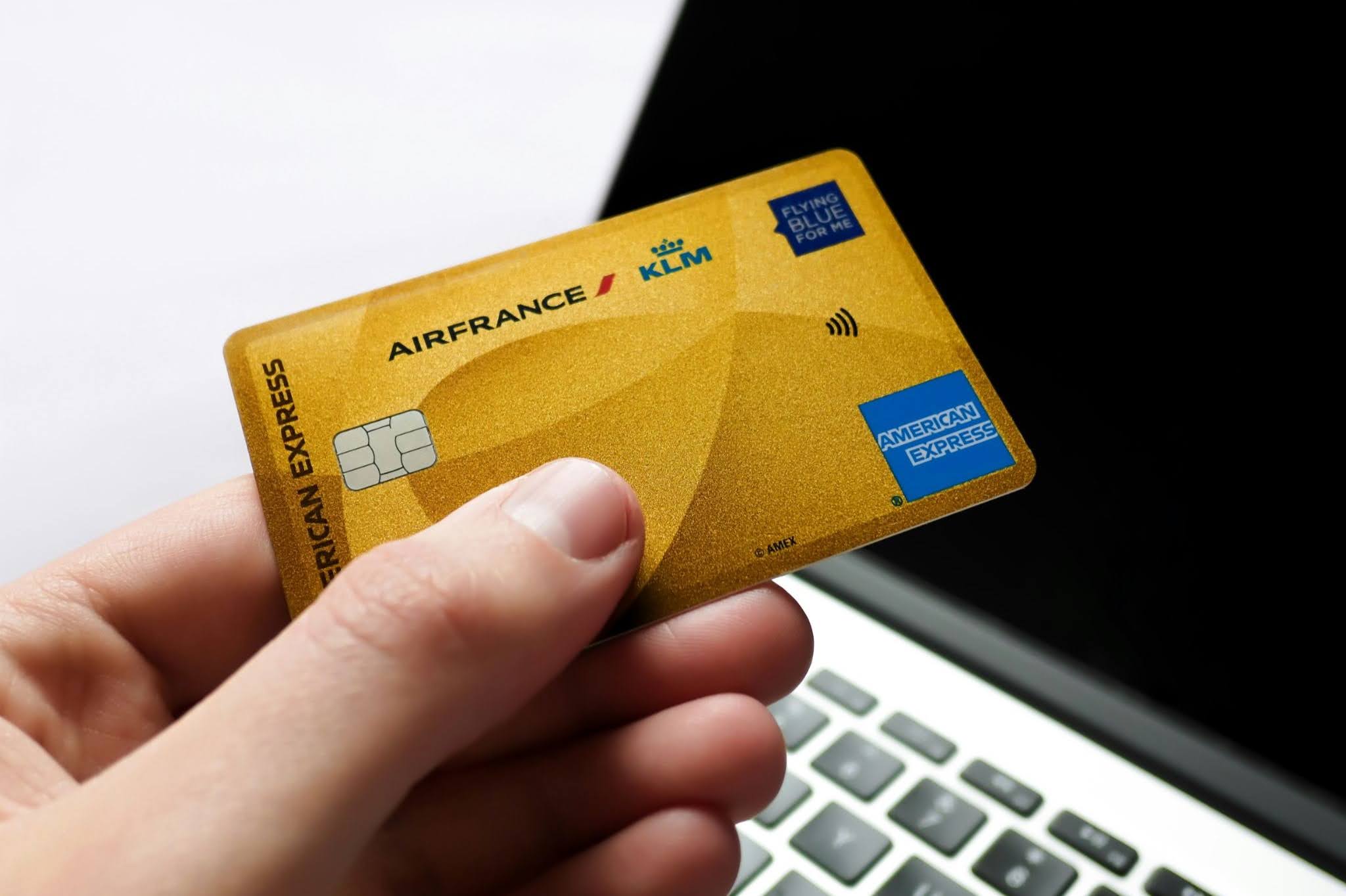
Air France-KLM launched “Flying Blue Experiences” in January, allowing members to use miles for premium access to concerts and major sporting events at venues such as the Accor Arena and Stade de France.
That may sound like a relatively small product extension, but it tackles another structural weakness of loyalty programs:
Points often feel abstract. Experiences do not.
- Another 5,000 miles sitting in an account may not create much emotional attachment.
- Access to a sold-out concert, a major sporting event, or a memorable travel experience is much easier to understand and value.
This also opens loyalty programs to less frequent and younger travelers. They may never fly enough to reach top-tier status, but they can still become engaged members if rewards feel attainable and relevant to their interests.
The strategic shift is subtle but important.
Loyalty is slowly expanding from rewarding repeated flights toward connecting a broader ecosystem of travel and experiences.
We are still far from a fully integrated model. Many partnerships remain fragmented, limited to selected tiers, or unnecessarily difficult to understand.
But the direction is promising.
The strongest loyalty programs of the future may be the ones giving members the most useful reasons to stay engaged between flights.
Positive development #3: Loyalty is becoming a service, not just a currency
The third positive development is more experimental: some airlines are trying to make loyalty something members use continuously, rather than a points balance they remember twice a year.
The first route is subscriptions.
- Admittedly, the broad “pay a fee, receive cheaper flights” model has proven difficult to make work.
- Ryanair closed its Prime trial after eight months. Its 55,000 members generated €4.4 million in subscription fees but received more than €6 million in fare discounts.
- Looks like Ryanair’s customers understood the value proposition slightly better than the airline did.
But that does not mean airline subscriptions are dead.
It suggests the more promising models may be narrower and more closely connected to loyalty.
- In March, JetBlue launched Points On Repeat, offering three subscription tiers with recurring TrueBlue points, additional flight-earning bonuses, and redemption rebates.
- Instead of discounting every fare, JetBlue is selling a faster path through its loyalty ecosystem.
Emirates Skywards+ follows a similar logic.
- Its annual subscription packages combine bonus miles with benefits such as reward discounts, upgrade offers, and lounge access.
- The product concentrates value among travelers already likely to use it, rather than subsidizing cheaper flights for everyone.
Subscriptions therefore deepen the relationship with frequent and high-intent travelers.
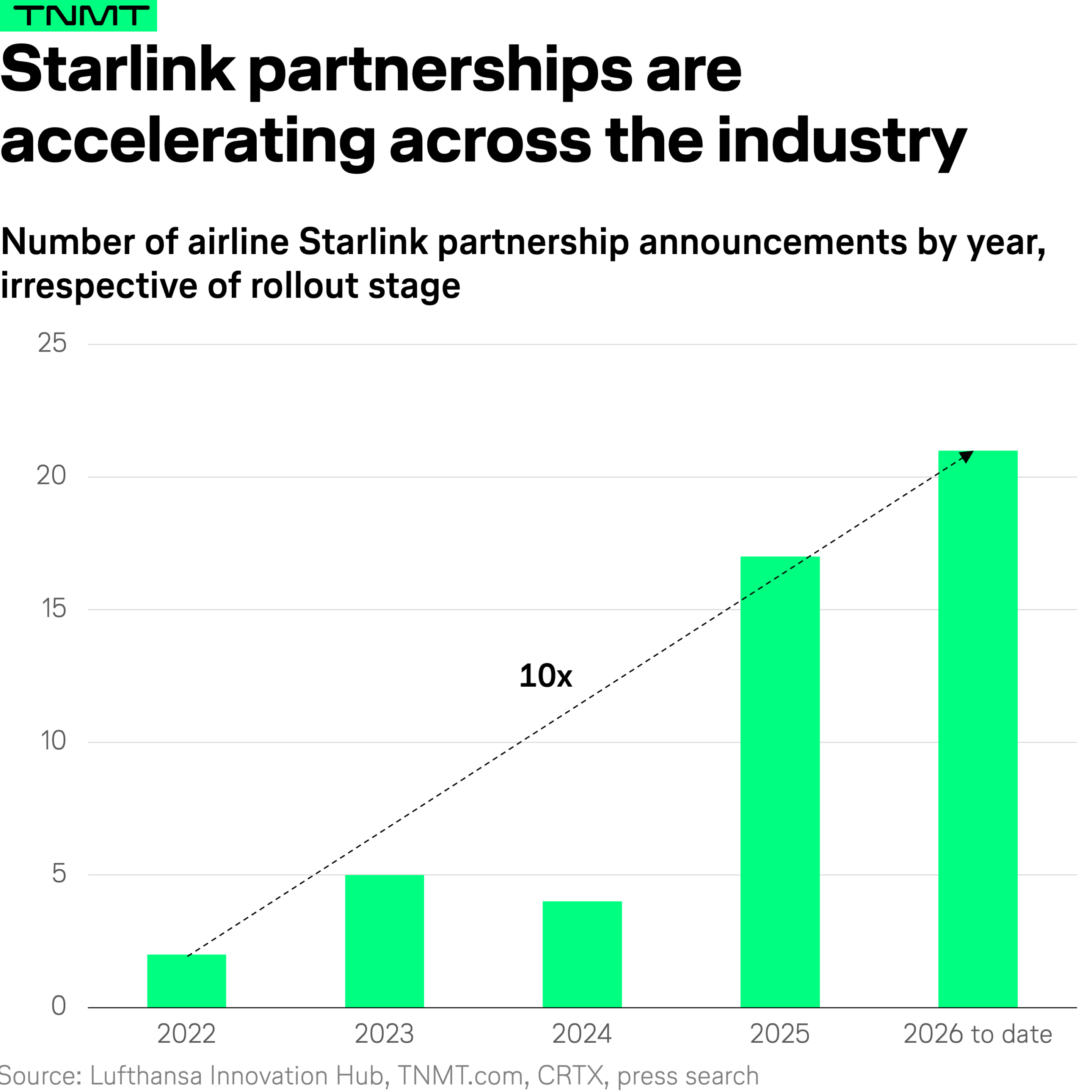
But high-speed in-flight Wi-Fi is opening a second, potentially much larger route into loyalty.
- Several Starlink adopters are making connectivity free, but only after passengers identify themselves as loyalty members.
- United offers complimentary Starlink access to MileagePlus members, while Alaska is rolling it out free for Atmos Rewards members.
That small login requirement changes the commercial logic.
- In-flight Wi-Fi used to be a paid ancillary.
- It is now increasingly becoming a membership-acquisition tool.
A traveler who flies once a year may see little reason to join an airline program for distant status benefits.
But place an eight-hour flight between that traveler and free high-speed internet, and registration suddenly becomes much more attractive.
- For the passenger, the exchange is simple: join the program and get a valuable service immediately.
- For the airline, an otherwise anonymous traveler becomes an identified member with whom it can build a permission-based relationship beyond the flight.
The two approaches therefore solve different loyalty challenges:
- Subscriptions create more recurring value for existing, highly engaged members.
- Free connectivity brings less frequent travelers into the loyalty ecosystem in the first place.
Of course, another membership registration does not automatically create loyalty.
If airlines use the new relationship only to send generic offers, or continue devaluing the points members earn, the exercise simply produces larger databases rather than more loyal customers.
But we think the direction is encouraging.
Airlines are beginning to treat loyalty as an ongoing service and value exchange, not merely a currency awarded after someone buys a ticket.
That feels much closer to the kind of reinvention we wished for.