
Two weeks ago, we spent far too much time reading airline earnings call transcripts.
(Yes, this is apparently what passes as entertainment in our TNMT analyst team.)
After analyzing 17 quarters of earnings calls across ten of the world’s largest publicly listed airline groups, one result stood out above all others:
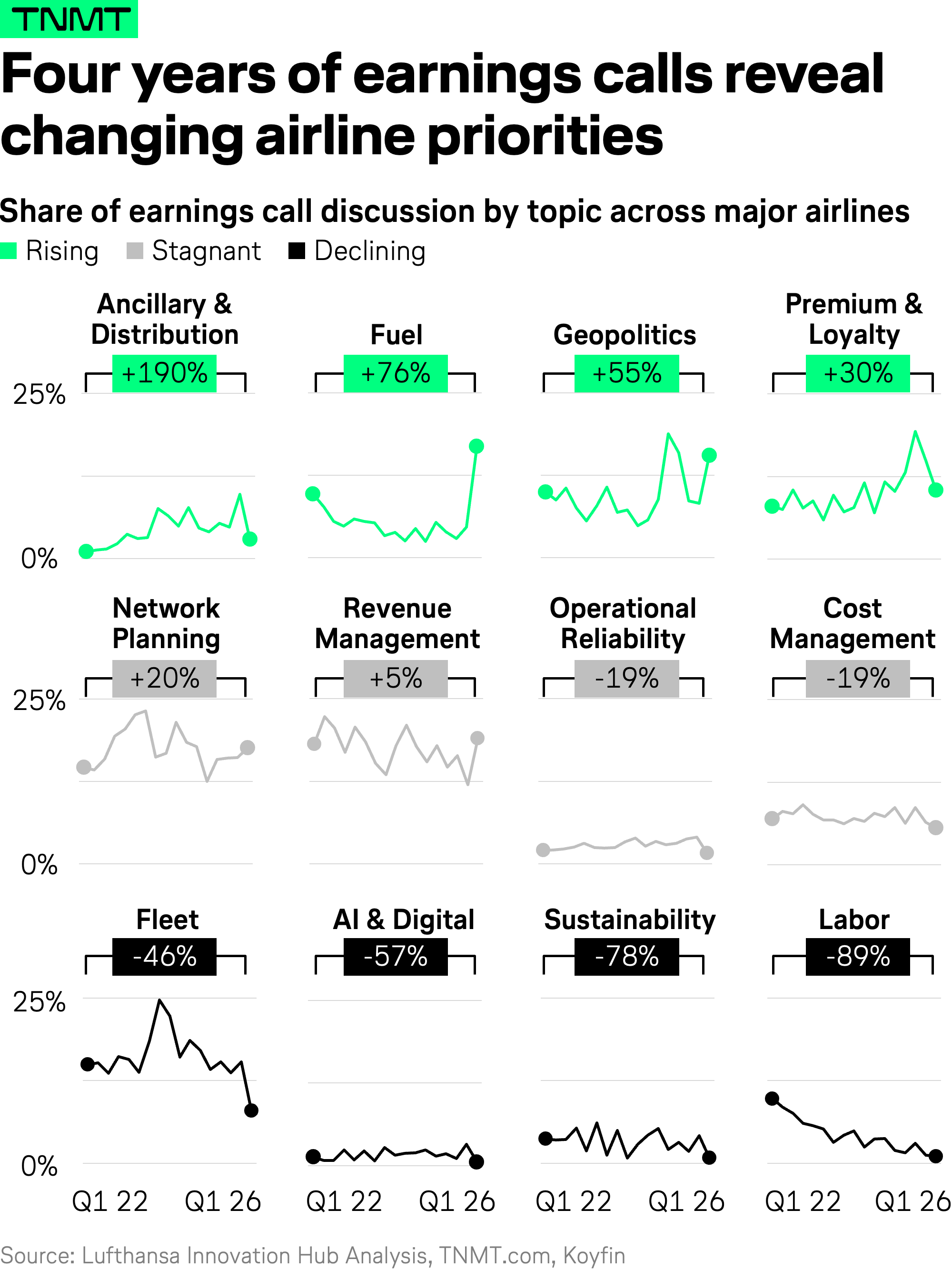
Ancillary & Distribution has become the fastest-rising topic in the airline boardroom, with mentions up 190% since 2022.
But while working through the transcripts, we noticed something else.
A typical earnings call is actually two very different conversations.
- The first is carefully rehearsed. Executives spend days preparing their opening remarks, choosing every slide, every data point, and sometimes every adjective.
- The second conversation starts the moment analysts begin asking questions. Suddenly, management no longer controls the agenda. Investors do.
And that made us wonder:
What happens if we separate the conversation airlines want to have from the conversation investors want to have?
To find out, we split every earnings call into two parts:
- Prepared management remarks
- Analyst Q&A
Then we compared how the industry’s priorities differ between the two.
So, let’s get straight to the point.
When we split airline earnings calls into prepared management remarks and analyst Q&A, one pattern immediately jumps off the page.
- Some topics are clearly driven by management.
- Others are clearly driven by analysts, aka investors.
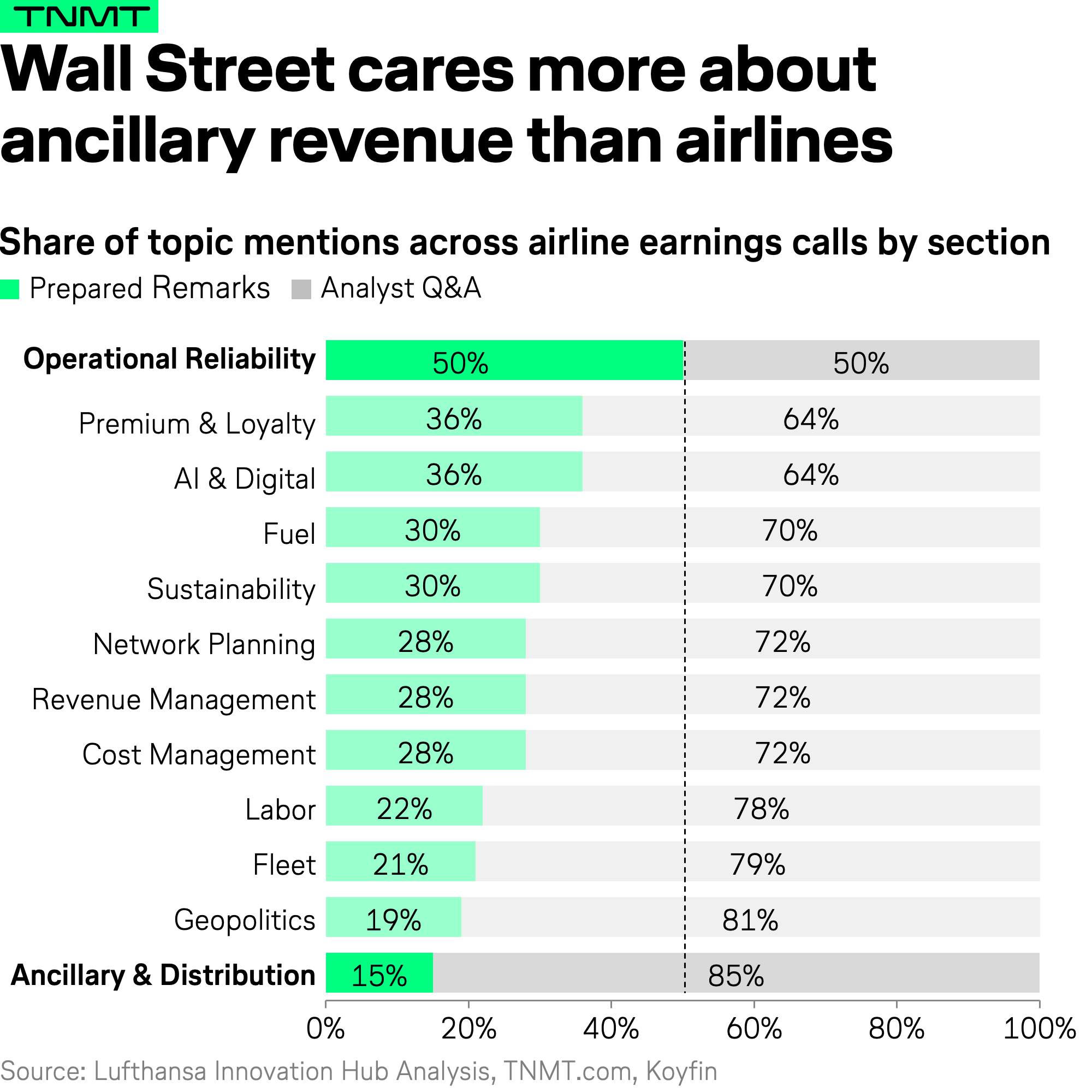
Take Operational Reliability.
- By this, we mean the industry’s day-to-day ability to run flights reliably, think punctuality, operational resilience, network stability, disruption management, and the countless moving pieces required to get aircraft from A to B on time.
- It’s the topic airline executives most often discuss, accounting for the largest share of prepared management remarks.
At the opposite end of the spectrum sits Ancillary & Distribution.
As we showed two weeks ago, it has become the fastest-growing topic across all twelve themes in our dataset.
But here’s the interesting twist:
- The increase is driven far more by analyst questions than by management commentary.
- In simple terms: investors repeatedly push airlines to explain their ancillary revenue strategy, distribution approach, customer ownership, and future monetization opportunities.
That makes Ancillary & Distribution one of the biggest gaps between what airlines choose to emphasize and what capital markets actually want to understand.
And that’s precisely what makes this finding so relevant.
Because it connects directly to another observation from our previous analysis…
The AI connection nobody expected
If you read our full analysis, you might remember one seemingly straightforward conclusion:
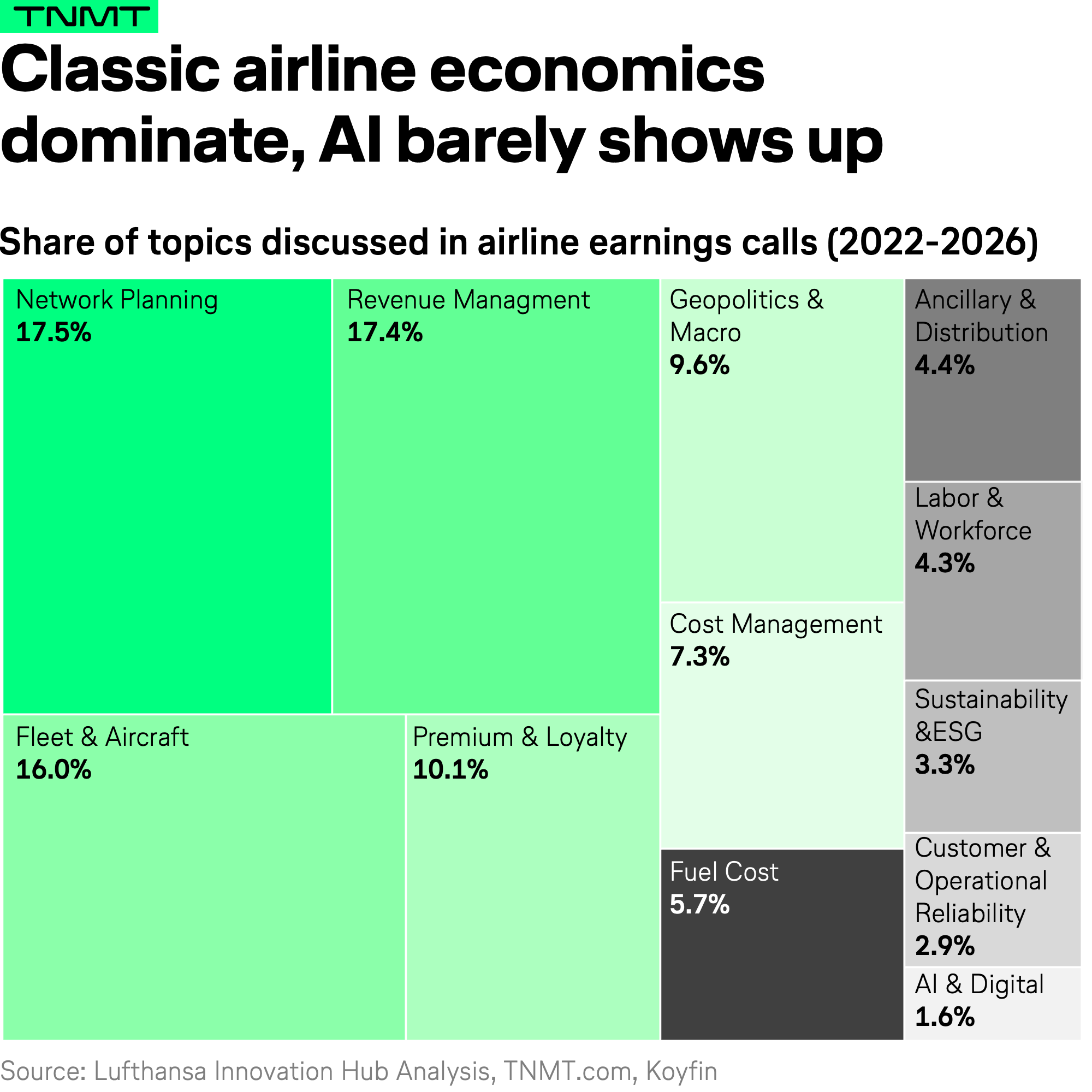
AI barely showed up.
Across all 17 quarters and twelve topic clusters we analyzed, AI accounted for just 1.6% of all earnings-call mentions.
At first glance, that seemed surprising.
- After all, every travel conference has effectively become an AI conference.
- Given all the industry attention, we would have expected AI to occupy a much larger share of airline earnings calls.
But the result also made intuitive sense. If AI isn’t yet moving revenues, margins, or costs in a measurable way, it probably shouldn’t dominate earnings calls either.
So far, so reasonable.
But then we decided to ask a different question.
Instead of measuring how often AI was mentioned, we measured where it appeared.
- More specifically, we calculated which of our 12 topic clusters most frequently appeared in close proximity to AI-related terms within the earnings call transcripts.
- Put differently: when executives talked about AI, what were they actually talking about?
And that’s where things became really interesting.
Because the topic most closely associated with AI wasn’t operations (despite all the excitement around AI copilots, predictive maintenance, and operational optimization).
It wasn’t customer service either (despite virtually every major airline now rolling out AI-powered chatbots and virtual assistants).
It also wasn’t pricing (despite all the headlines around AI-driven revenue management, for example, Delta’s AI pricing ambitions).
It was, wait for it, Ancillary & Distribution.
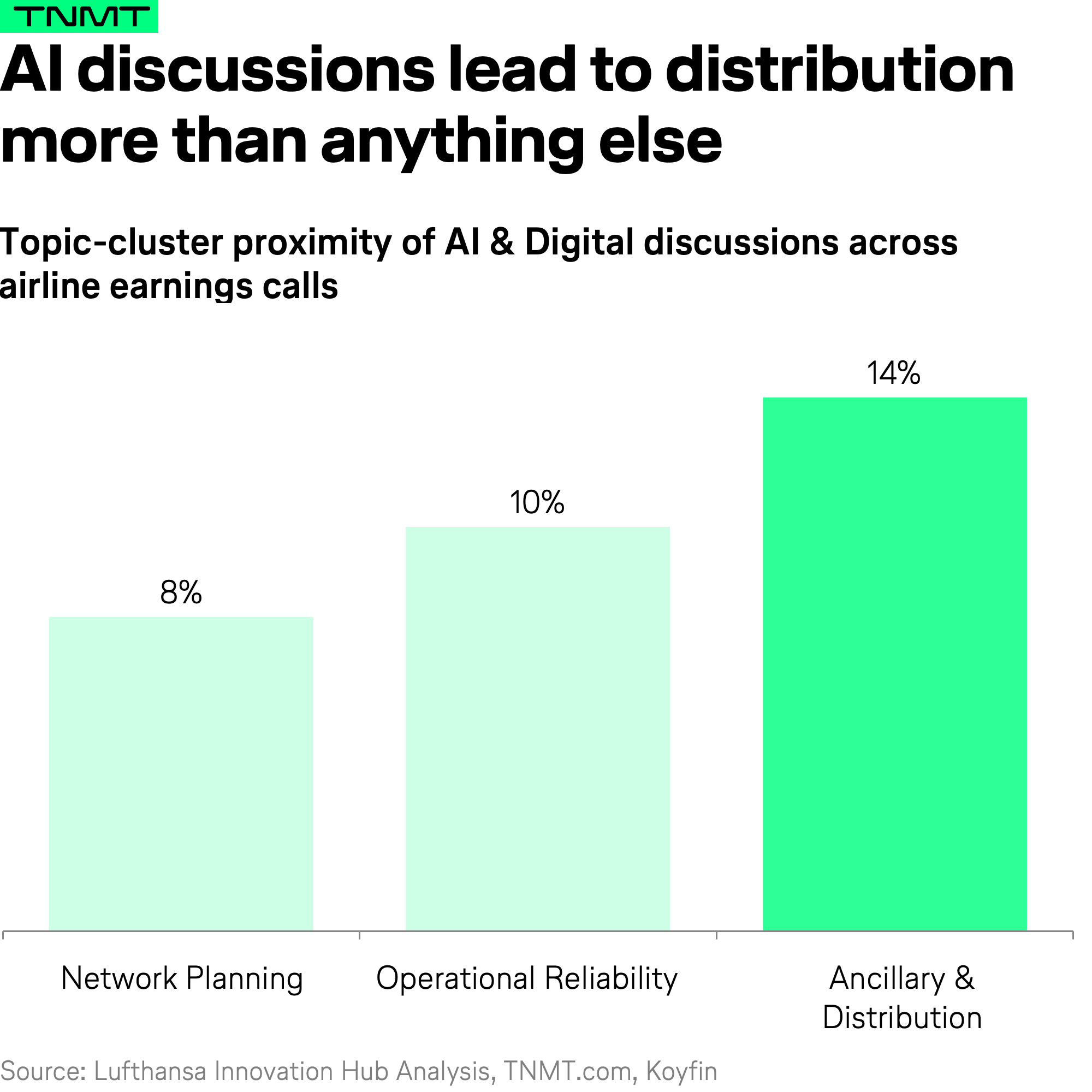
Across the earnings calls we analyzed, AI discussions repeatedly surfaced in the context of future distribution models, and how airlines will reach travelers as search and booking increasingly move into AI environments.
That combination should make airline executives uncomfortable.
- The topic investors are most eager to discuss is also the topic most closely associated with AI-driven disruption.
- Yet it remains one of the least proactively discussed subjects in management commentary.
Perhaps that’s because the industry still lacks clear answers.
Or perhaps because the commercial implications remain difficult to quantify.
Either way, it raises an important question:
If travelers increasingly search, plan, and eventually book through AI interfaces, are airlines truly prepared for what happens next?
We have our doubts.
Agree? Disagree? Somewhere in between? Write us an email to newsletter@tnmt.com.
We’d love to hear your take.