This article was developed with significant research contributions by Hsiang Ting Huang, a Research and Intelligence Intern at Lufthansa Innovation Hub.
The time before a flight departure remains one of travel’s most under-optimized moments.
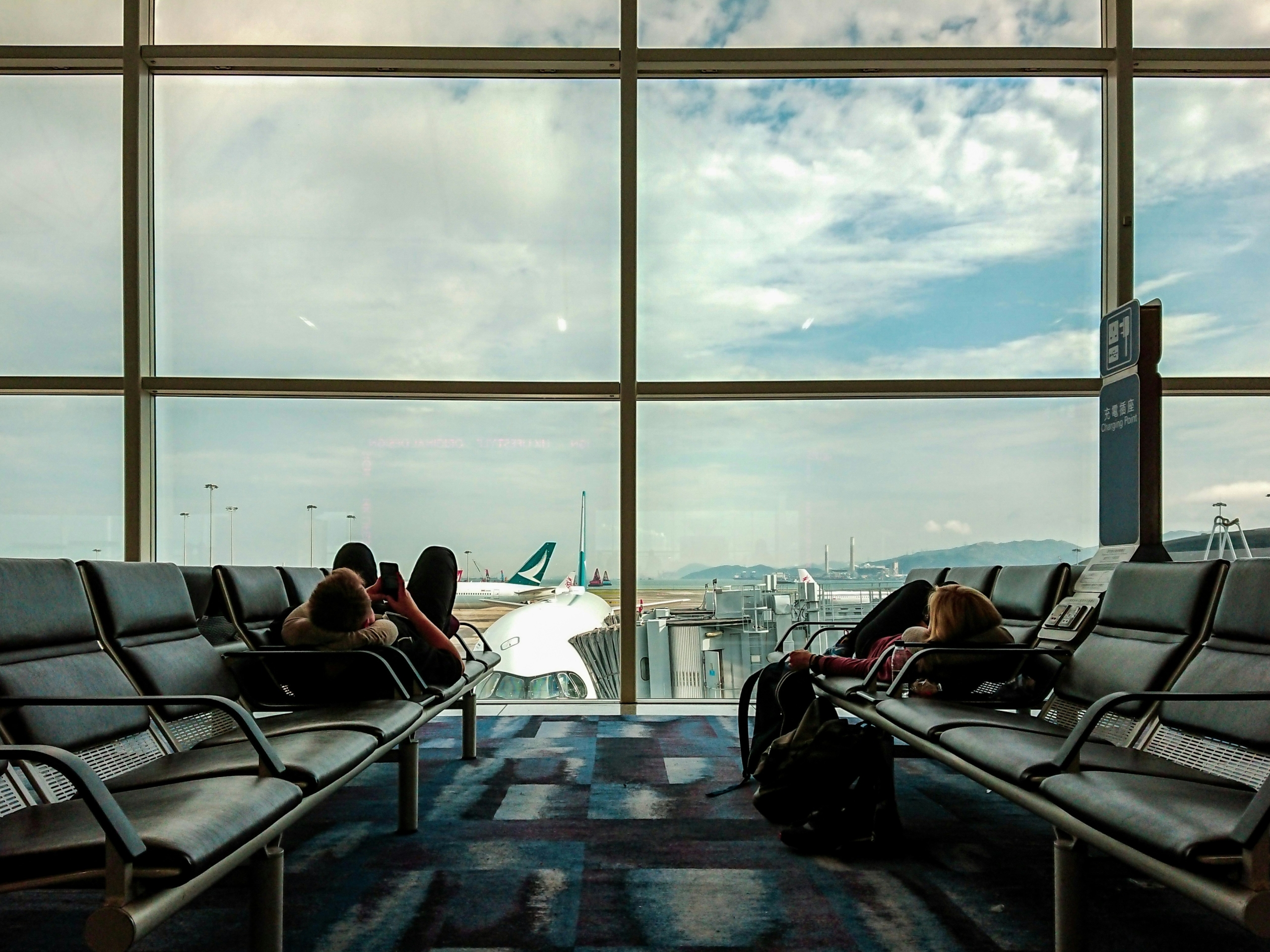
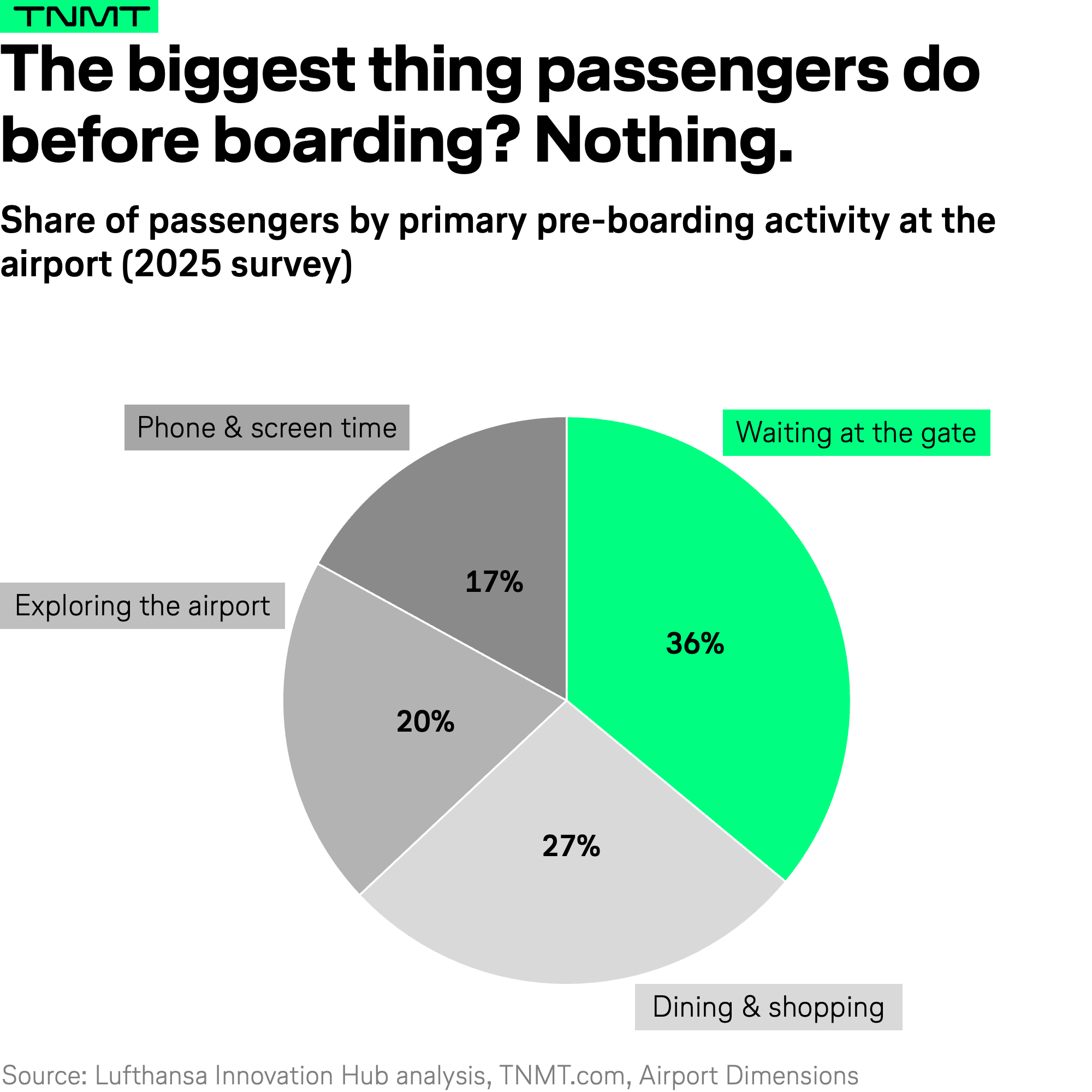
If you read our newsletter two weeks ago, you might remember our very scientific conclusion: most travelers waiting for boarding to begin are basically doing… nothing.
- Sure, some are doomscrolling.
- Some are staring intensely at the gate screen, as if that might make boarding start faster.
- And some have entered the classic airport waiting pose: arms crossed, boarding pass ready, emotionally unavailable like a Berghain bouncer guarding Gate A17.
Then boarding finally starts.
Does it get better?
Not really.
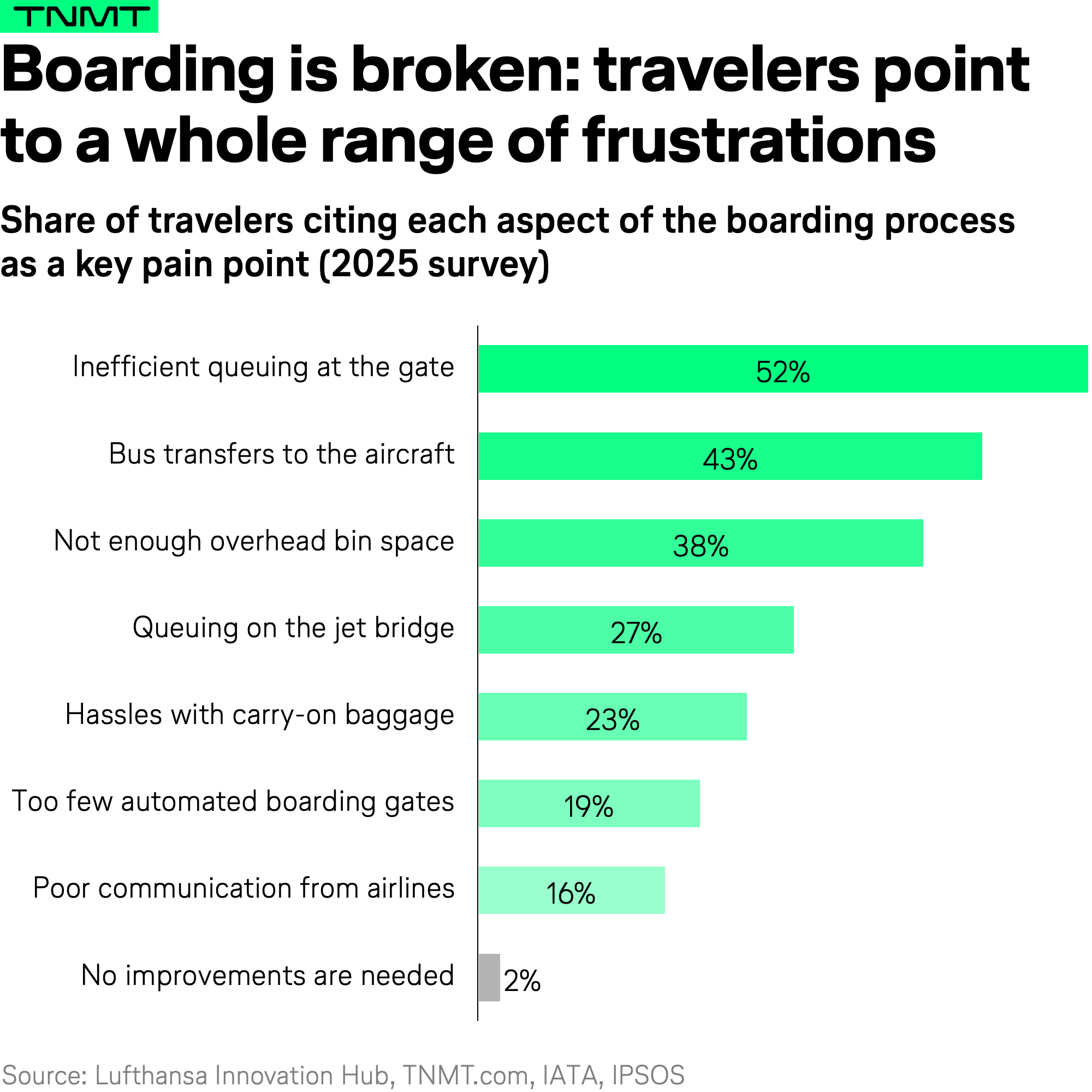
Now the boarding-gate ballet begins.
- Premium travelers quietly assemble at the front, ready to exercise their hard-earned priority rights, only to discover that families with young kids, strollers, and suspiciously large snack bags also get to board first.
- Everyone else starts shuffling toward the scanner in a loosely organized human funnel, scans their boarding pass, and then waits again in the jet bridge (aviation’s most underrated second waiting room).
- In the worst-case scenario, there is no jet bridge at all, and passengers are packed into a transfer bus where personal space becomes a theoretical concept, and everyone pretends not to breathe too deeply, while the aircraft somehow still looks both very close and very far away.
And then comes the final boss level: the aircraft aisle.
Rolling suitcases turn into weapons of spatial negotiation, boarding groups lose all meaning, and passive-aggressive overhead-bin diplomacy begins.
The good news: this doesn’t have to be the airport experience forever.
Last time, we showed you eight emerging innovations that could improve the terminal waiting and boarding process.
In this article, we’re taking the next step: highlighting the startups and companies building concrete solutions around those ideas.
Before we move to the companies transforming the terminal and boarding process, let’s quickly revisit the eight emerging innovations we outlined in our previous TNMT edition.
This time, we’re not just listing them.
We’re mapping them.
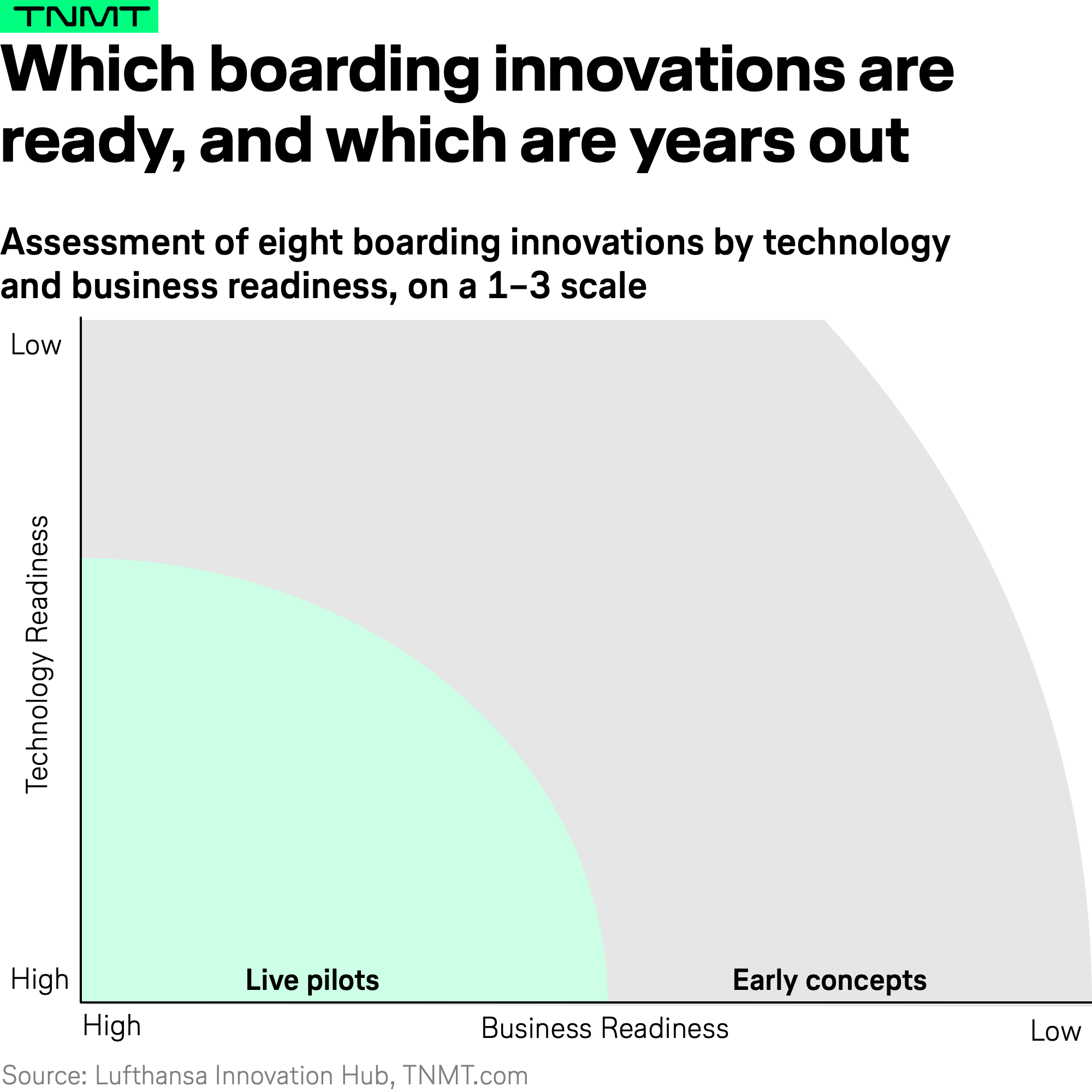
To make the landscape easier to navigate, we evaluated each innovation across two independent dimensions drawn from established readiness frameworks:
- Technology Readiness sits on the vertical axis. Originally developed by NASA, this scale assesses how mature the underlying technology is (is this still an early-stage concept, a proven system already deployed in real-world environments, or something in between?).
- Business Readiness sits on the horizontal axis. Based on the framework developed by KTH Innovation (the innovation arm of Sweden’s Royal Institute of Technology), this dimension evaluates how mature the commercial model is (is this still an undefined business idea, have key assumptions been tested, has customer demand been validated, or is there already a scalable business model in place?).
In very simple terms:
- One axis asks: does the technology actually work?
- The other asks: is there a viable business behind it?
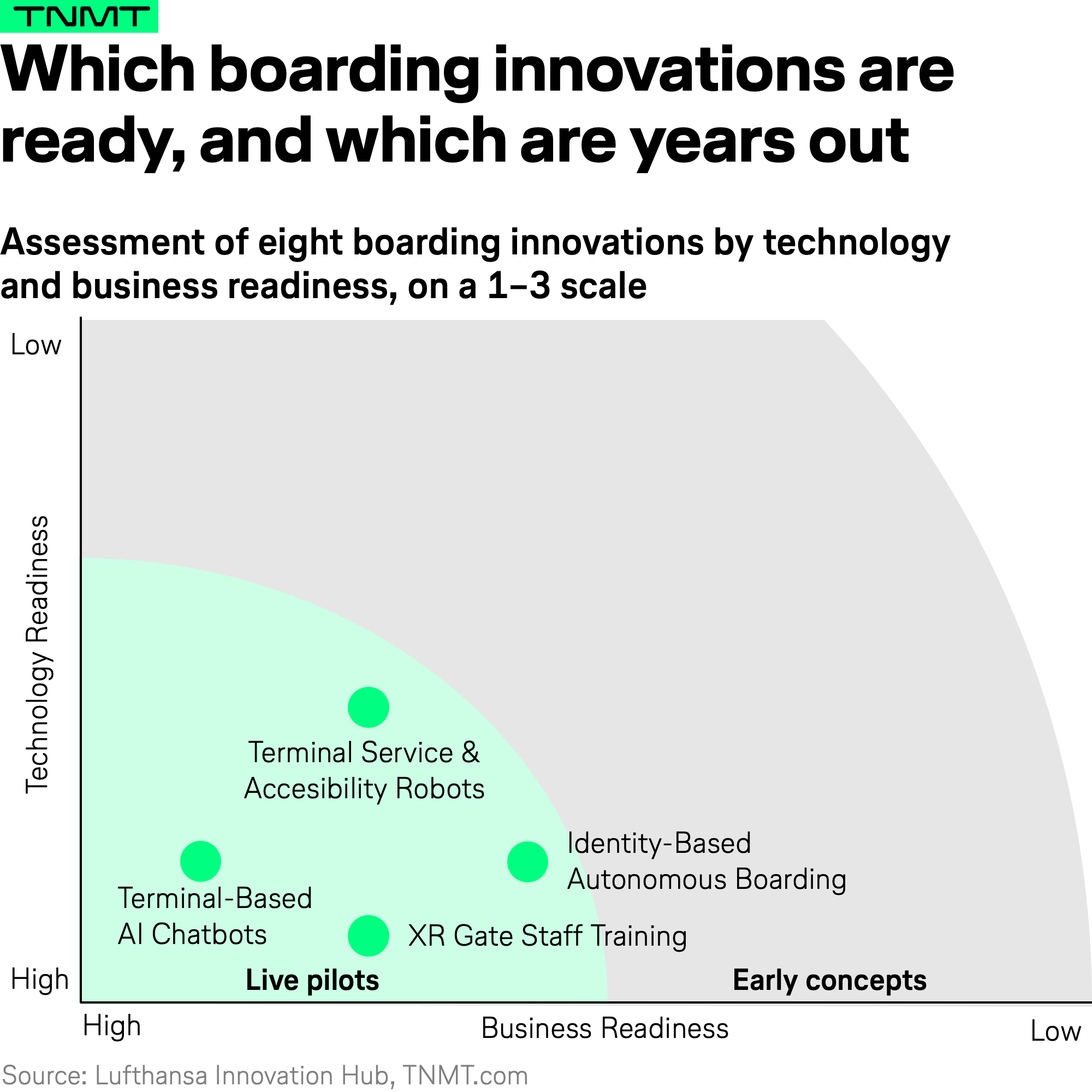
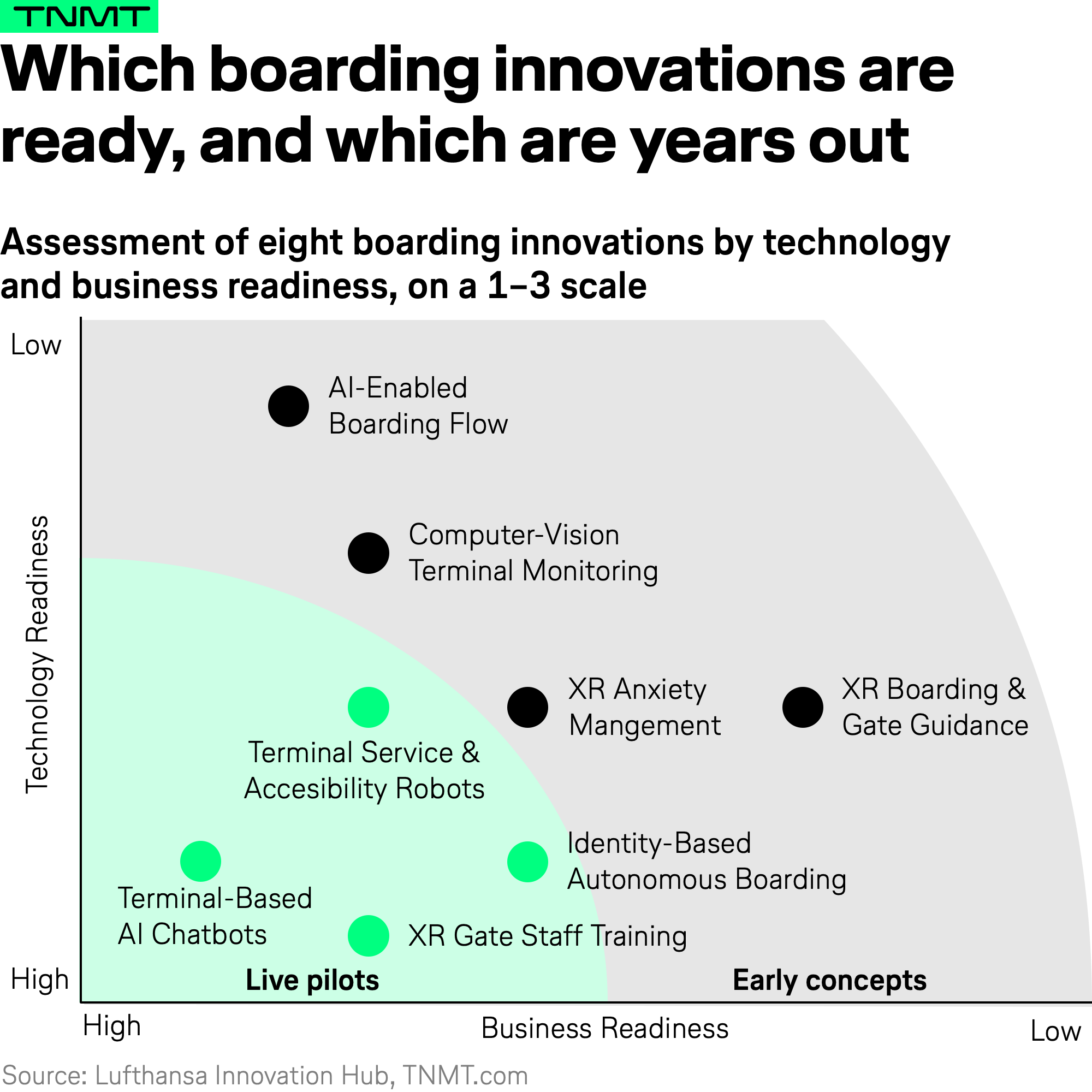
Based on these two scores, we mapped all eight innovations into a single radar view.
Why is this useful?
Because innovation teams often face the same challenge: too many technologies, too many pilots, too many “strategic opportunities,” and not enough clarity on what deserves attention first.
This framework helps separate the low-hanging fruit from the longer-term bets.
Important side note: The goal is not to declare winners and losers.
It’s to help airport operators, airlines, and innovation teams understand where each solution sits today, and what kind of action makes sense next.
With that framework in place, let’s move through the eight technology areas one by one, starting with the four live pilots.
Terminal AI Chatbots
Let’s start with one of the most mature solutions in our framework: terminal-based AI chatbots.
At first glance, this sounds like standard AI talk. Another chatbot. Another digital assistant. Another “How can I help you today?” interface.
But in the airport context, the real-world impact is unusually clear.
Terminal AI chatbots are airport-run digital assistants that help passengers navigate the journey in real time, answering questions about gates, baggage, security, facilities, disruption updates, accessibility services, and the many other things travelers usually ask human service teams.
They solve two commercial problems at once:
- On the cost side, some airports deploying conversational AI have reportedly reduced customer service costs by up to 30%. Heathrow’s chatbot handles around 4,000 questions per month and has contributed to a 27% reduction in average call handling time. Bristol Airport says its chatbot nearly halved switchboard calls and reduced email inquiries by more than one-third.
Quite clearly, this is not futuristic airport tech. This is already working.
- The revenue angle may be just as interesting. Once personalization is layered on top, airport chatbots could move beyond answering questions and start influencing passenger behavior, like recommending restaurants, retail offers, lounges, fast-track services, or airport experiences based on context, location, timing, and traveler intent.
XR Gate Staff Training
Next up: Immersive reality training for gate, ramp, and ground-handling staff (think virtual reality headsets).
The use case is this: instead of depending on real aircraft, available equipment, or rare quiet moments in live operations, staff can practice safety and operational procedures in immersive simulations.
The need feels obvious.
- Ground handling is a $142.6 billion global market, but it faces a structural workforce crisis.
- Staffing gaps above 15% are already driving delays and service inconsistencies during peak periods, while IATA estimates ground damage losses could exceed $9 billion USD over the next 15 years if no corrective action is taken.
XR training attacks the cost side of that problem directly: it can cut training time by up to 40% in some deployments and removes the need for live aircraft access.
- For airports and ground handlers, this is a low-risk efficiency play with clear ROI.
- No passenger-facing beta test.
- No “please download another app” moment. Just faster, safer staff readiness.
All of that makes XR ground staff training a strong right-now opportunity.
Next Up: Terminal Service and Accessibility Robots
By this, we mean autonomous machines that take over repetitive, physically demanding tasks inside the airport; think of gate-side delivery, assisted mobility, cleaning, baggage handling, passenger guidance, and even security patrols.
This category already has plenty of live pilots, which is why we score it high on business readiness. The technology, however, still sits closer to medium readiness because most robots work in controlled airport environments, but scaling them across crowded, messy, highly dynamic terminals remains far from trivial.
In any case, the business case appears massive.
The airport robotics market is projected to grow from $1.7 billion in 2025 to $1.98 billion USD in 2026, and reach $3.67 billion USD by 2030.
That growth is driven by two structural forces airports cannot simply hire their way out of.
- First: again, labor shortages, which are already contributing to service inconsistencies during peak travel periods.
- Second: demographics. The global population aged 65+ is rising fast, and with it the number of travelers needing physical assistance. In the UK alone, airport assistance requests have doubled since 2010 to 5.5 million per year.
Next Up: Identity-Based Autonomous Boarding
This technology field sounds slightly cryptic, but the idea is well established at many airports already.
Instead of repeatedly showing your passport and boarding pass like you’re trying to prove your existence at every airport checkpoint, travelers use one trusted biometric identity across the journey.
The business momentum is strong because this is no longer just a convenience play. It is increasingly becoming a regulatory and infrastructure requirement.
- The EU Entry/Exit System went live in October 2025, making biometric border processing compulsory across EU airports. That creates a massive implementation push, especially across European airport infrastructure.
- Commercial activity reflects this momentum. Amadeus’ €320 million acquisition of Vision-Box in 2024 showed where the defensible value sits: not just in biometric hardware, but in the integration layer connecting identity systems with airport operations.
That is why this opportunity window matters.
Airports across Europe are now actively procuring biometric infrastructure to meet regulatory deadlines.
Once systems are embedded into airport processes, switching costs become high, and the market could quickly consolidate around early winners.
Now we move into the more experimental part of the framework, starting with immersive anxiety management.
XR Anxiety Management
By this, we mean XR-based tools that make the airport and flight journey less stressful for passengers who need additional support. This can include VR exposure therapy for fear of flying, AR guidance for neurodiverse travelers, or immersive sensory environments that help passengers rehearse, understand, or calm down before boarding.
Compared to the previous categories, this area scores lower on both technology and business readiness. The solutions exist, but they are not yet widely deployed, commercially standardized, or integrated into airport operations at scale.
And yet, this might be one of the most underappreciated opportunities on the list.
Why?
Because the passenger need is much larger than most people assume.
Around 25–30% of adults experience some level of flight anxiety, and clinical research into immersive anxiety treatment is promising, with some randomized controlled trials reporting effectiveness rates of up to 80% for VR-based anxiety therapy.
Now, an important distinction: the strongest clinical use case is likely not a last-minute VR session at the gate while boarding group three is already forming.
Gradual VR exposure therapy, conducted weeks before travel, consistently makes more sense from a medical perspective.
But the in-terminal opportunity is still commercially compelling for a different reason.
- Airports that invest in sensory rooms, calming XR zones, and pre-boarding immersive environments send a powerful signal to anxious passengers: this airport has prepared for you.
- This can influence airport preference, improve perceived service quality, and potentially create a direct link between anxiety-support infrastructure and non-aeronautical revenue.
Next Up: AI-Enabled Boarding Flow
This is about moving gate management from fixed procedures to dynamic orchestration.
Instead of relying only on predefined boarding groups, static schedules, and staff observation, AI systems can predict passenger arrival patterns, monitor gate-area congestion, estimate boarding readiness, and flag issues like carry-on baggage pressure before they turn into visible bottlenecks.
The commercial logic is this: reduce operational friction while supporting understaffed gate teams.
The need is undeniable. According to OAG, the airline industry currently faces a shortfall of around 32,000 skilled workers, with thousands more retirements expected each year through 2042.
In other words, the labor gap is becoming a structural constraint.
At the gate, this is especially painful.
Boarding looks simple from the outside. In reality, it is a fragile choreography of passengers arriving late, families needing more time, premium travelers expecting priority, overhead-bin pressure building up, and gate agents trying to keep the process moving while also answering 47 unrelated questions.
This makes the category attractive from an innovation perspective, but not yet fully commercially mature.
Next Up: Computer-Vision Terminal Monitoring.
The idea: turn existing airport camera infrastructure into real-time operational intelligence.
- Instead of using CCTV mainly for surveillance, airports can use AI to detect crowd density, queue lengths, baggage volumes, safety issues, and movement patterns across terminals and gate areas.
- The beauty of this category is that airports already have the hardware. Computer vision adds the intelligence layer, turning cameras into something closer to the airport’s nervous system.
The opportunities from this span way beyond just one use case.
- Biometric identity needs to know where passengers are.
- AI boarding flow needs to understand gate congestion.
- Turnaround systems need visibility on what is happening at the stand.
Computer vision is the data layer that makes all of this smarter.
Today, most airport deployments are still fragmented: luggage monitoring here, crowd analytics there, security alerts somewhere else. The real opportunity is connecting these signals into one operational view.
The commercial case is very much visible:
- Assaia’s turnaround AI reportedly saves around $600 per turnaround.
- San Diego Airport generated $4 million USD in additional non-aeronautical revenue using Ariadne’s passenger-flow analytics to optimize retail placement and staffing.
- No wonder investors are circling. Ultralytics raised $30 million USD in 2025, with a 10-airport coalition directly backing the round.
Finally: XR Boarding and Gate Guidance
The final idea is to move airport navigation beyond static signs, maps, and gate screens. Passengers receive real-time AR guidance, personalized directions, and contextual boarding updates as gate assignments, walking times, or boarding information change.
This would be a meaningful improvement because terminal navigation remains one of the last unresolved friction points in the airport journey.
- Every minute a passenger spends confused, backtracking, or hunting for Gate B42 is a minute not spent in a retail zone.
- And every poorly communicated gate change increases the risk of missed boarding, staff intervention, and compensation claims.
The technology foundation is already becoming familiar. Google Maps has pushed immersive views and AR navigation into the mainstream, proving that travelers understand the behavior. Airports now need to translate that logic into complex indoor environments.
The demand is there, too.
- Airport Dimensions’ AX26 report finds that 77% of travelers want a single digital platform to unify their airport journey, while most airports still operate fragmented navigation tools.
- For airport operators, this is a rare use case that can protect operational efficiency and non-aeronautical revenue at the same time.
And investors are starting to notice. Mappedin’s $34.8 million USD Series B in April 2026 is the latest signal that institutional capital is moving into this category.
Startup Leaderboard
Hopefully, this gives you a solid overview of the innovation areas we find most interesting across the terminal waiting and boarding journey.
And if you made it all the way down here: respect.
That was a lot of airport innovation before most people have even reached their gate.
But we haven’t forgotten what we promised at the beginning.
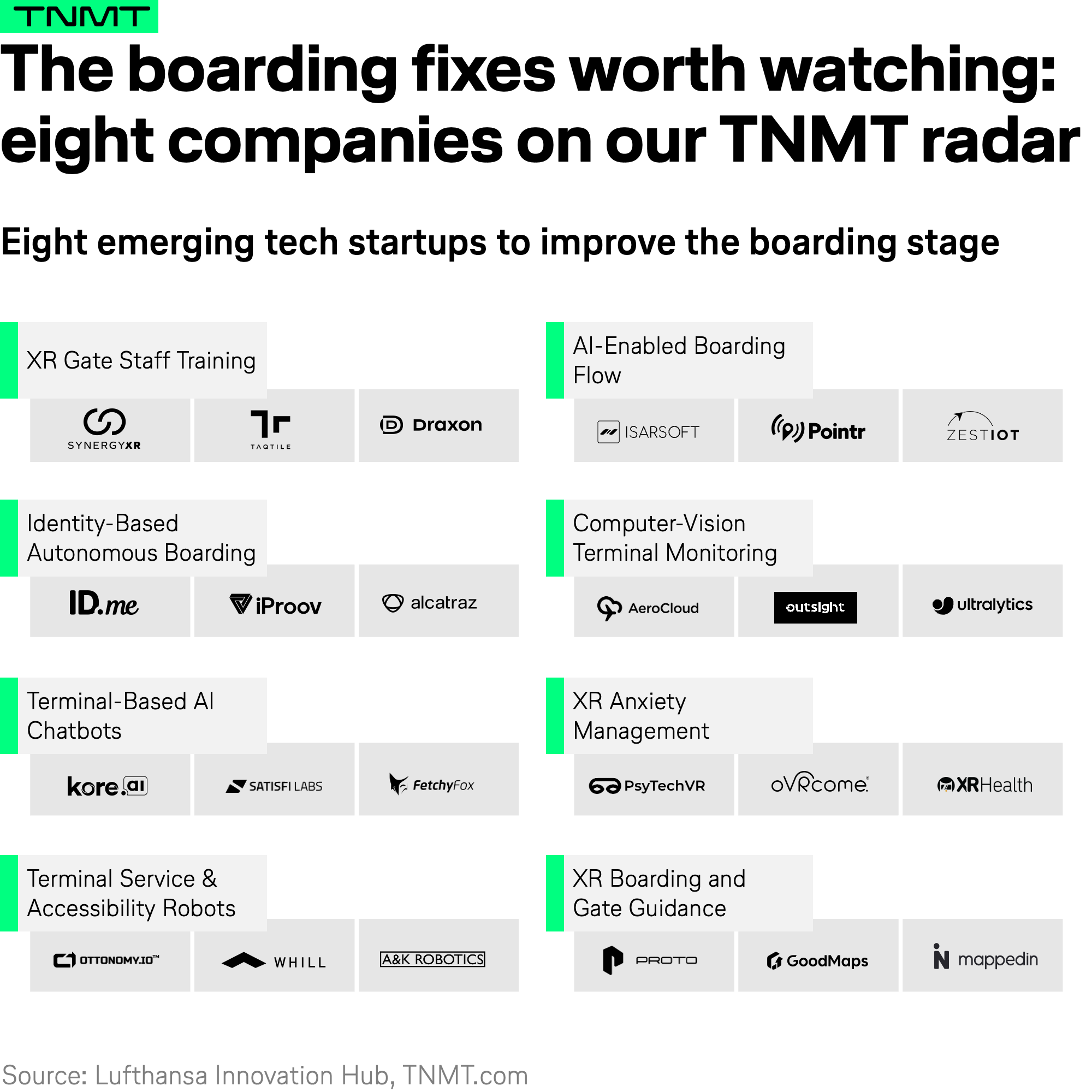
Beyond mapping the eight technology areas, we also looked at some of the most promising startups building concrete solutions around them.
So, without further ado: here is our startup leaderboard.
Want to learn more about each player and why we selected them?
We break it all down in our original full analysis.