Everyone is watching AI reshape travel discovery and booking through chatbots and increasingly capable AI assistants.
The latest proof point:
- Expedia just acquired Berlin-based AI travel planner Layla to accelerate its AI-native trip-planning and booking strategy.
- Side note: We highlighted Layla as a promising AI play more than two and a half years ago. Consider this your occasional reminder that TNMT can help you spot important companies early.
But back to the story.
While conversational AI gets most of the glamour in travel, the more consequential work may be happening somewhere less visible: inside airline operations.
This is where AI can influence whether schedules hold, disruptions are recovered, aircraft turn around on time, and crews are where they need to be.
In simpler terms: whether the trip suggested by the shiny AI travel planner actually takes place.
Plenty of airlines are already putting AI to work in this context.
One concrete example comes from within our own Lufthansa cosmos.
Lufthansa Group subsidiary zeroG uses apron video feeds and AI to monitor turnaround activities in real time, predict off-block times, and improve coordination between airlines and ground-handling partners through its Seer platform.
This example raises a logical follow-up question:
Which other technology companies are building the next wave of AI solutions for concrete airline operations?
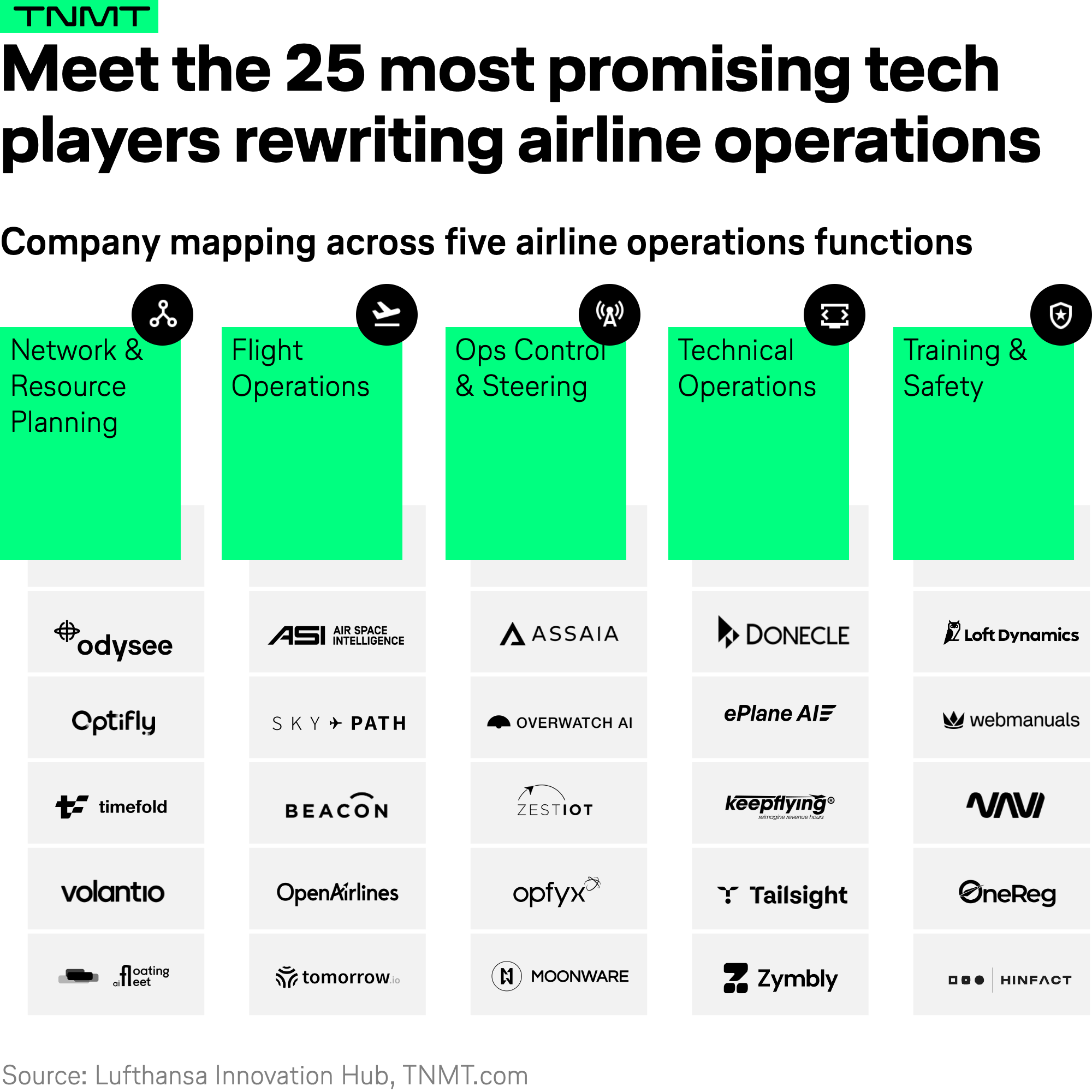
We pointed our TNMT startup radar toward this space and curated a list of 25 AI startups and technology players worth watching.
We then mapped them across the five core functions of airline operations:
1) Network & Resource Planning
Everything committed before the day of operation, including schedule design, fleet assignments, aircraft rotations, crew planning, rostering, slots, and capacity.
2) Flight Operations
The flight itself, covering dispatch, trajectory and fuel optimization, weather routing, airspace efficiency, digital cockpit tools, and fuel and SAF intelligence.
3) Operations Control & Steering
Live decision-making on the day of operation, including OCC processes, disruption recovery, aircraft and crew re-optimization, turnaround performance, and network resilience.
4) Technical Operations
Everything that keeps the aircraft airworthy and available, from predictive maintenance and aircraft health monitoring to engineering, parts, and the MRO supply chain.
5) Training & Safety
The capabilities that keep aviation’s people qualified, including pilot and cabin-crew training, simulation, licensing, competency management, safety, and compliance.
The result is not meant to be an exhaustive directory.
It is our curated view of the players we believe airline executives and operations teams should have on their radar this summer (and beyond).
Here they are.
Wondering what makes each of those 25 players worth a closer look?
We don’t have enough space to profile every company here without turning this newsletter into an airline operations manual.
You can explore all five players in each category through the links below.
For now, we picked one standout from each function.
Consider these our five category favorites.
1) Network & Resource Planning
Explore all five players:
https://odysee.ai/
https://optifly.com/
https://timefold.ai/
https://www.volantio.com/
https://www.floatingfleet.ai/
Our pick: Odysee
Odysee uses historical operational data, network schedules, punctuality records, and airport constraints to stress-test airline schedules for both resilience and profitability.
Built by UP.Labs with Alaska Airlines, the platform has reportedly been trained on more than 700,000 flight segments. It can run hundreds of schedule simulations in seconds, compared with a process that previously took weeks, and reports roughly 90% back-testing accuracy.
The company raised $5 million in seed funding in October 2024. Its appeal is straightforward: helping airlines build stronger schedules before the operating day can break them.
2) Flight Operations
Explore all five players:
https://www.airspace-intelligence.com/
https://www.openairlines.com/
https://skypath.io/
https://beaconai.co/
https://www.tomorrow.io/
Our pick: Air Space Intelligence
Air Space Intelligence’s Flyways platform predicts how airspace conditions will evolve up to eight hours ahead and recommends more efficient routes to airline dispatchers.
Alaska Airlines has used the technology since 2021, followed by Delta, United, the U.S. Air Force, and now the FAA. According to Alaska, Flyways identified optimization opportunities on 55% of flights, reduced fuel burn by 3%-5% on longer sectors, and saved more than 1.2 million gallons of fuel in 2023.
After raising a $34 million Series B in 2024, the company secured an $875 million contract with the FAA in June 2026. This is no longer just an interesting airline pilot. It is starting to look like critical flight-operations infrastructure.
3) Operations Control & Steering
Explore all five players:
https://www.assaia.com/
https://overwatch-ai.com/
https://www.zestiot.com/
https://moonware.com/
https://www.opfyx.com/
Our pick: Overwatch AI
Overwatch AI combines company procedures, aircraft manuals, minimum equipment lists, and live airport, runway, and weather data into a single natural-language interface.
Its Wingman assistant supports pilots, cabin crews, and OCC teams with faster, more compliant operational decisions. United Airlines Ventures and Pegasus Airlines’ venture arm have both invested, with Pegasus among the first carriers testing the product.
Across roughly 30,000 monthly flights, Overwatch reports a 4.6x increase in compliant decision-making and a 6.6% lift in crew productivity. The company raised $1.5 million in May 2026.
4) Technical Operations
Explore all five players:
https://www.donecle.com/
https://www.eplaneai.com/
https://www.keepflying.aero/
https://tailsight.ai/
https://www.zymbly.com/
Our pick: Zymbly
Zymbly applies a large language model to maintenance manuals, local procedures, and aircraft records.
The platform supports troubleshooting, parts identification, voice-based queries, and automated documentation, while keeping human verification in the loop. In practical terms, it helps maintenance teams find the right answer faster when an aircraft is sitting on the ground and every minute matters.
The company is still very early, having raised $500,000 in accelerator funding in January 2026. But it targets one of the most persistent problems in technical operations: turning fragmented maintenance knowledge into usable, real-time guidance.
5) Training & Safety
Explore all five players:
https://www.loftdynamics.com/
https://webmanuals.aero/
https://hinfact.com/
https://www.flynavi.com/
https://www.onereg.com/
Our pick: Navi AI
Navi AI functions almost like an AI layer on top of the black box.
It combines cockpit audio, aircraft telemetry, and environmental data to analyze every training flight and generate an immediate debrief. That could shift flight training from selective, delayed review toward continuous learning based on what actually happened in the cockpit.
Navi emerged from stealth in March 2026 and raised $5.4 million, with United Airlines Ventures among its backers and a United deployment expected to follow.
If the model scales, instructors may no longer need to choose which flights deserve a detailed investigation. Every flight could become a learning opportunity.