
Agentic AI could fundamentally change how travelers search for, compare, and eventually book flights.
But the direction of that transformation remains highly uncertain.
- Will travelers trust AI agents enough to delegate real decisions and payments to them?
- And if they do, who will control the customer knowledge and data those agents need to make useful choices?
To explore these questions, we ran a structured scenario-planning process over the past few months.
- Drawing on our proprietary research and internal expertise, we assessed 40 trends spanning technology, regulation, consumer behavior, geopolitics, and airline distribution.
- We then prioritized those with the highest combination of potential impact and uncertainty.
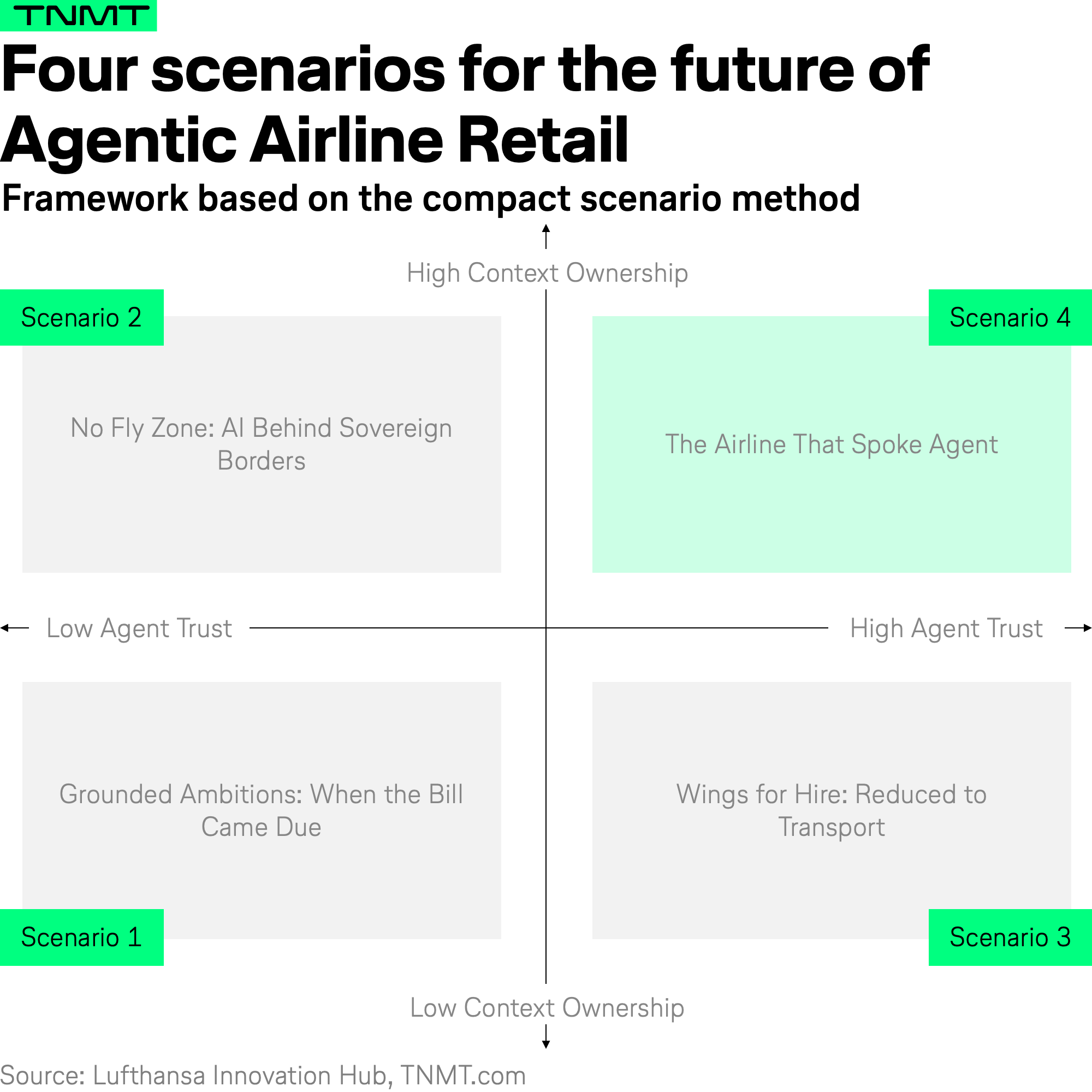
That process surfaced two critical uncertainties:
- #1: Trust in Agentic Booking, meaning how comfortable will travelers become with allowing AI agents to search, compare, decide, and transact on their behalf?
- #2: Context Ownership, asking who will control the preferences, travel history, loyalty data, payment credentials, and broader customer context that enable an AI agent to make those decisions?
Together, these two axes create four distinct futures for flight booking in the 2030s.
The goal was not to predict one definitive future.
That would be ambitious even by our own TNMT standards.
- Instead, we developed four radical scenarios and explored what each could mean for airline distribution, customer relationships, and commercial strategy.
- We also identified milestones that could help us recognize which of these futures the market is moving toward.
Without further ado, let’s share the underlying framework and the four market scenarios that all of this generated.
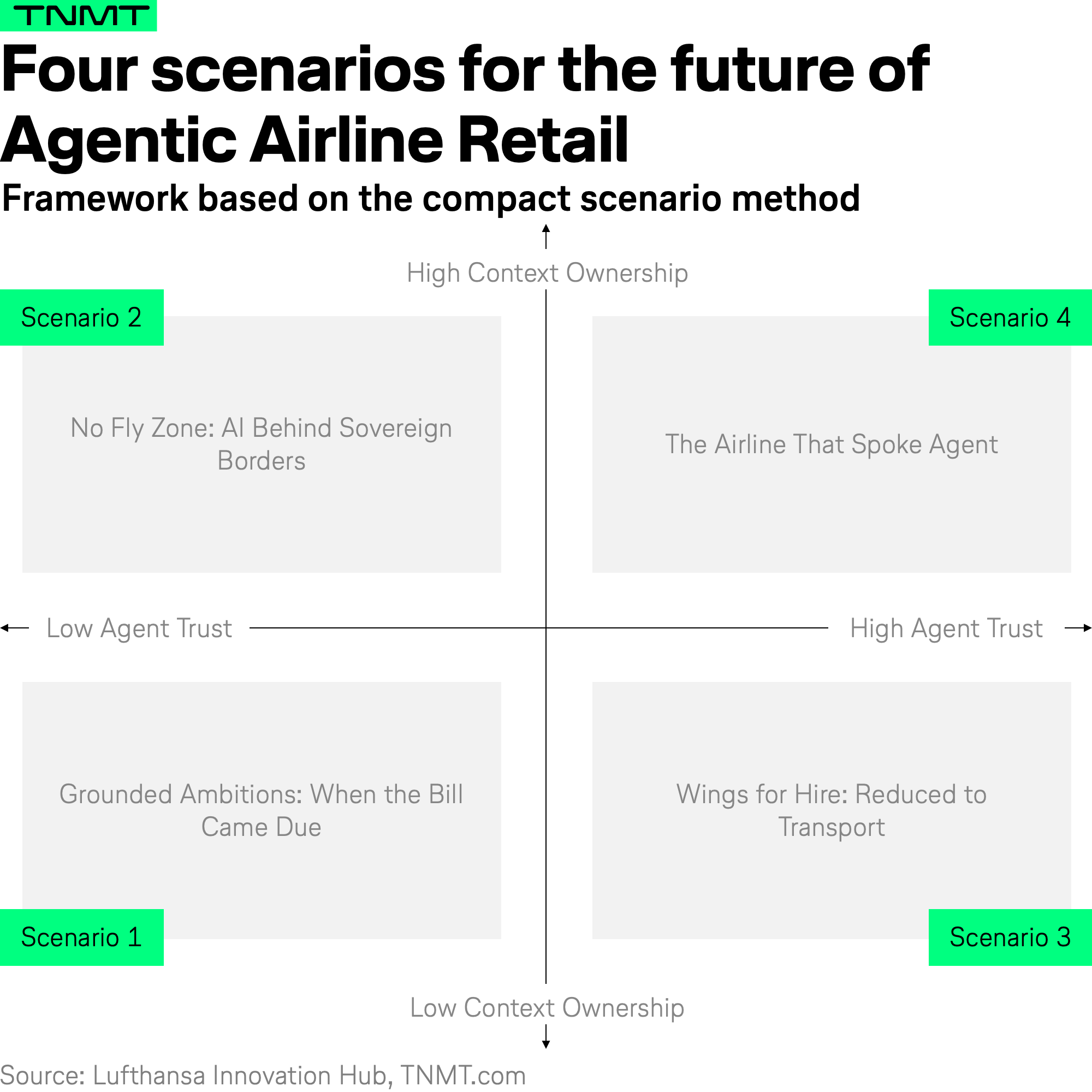
We know what you may be thinking: the names of these scenarios sound a little abstract and buzzword-heavy.
Bear with us. They will make much more sense once we examine each one in detail.
Before that, one more reminder:
- None of the scenarios are predictions from our side.
- Each is a strategic lens for understanding what could happen, what airlines may need to prepare for, and who might ultimately control the customer relationship.
With that context in place, let’s examine the four scenarios one by one.
As you read, keep one question in mind:
Which future feels most realistic when you imagine booking your next flight ten years from now?
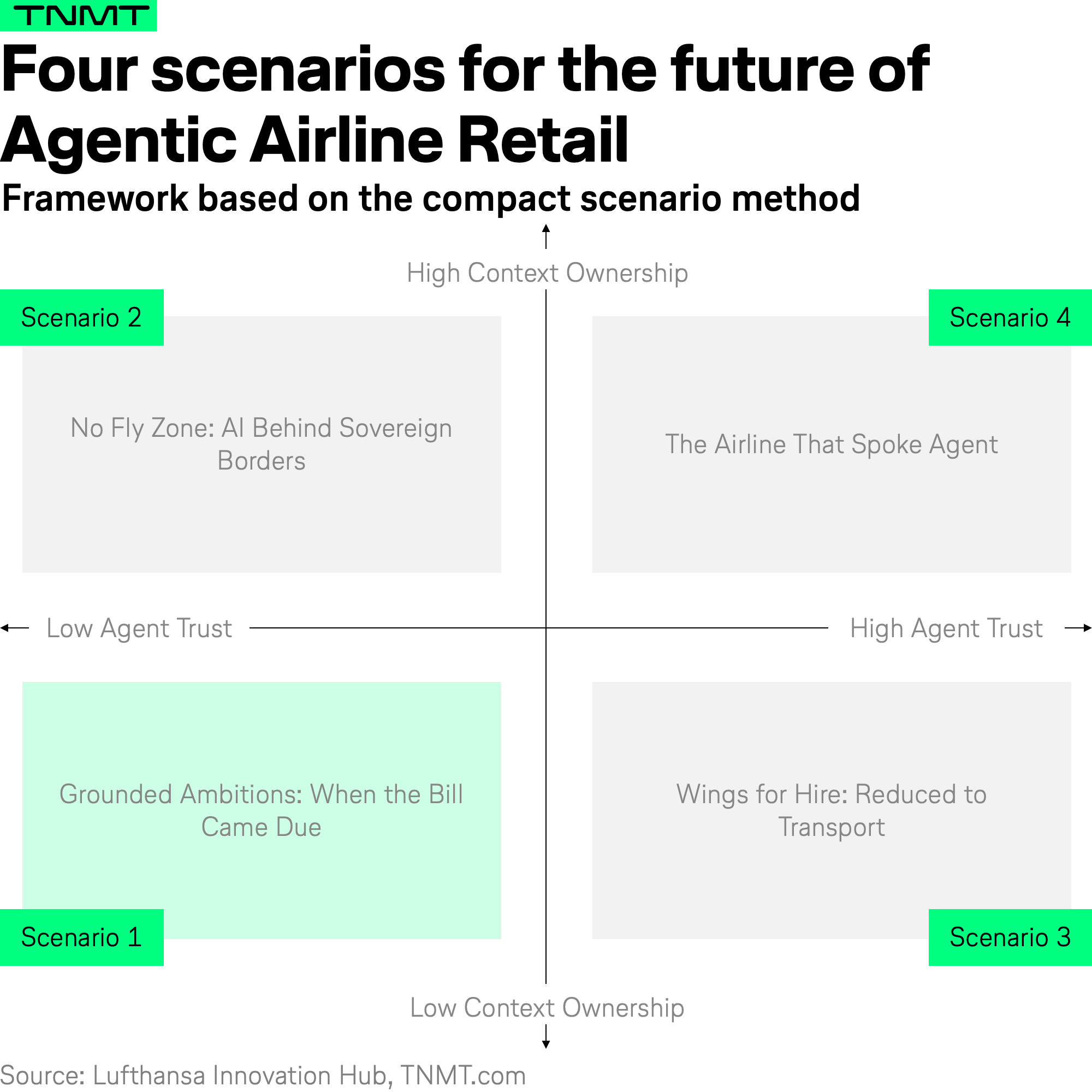
Scenario 1: Grounded Ambitions
In this first scenario, AI-assisted travel search has become routine, but consumers still refuse to hand over the final booking decision to an autonomous agent.
Airlines, meanwhile, have not adapted their commercial infrastructure fast enough.
Their digital stacks remain centered on conventional direct channels such as airline.com and mobile apps, while fares, seat maps, ancillaries, and loyalty benefits are only partially accessible in a format AI agents can reliably use.
Intermediaries therefore become the crucial bridge between AI-powered discovery and human-controlled booking. Indirect sales overtake direct bookings, while airlines absorb the rising cost of serving AI-generated searches without owning enough of the resulting transactions.
This future is not as far removed from today’s reality as it may sound.
- In a recent Bain experiment, LLMs relied much more heavily on OTA websites than airline websites when searching for flights.
- In a separate booking test, OTAs also proved more reliable at getting AI tools to the payment page.
Bain’s explanation was straightforward: Intermediaries currently provide cleaner, more structured, and more agent-readable data.
If that gap persists, airlines will still operate the flight. But discovery, comparison, and payment will increasingly happen somewhere else.
Let’s experience this future through the eyes of an imaginary traveler. Let’s call her Julia.
It is 2031, and a client meeting has just appeared in her calendar for Friday morning in Milan.
Julia pulls out her phone, opens her preferred AI assistant, and dictates:
“Need to go to Milan. Thursday out, Saturday back. Usual rules.”
The AI assistant knows what “usual rules” means:
- Morning departure.
- Aisle seat.
- No tight connections.
- No arrival after 10 p.m.
- And definitely no transfer through the airport Julia has avoided since a particularly painful disruption the year before.
Julia does not need to explain any of this again.
Her AI assistant can access her calendar, previous searches, rejected itineraries, travel history, and broader digital preferences. It knows which trade-offs she usually accepts and which ones immediately eliminate an option.
Within seconds, three itineraries appear.
Julia sees departure times, prices, connection lengths, and an estimate of which journey is most likely to arrive on schedule.
But the recommendation is incomplete.
The assistant cannot reliably confirm her preferred seat, lounge eligibility, upgrade options, baggage benefits, or how many status points each fare would earn.
Why?
The airlines hold much of this information, but it remains scattered across different systems rather than presented as a single, complete, machine-readable offer that the AI assistant can confidently evaluate.
So Julia starts asking follow-up questions:
- “Will option two help me retain my status?” The assistant cannot confirm immediately; it would have to check the airline’s website and log in to Julia’s account, but it is not authorized to do so.
- “Can I use the lounge during the connection?” Possibly. The answer depends on fare and status rules the assistant cannot reliably retrieve.
One simple trip therefore triggers several additional searches and dozens of queries across airline and intermediary systems.
At scale, this behavior drives the so-called look-to-book ratio to an exponential level.
Eventually, the AI assistant ranks the options based on information it can evaluate with confidence, such as price, schedule, and journey time.
Julia gives up on the unresolved loyalty questions and selects the best itinerary.
Then the assistant asks whether it should complete the booking.
Julia says no.
- Two years earlier, a major security incident prompted her to review the permissions across her AI tools.
- She stopped allowing assistants to retain her credit card details and never turned the feature back on.
She therefore clicks through to the OTA, checks the pre-filled fare conditions and seat, and enters her payment information manually. After receiving confirmation, she contacts the operating airline separately to verify that her loyalty number and status benefits have been applied correctly.
In summary: The booking still feels very much like 2026.
One final detail is crucial from the airline perspective.
The flight happens to be operated by a major network airline. And Julia is still classified as one of its highest-value customers, but neither the airline nor her loyalty status played a meaningful role in the decision.
She chose the itinerary her AI assistant ranked first.
Why does that matter?
Because loyalty programs were never designed to reward travelers after they book. They are meant to influence the booking decision itself, pull customers into direct channels, and create opportunities for upgrades, ancillaries, and repeat business.
In Julia’s case, that mechanism has broken down.
Her AI assistant could not properly evaluate her status benefits. By the time the airline enters the journey, the most commercially valuable moments have already occurred elsewhere.
This is what makes the scenario commercially painful for airlines:
- The personal AI platform owns Julia’s intent and preferences.
- The OTA owns the shopping and payment relationship, and the airline pays to be represented in these channels at all.
- The airline receives the booking, but does not control the offer and, with it, its margins.
Meanwhile, airlines still pay to make their schedules and fares accessible to enormous volumes of AI-generated searches, and intermediaries like OTAs play a key role in that. Look-to-book ratios rise, infrastructure costs go up, and direct customer interactions decline.
That is why this future is called Grounded Ambitions. Airlines intended to build for an agentic world, but the economics never took off.
For airline leaders, this raises one important question:
If your systems must serve rapidly rising volumes of AI-generated searches while travelers still refuse to let agents book, who should ultimately pay for that infrastructure?
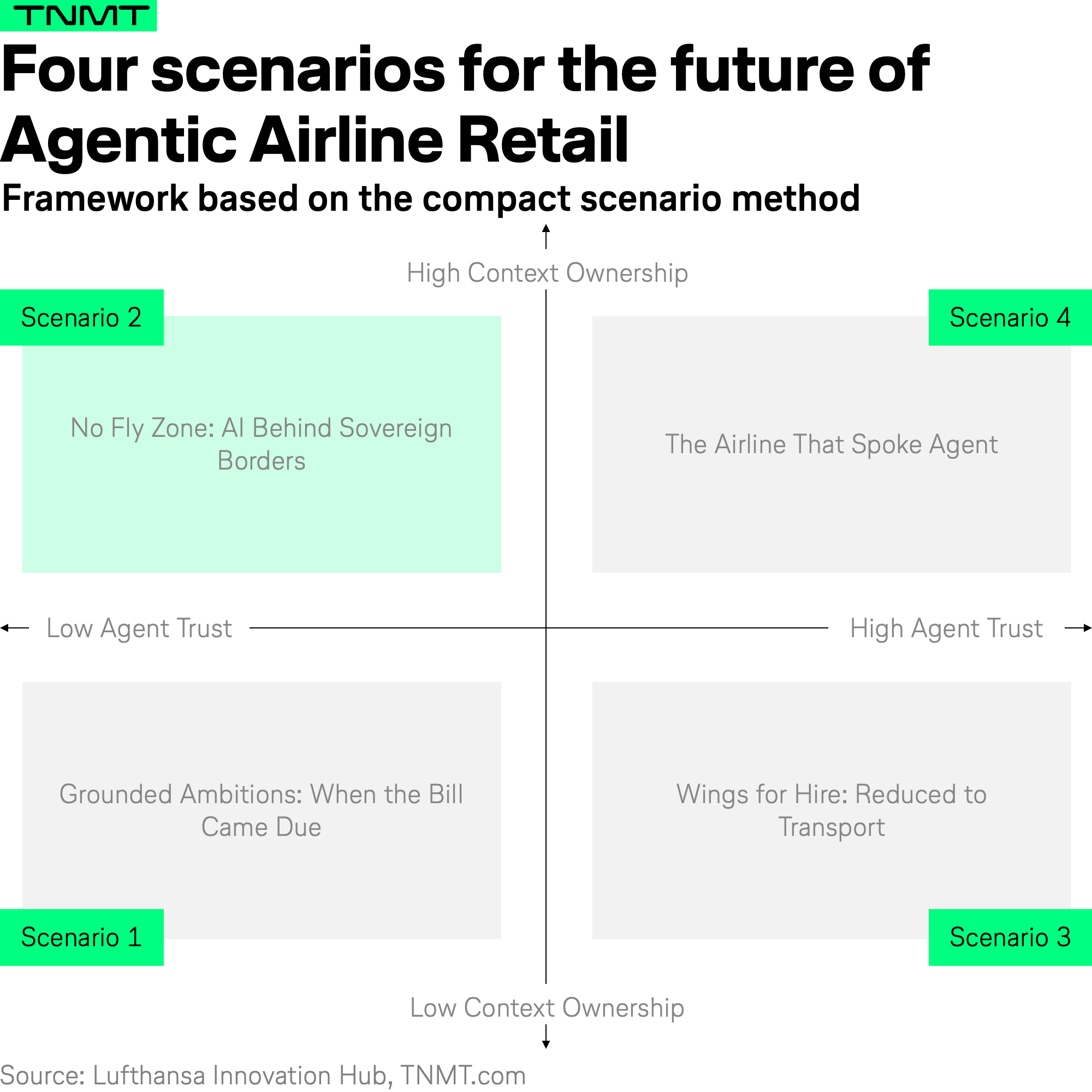
Scenario 2: No Fly Zone
In this second scenario, geopolitical tensions cut Europe off from the world’s leading foreign AI models.
Remember when European users suddenly lost access to Anthropic’s latest Claude Fable model following a U.S. export-control order a few months ago?
That disruption lasted only a few weeks. In this second scenario, it has become the default: access to frontier AI can be withdrawn overnight, leaving Europe dependent on technology and infrastructure it does not control.
And that dependency is already visible today.
Stanford’s latest AI Index counted 59 notable AI models associated with the United States in 2025, compared with 35 for China. Europe accounted for just two.
The physical infrastructure follows a similarly concentrated pattern.
- Cloudscene counted 5,427 data centers in the U.S., compared with 2,269 across the entire EU.
- Germany ranked second among individual countries, but with only 529 facilities.
- Data-center counts are an imperfect proxy for actual AI computing power, but the imbalance is difficult to ignore.
The takeaway is pretty clear: Europe’s access to frontier AI rests on a remarkably narrow external base.
Once export controls and geopolitical tensions enter the equation, it becomes a strategic vulnerability.
In this future, European airlines respond to various bouts of geopolitical volatility by securing long-term access to European computing infrastructure and building a shared, airline-controlled offer layer.
Think of it as an NDC-style industry collaboration rebuilt for the AI era, like a common layer that makes fares, availability, seat maps, ancillaries, and loyalty benefits accessible to approved AI assistants without surrendering control to foreign platforms.
But greater control over airline data does not automatically create trust in autonomous transactions.
- After years of AI fraud, fake booking interfaces, and growing concern over where payment, passport, and personal data are stored, travelers remain reluctant to hand over the final purchase decision.
- They trust AI to search, compare, and prepare the booking.
- They do not trust it to complete the transaction.
- The result: offers are aggregated and compared by AI agents, but the booking remains human.
Let’s experience this future through the eyes of Julia again.
It is 2031, and a client meeting has just appeared in her calendar for Friday morning in Milan.
Julia pulls out her phone and gives her European AI assistant the same brief as before:
“Trip to Milan. Thursday out, Saturday back. Usual rules.”
We already know the drill.
- The assistant remembers her preferred departure time, aisle seat, aversion to tight connections, and the airport she refuses to transfer through.
- It also has access to her calendar, travel history, and employer policy.
Within seconds, three itineraries appear.
But this time, something is different: the recommendations are complete.
Julia can see the live seat map, exact baggage rules, lounge eligibility, change fees, upgrade options, and the status points she would earn with each fare.
Her preferred aisle seat on the 07:40 flight is shown as available.
How is that possible?
Following the withdrawal of foreign AI providers, Europe’s largest airlines came together to build the “European Airline Layer,” or EAL.
The EAL does not replace airline websites, apps, or reservation systems.
Instead, it acts as a jointly governed connection layer that translates airline inventory into standardized, machine-readable information for approved AI assistants.
Every verified airline offer now carries a small EAL-certified badge.
Julia has learned to look for it.
Her colleague Marek lost €800 the previous spring after paying via an AI-generated booking page that looked completely legitimate but belonged to no one.
He was not the only one.
Fraudulent interfaces, manipulated recommendations, and cloned travel brands became common enough that travelers now treat unverified AI offers with immediate suspicion.
Two cheaper flights appear in Julia’s results without the EAL badge.
Their airlines never joined the shared infrastructure, either because they rejected the cost or could not justify the integration work.
Julia ignores them. She selects the verified 07:40 flight.
The assistant responds:
“I’ll hand you over to the airline to confirm.”
The airline app opens automatically.
- Julia unlocks the app with her face, and the selected fare is already waiting. The app confirms her seat, baggage allowance, lounge access, cancellation conditions, and the status points she will earn.
- It has also prepared an optimized payment mix, applying an unused airline voucher and part of her loyalty balance to reduce the amount charged to her bank account.
- Julia reviews the details and presses the payment button herself.
The additional step takes around 20 seconds.
She does not resent it.
After years of fraud cases, privacy concerns, and political disputes over access to personal data, Julia is happy to have AI narrow down the options.
But she still refuses to delegate her credit card details, passport information, and the final contractual decision.
We conclude:
- The search was AI-assisted.
- The booking remained human.
- But unlike in Grounded Ambitions, the airline still mattered.
Because the European Airline Layer exposed the carrier’s full offer, Julia could evaluate more than price and schedule. Those benefits helped her choose the 07:40 flight, and the transaction stayed inside the airline’s app.
For airlines, this is the upside of context ownership:
- They remain visible during AI-powered discovery.
- Loyalty still shapes the decision.
- And the direct customer relationship survives.
That protection comes at a cost, though.
European computing capacity, shared data standards, certification, and cybersecurity require sustained investment. Larger carriers can afford it. Smaller airlines may struggle to participate and risk becoming less visible in AI search.
The central irony remains:
Airlines built the infrastructure for agentic booking, but consumers still refuse to delegate the final purchase.
That is why this future is called No Fly Zone.
Europe keeps AI-powered flight search operating behind sovereign borders, but fully autonomous booking never receives clearance for takeoff.
For European airline leaders, this raises another important question:
Can airlines build the shared AI infrastructure needed for digital sovereignty while preserving the differences that make travelers choose one carrier over another?
Scenario 3: Wings For Hire
For the remaining two scenarios, one variable changes fundamentally.
Travelers start trusting AI agents to make decisions and complete bookings on their behalf.
In the Wings for Hire scenario, however, airlines fail to secure the customer context and transaction layer.
And one present-day signal suggests that this risk is already taking shape.
Adobe’s latest AI Traffic Trends report measures what it calls AI Citation Readability, meaning how easily website content can be understood, structured, and surfaced by AI systems.
- Airlines rank last across several major travel page types.
- Airline homepages score just 42%, compared with 71% for hotels.
- The gap becomes even more relevant closer to the transaction: airline booking pages score only 37%, versus 57% for hotels and car rental and 59% for cruise websites.
Quite clearly, airlines already have some catching up to do.
If their offers, loyalty benefits, and booking flows remain harder for AI agents to interpret than those of other travel platforms, Wings for Hire starts to look less like science fiction and more like an extrapolation of today’s digital gap.
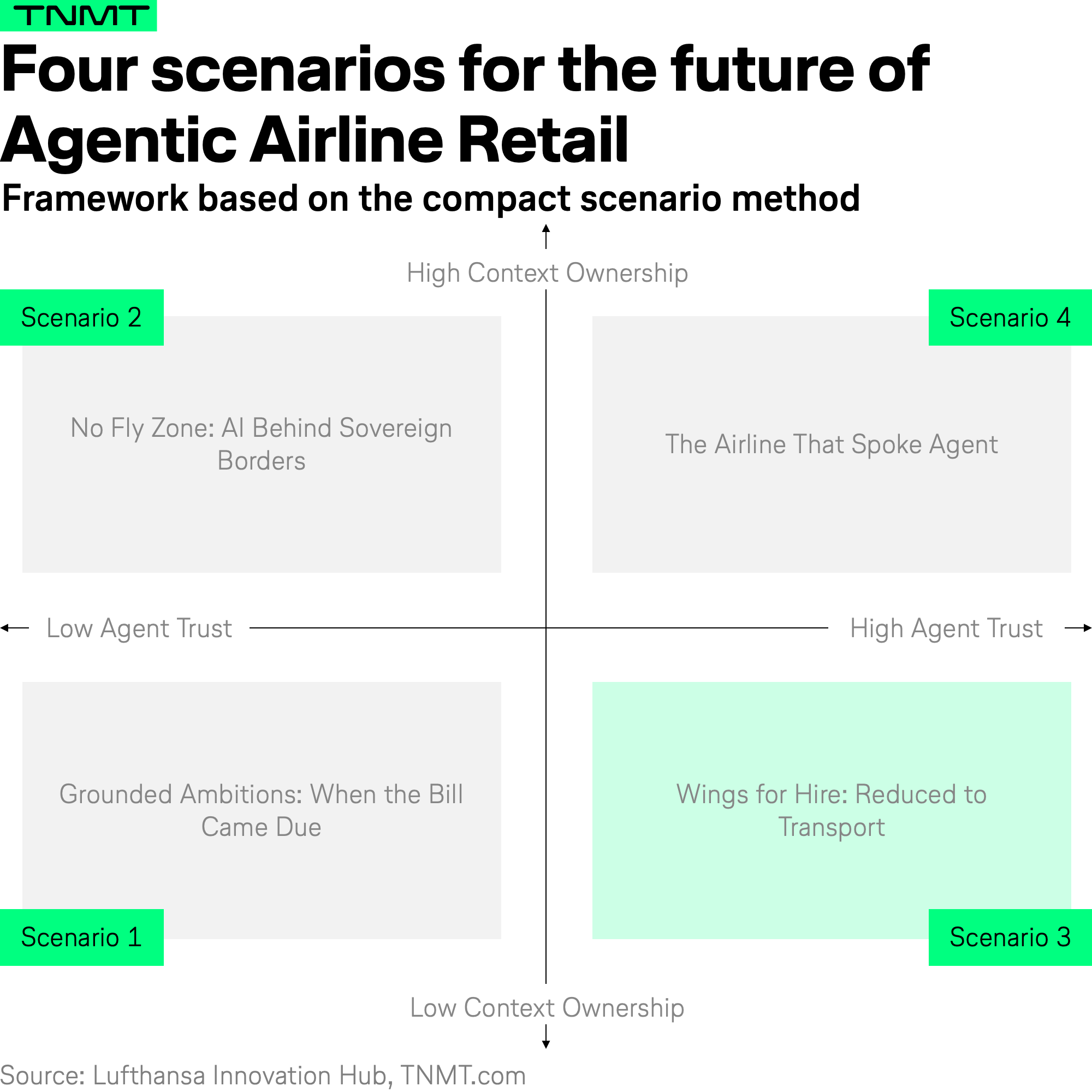
Personal AI platforms become the default travel storefront, while carriers are increasingly reduced to operating whichever flight the agent selects.
Let’s return to Julia and the same business trip to Milan.
In this future, Julia never actively searches for a flight.
Because on Monday morning, when the client meeting in Milan appears in her calendar, her AI agent notices it immediately and begins working in the background.
Ninety seconds later, a travel card appears on her phone:
- Thursday, 07:40 departure
- Saturday, 18:20 return
- €428 total
The itinerary already reflects Julia’s usual preferences.
There is no list of ten alternatives to compare. No filters to adjust. No reason to open three additional tabs.
Just one button: Approve.
Julia glances at the offer between two meetings and authorizes it.
- Booked.
- Paid.
- Calendar updated.
The email confirmation carries the AI provider’s logo at the top.
The airline and flight number appear further down, beneath the agent’s booking reference.
On Thursday morning, Julia notices on her boarding pass that the flight is operated by a major network carrier. It could have been almost any airline.
The flight is good. The crew is friendly. The operation runs on time.
But “good” is not something Julia actively chose. She approved the itinerary her agent recommended.
How about her loyalty status, you might ask?
It did play a role somewhere in the background. It helped break a tie between two similarly priced options, but Julia never saw that calculation and could not immediately name her current tier.
- So, the loyalty program still influences the algorithm.
- But it no longer creates much of a relationship with the traveler.
On Saturday, a disruption affects Julia’s return flight.
Before the airline contacts her, the agent has already compared alternatives, changed her flight, updated her calendar, and moved the airport transfer.
Julia learns about the change through a notification from the agent while sitting in her Uber to the airport.
- No phone call.
- No airline app.
- No direct conversation with the carrier.
The disruption was resolved between machines, which is how most of Julia’s travel now works.
What she does monitor carefully is the agent provider itself.
She abandoned her previous one after it emerged that the company had sold inferred health data to insurers. But she did not return to booking flights manually.
She simply switched to another agent.
That distinction is a game changer.
- Travelers may distrust individual providers, but they no longer question the basic act of delegating a booking.
- Choosing flights manually now feels as dated as calling an airline reservation desk.
Why does this matter for airlines?
In this scenario, AI agent adoption succeeds. Airline distribution does not.
The agent owns the traveler’s preferences, identity, payment credentials, and decision-making process. It searches, compares, books, pays, services, and rebooks. The airline appears only when the physical journey begins.
That shift weakens two of the industry’s most valuable commercial assets:
- First, direct channels lose relevance. Travelers rarely visit airline websites or apps because the agent handles the entire journey elsewhere.
- Second, loyalty becomes an optimization variable rather than a customer relationship. Miles, status, lounges, and baggage benefits still carry value, but the agent evaluates them silently alongside price and schedule.
As a result, the traveler no longer feels loyal. The algorithm simply calculates whether loyalty is useful for this particular trip.
That is why this future is called Wings for Hire. The airline still owns the aircraft, crews, safety, and operation.
But the agent owns the journey. So someone else sells the trip. The airline supplies the wings.
The question for airline leaders is: If agents hold the touchpoint, the data, and the repeat purchase, which revenue can we still defend or create beyond “selling the seat”?
Scenario 4: The Airline That Spoke Agent
Our fourth and final scenario is the most optimistic future for airlines.
- Travelers trust AI agents to make decisions and complete transactions.
- At the same time, airlines have learned to make their full offer visible, understandable, and bookable inside those agentic environments.
The traveler keeps control of their personal context. The airline retains control over its product, transactions, and customer relationships.
Let’s see what that means for Julia’s trip to Milan.
In this future, Julia’s personal AI agent notices the client meeting on her calendar and automatically starts searching.
But it does not guess from scraped fare pages or connect to OTAs’ agentic systems to search for options.
Instead, it connects directly to the agentic layers of several airlines and introduces Julia through a secure, permission-based request:
A verified traveler needs to reach Milan on Thursday and return Saturday. She prefers an aisle seat, avoids tight connections, values lounge access, and wants to retain her airline status.
Two different types of context come together here.
- Julia’s personal agent knows her calendar, employer policy, private preferences, and wider digital life. That information stays on her side.
- The airline recognizes Julia through its own customer ID. It knows her status, mileage balance, recurring routes, previous upgrades, and fourteen-year history with the carrier.
So, the airline knows who is asking and what they are asking for.
Within seconds, Julia receives a tailored offer:
- Thursday, 07:40 departure
- Saturday, 18:20 return
- Aisle seat confirmed
- Lounge access included
- Upgrade available
- Enough status points to retain her tier
Her agent also displays a cheaper low-cost option. But that carrier provides little beyond the departure time and headline price. Its systems cannot explain the full product in enough detail for the agent to compare it properly.
Julia barely looks at it.
Her AI agent recommends the 07:40 flight because it offers the strongest overall value and includes all the information she needs.
- Six years earlier, the process would have opened with several consent screens and requests for unnecessary data.
- Now, the systems exchange only what is needed for this specific transaction. Privacy concerns have declined because the technology finally stopped asking travelers to share their entire digital lives just to book a flight.
Julia reviews the recommendation and taps Approve.
The agent confirms the seat, applies her loyalty benefits, pays the airline directly, and adds the full journey to her calendar.
Eleven seconds. Booked. And most importantly, this time, the airline is not hidden somewhere in the small print. Julia knows which carrier she selected and why.
Why does this matter for airlines?
This scenario represents the best possible outcome for carriers in an agent-mediated world.
The personal AI agent owns Julia’s broader context and remains her primary interface. But the airline owns the authoritative commercial layer, which allows airlines to compete on their complete value proposition rather than being reduced to price and schedule.
It also changes what a direct channel means.
- The airline may no longer own the screen through which Julia shops.
- But if its airline layer controls the offer, completes the transaction, and continues to service the customer, the relationship remains direct.
Trust also grows inside the airline.
- Agentic systems support disruption recovery, resource planning, maintenance, customer servicing, and other operational workflows.
- Those efficiency gains help offset the cost of serving growing volumes of AI-generated demand.
Airlines also keep infrastructure costs under control by routing tasks to the right models and answering agent queries through authoritative interfaces rather than repeatedly generating expensive responses from scratch.
The outcome is a much healthier balance.
That is why this future is called The Airline That Spoke Agent.
The winning airlines did not need to build the world’s most powerful consumer AI.
They simply learned how to make its products, benefits, and relationships fully understandable to the agents acting on behalf of its customers.
The agent owns the conversation. The airline still earns the relationship.
For airline leaders, this raises one final question:
If agentic booking gives your airline richer context at the moment of sale, which new products, bundles, and ancillaries become possible, and what capabilities must you build to assemble them dynamically for each traveler?
Four Potential Outcomes: Now You Decide!
You have seen all four possible futures. Now we want to know which one you consider most likely.
Given how many TNMT readers work for airlines, we suspect The Airline That Spoke Agent already has a few supporters. Entirely unbiased supporters, of course.
But scenario planning is not about selecting the future we would prefer. It is about preparing for the one we genuinely expect.
So now it is your turn:
- Which scenario comes closest to how you believe flight booking will work a decade from now?
- Send us an email at newsletter@tnmt.com and let us know your choice.
- For once, we are not presenting the final data point. We are asking you to create it.
(And yes, we’ll share the results in one of our next TNMT Newsletters.)