This article was developed with significant research contributions by Hsiang Ting Huang, a Research and Intelligence Intern at Lufthansa Innovation Hub.
Today’s analysis focuses on one specific step of the airport journey that has come under severe structural pressure in recent years.
It is a step passengers increasingly associate with friction, uncertainty, and frustration.
And despite years of process improvements and operational fine-tuning, airlines and airports have still not fully figured out how to make it feel smooth.
We will get to that step in a moment.
But before we reveal what we looked at, it is worth taking one step back and looking at the airport environment from a broader perspective.
Airports are facing a simple but hard-to-solve problem:
- More travelers are moving through infrastructure that is often already close to its physical limits.
- At the same time, passenger demand keeps rising, but most airports cannot simply add more terminal space, more gates, more checkpoints, or more processing capacity overnight.
- The result is a more crowded airport environment, where even small operational bottlenecks can quickly become visible passenger pain points.
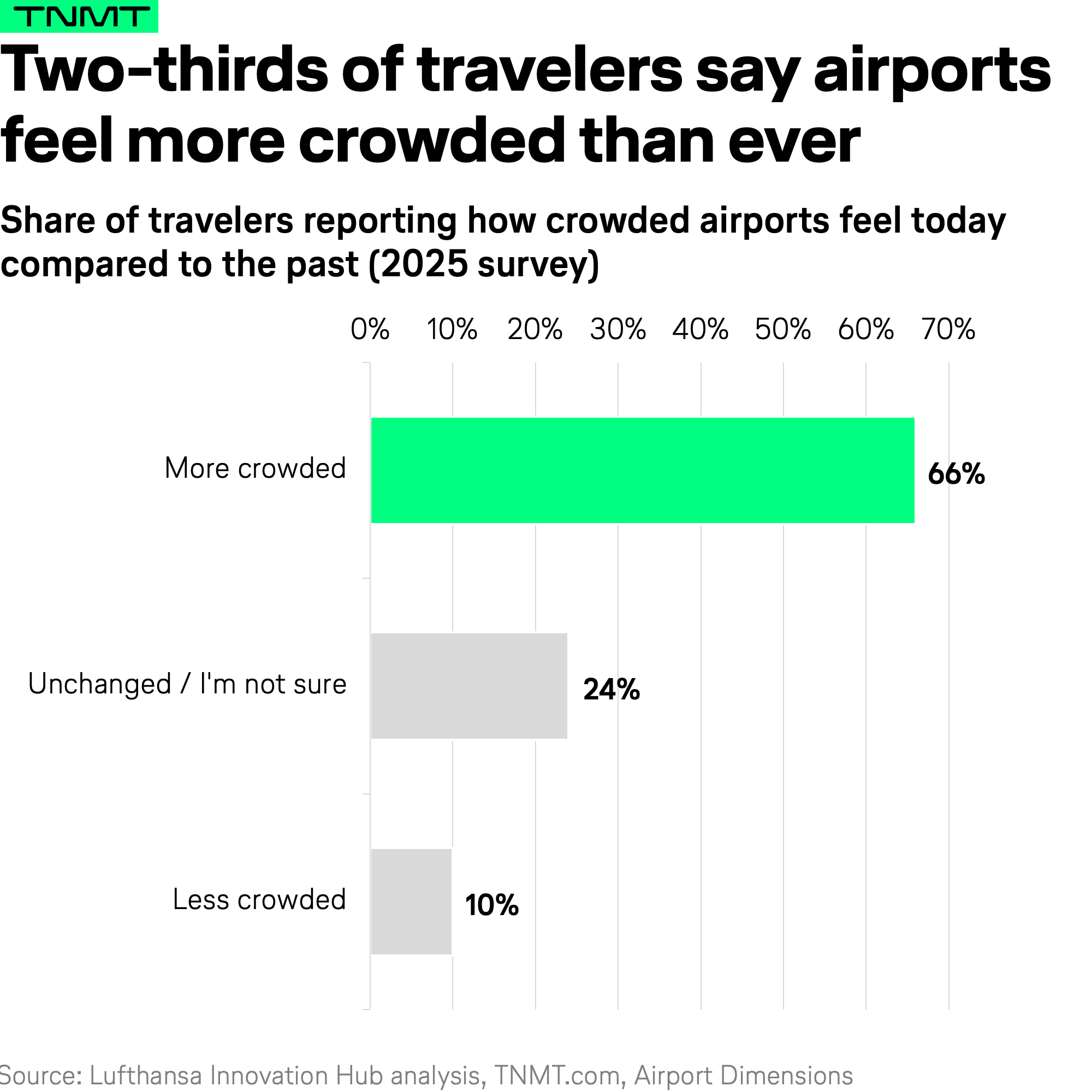
Passengers feel this clearly. Two-thirds say airports are more crowded than ever before.
That matters because crowding does not affect all parts of the airport journey equally.
It puts particular pressure on the steps where passengers, documents, staff, systems, and physical infrastructure all need to come together at the same time.
And one of those steps is where the real problem begins…
Boarding is where airport friction becomes unavoidable
The step we are talking about is boarding.
- On paper, boarding sounds simple: passengers move from the gate onto the aircraft.
- In reality, it is one of the most fragile moments of the airport journey.
This is where crowding, gate design, airline processes, passenger behavior, staff coordination, aircraft configuration, document checks, and carry-on baggage all collide in a narrow operational window.
If anything goes wrong, the friction is immediately visible to passengers and quickly becomes expensive for airlines.
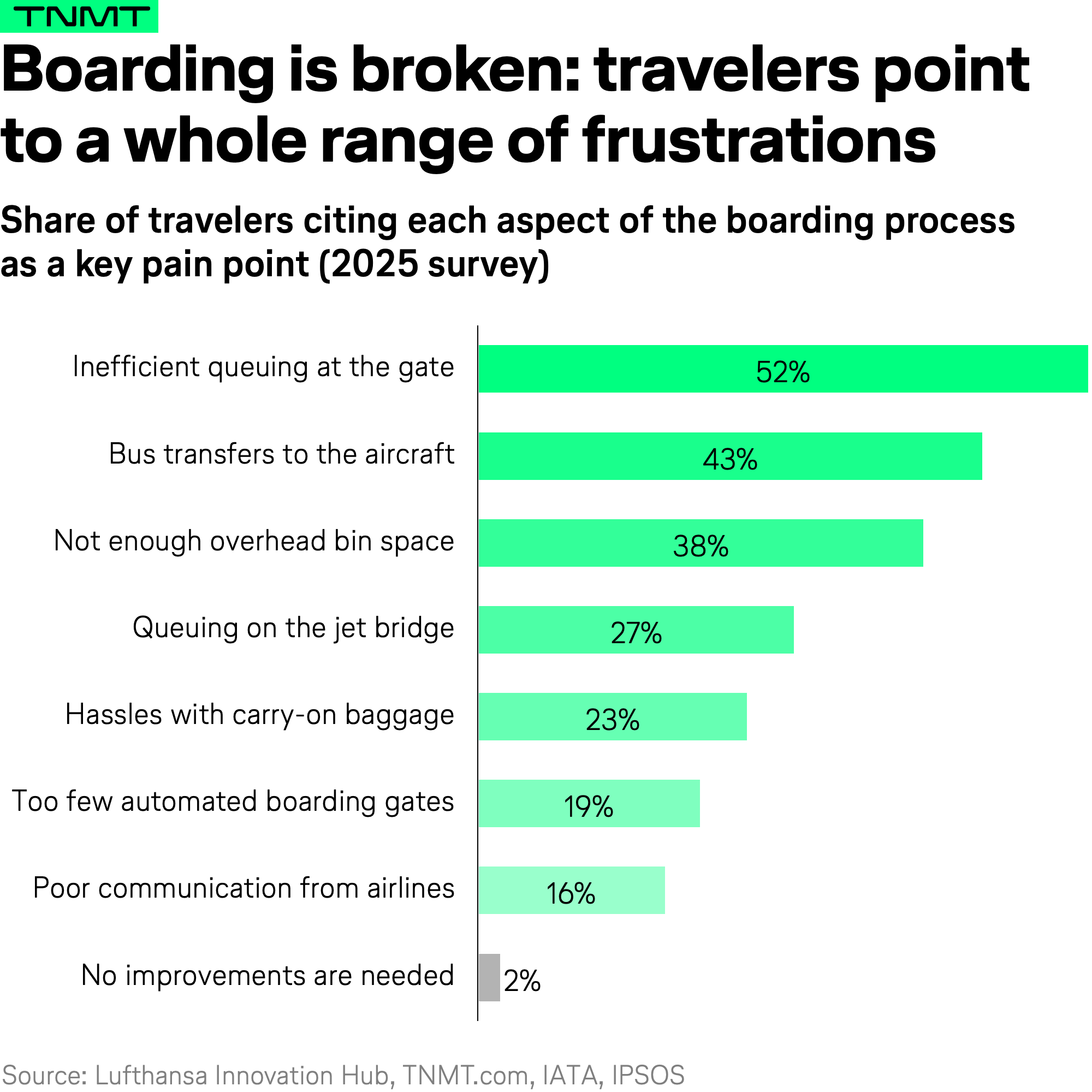
Survey data underlines just how broken the experience feels.
- According to IATA, only 2% of passengers describe boarding as a seamless process.
- The vast majority point to familiar pain points: inefficient queues, confusing gate procedures, annoying bus transfers to the aircraft, hassles with overhead bin space, and the general feeling of unnecessary waiting that can delay departure.
- In other words, boarding is the moment when the flight experience starts to fall apart before the flight has even taken off.
The gate is aviation’s most underused waiting room
If we widen the definition of boarding beyond the moment passengers physically step onto the aircraft, the problem becomes even more interesting.
- The gate area is not just the place where boarding happens.
- It is also the final pre-flight holding zone, where passengers have cleared security, committed to their flight, and are waiting for the journey to move forward.
And that waiting time is highly underused.
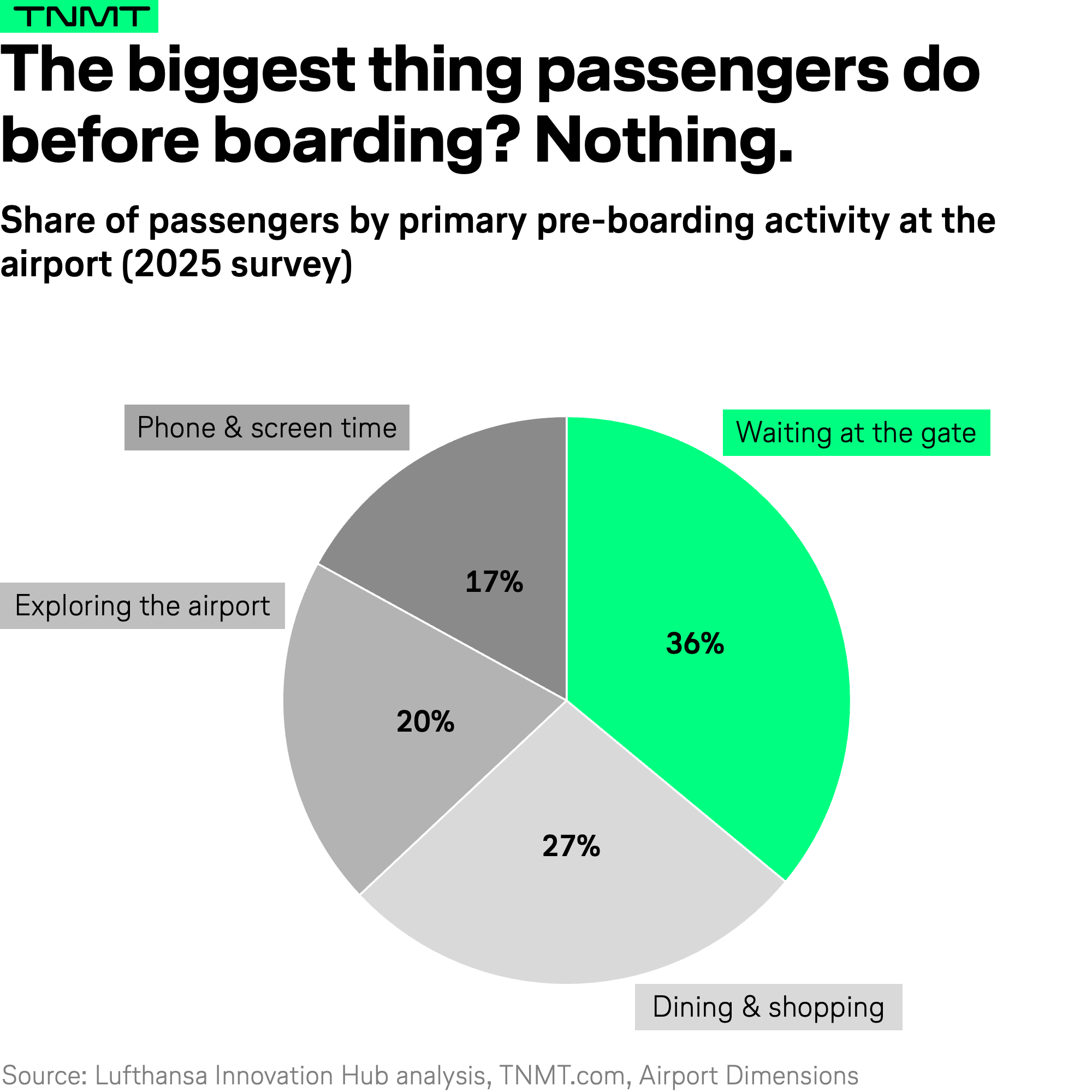
Airport Dimensions asked more than 10,000 regular travelers how they spend their time after security and before boarding.
- The largest group, 36%, said they simply wait.
- Another 17% spend time on their phones, while 20% explore the airport and look for distractions.
- Only about a quarter actively use dining or retail options.
Put differently: roughly half of all travelers are essentially killing time before boarding.
That is a passenger-experience problem, but also a commercial opportunity.
The gate is one of the few moments in the journey where airlines and airports still have a captive audience.
Yet in most terminals, that audience is left staring at screens, watching the boarding door, or refreshing flight status updates.
A few players have already understood the value of this moment. Plusgrade, for example, built a strong business around upgrade bidding and ancillary monetization close to departure. But compared with the size of the opportunity, the pre-boarding window remains surprisingly underdeveloped.
For airlines and airports, the question should not only be how to make boarding faster. It should also be about how to make the time before boarding more useful, more engaging, and more commercially productive.
The next boarding experience will be built around technology
The good news: the gate and boarding experience is not stuck forever.
Technology can play a much bigger role in making the time before boarding more useful and the boarding process itself smoother, faster, and less frustrating.
Over the past few months, we have spoken with a number of airlines and airports about how they are rethinking this part of the passenger journey.
What became clear is that innovation around the gate is no longer limited to better screens, clearer announcements, or slightly improved boarding groups.
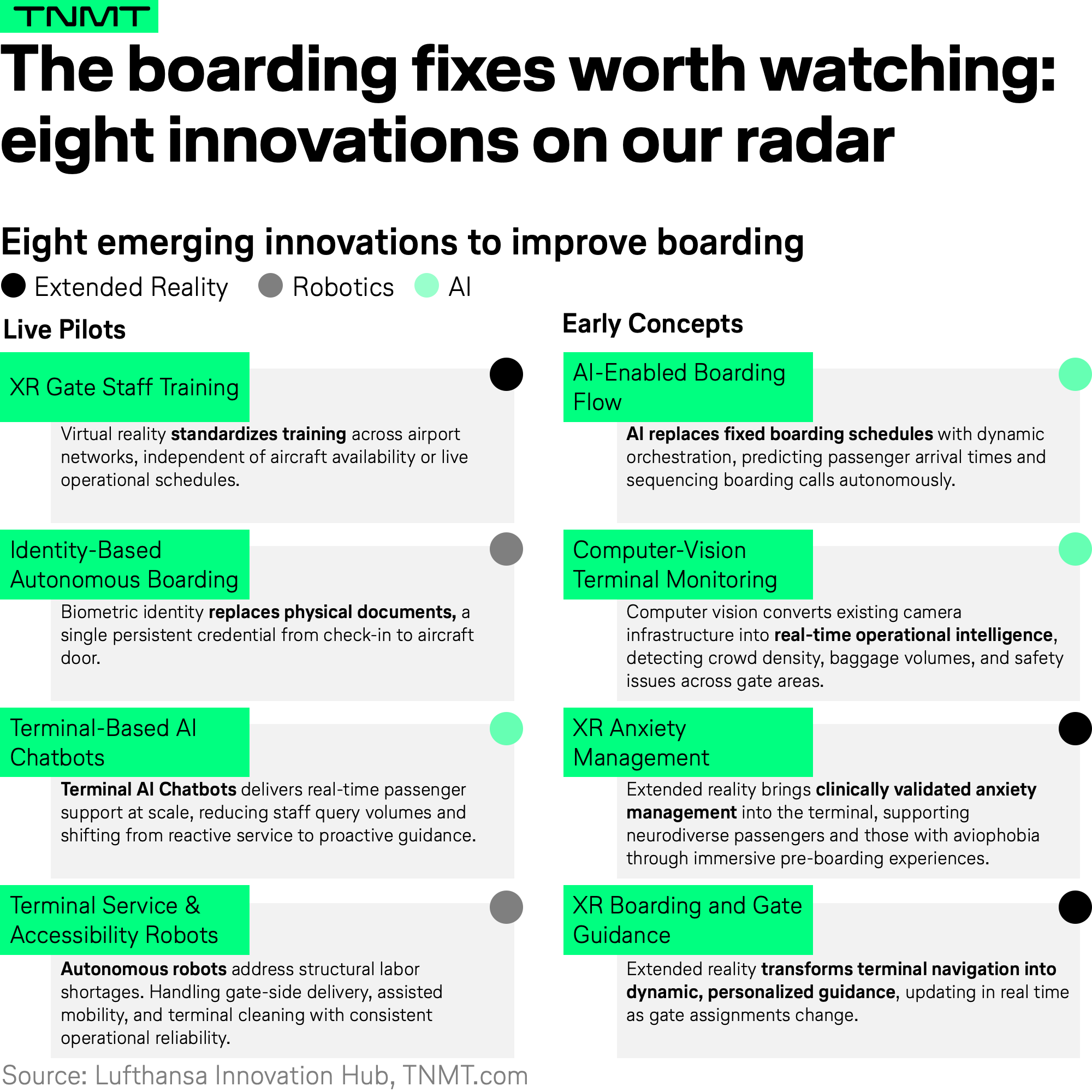
- We see eight emerging innovation fields that could reshape the future of boarding.
- Across these fields, three technology layers stand out: Extended Reality, including Virtual Reality; robotics; and, of course, the elephant in the room: AI.
So let’s look at these eight emerging fields of innovation in more detail.
For each, we focus on what it could change at the gate and during boarding, and where early use cases are already showing up across the airport ecosystem.
XR Gate Staff Training
XR training may not be the flashiest boarding innovation, but it is one of the most practical. The idea is simple: gate, ramp, and ground-handling staff can practice safety and operational procedures in immersive simulations instead of depending on real aircraft, available equipment, or quiet moments in live operations.
This is especially relevant in an industry still dealing with labor shortages, high staff turnover, and persistent skills gaps. Virtual and augmented reality can decouple training quality from equipment availability and staffing constraints. Airports and airlines can train more consistently, across more locations, and at scale, without disrupting daily operations.
The concept is already moving into live airport environments.
- All Nippon Airways launched ∀TRAS, described as Japan’s first VR-based ground-handling training system, to provide standardized learning across its domestic network.
- Basel EuroAirport adopted IATA’s RampVR for ground-handling safety training as early as 2019.
- Emirates has also pushed immersive training forward with its MIRA VR platform, extending it into safety-critical cabin crew training for procedures such as aircraft door operations and fire-fighting.
Startups are also helping accelerate this shift, and several have shown up on our TNMT radar in recent months:
- Cologne-based Draxon provides IATA-certified VR training for ground handling and says its solution is already used by more than 25 airports and ground handlers, including BER, Düsseldorf, and Zurich.
- Taqtile, based in Seattle, brings AR-assisted workflows into maintenance and training environments, including work with British Airways.
- Denmark-based SynergyXR has built an enterprise XR training platform for industrial safety and equipment-heavy environments, showing how lessons from manufacturing and energy could transfer into the airport context.
The bigger point: better boarding does not start only with better passenger technology. It also starts with better-trained frontline teams.
Identity-Based Autonomous Boarding
Identity-based boarding turns the passenger’s face into the boarding token. Instead of repeatedly showing a passport and boarding pass, travelers can use one trusted biometric identity across the journey, from check-in and bag drop to security, immigration, and finally the aircraft door.
This matters a lot because document checks remain one of the most visible friction points at the gate.
- According to IATA, 74% of travelers would share biometric data if it helped them skip document checks at boarding.
- At the same time, regulatory shifts such as the EU’s Entry/Exit System are pushing airports toward more biometric infrastructure anyway.
- In other words, identity-based boarding is not just a convenience play. It is becoming part of the next airport operating model.
Several major airports are already moving in this direction.
- Singapore Changi has rolled out passport-less clearance, using biometric identity to reduce manual checks and speed up the passenger flow across key touchpoints.
- Narita International Airport, together with Amadeus and NEC, introduced Japan’s first end-to-end biometric bfacesoarding journey. Passengers enroll their face at check-in and can then move through biometric kiosks, bag drop, security, and boarding without repeatedly presenting physical documents.
- Orlando International Airport shows how quickly this is moving from pilot to infrastructure. With biometric boarding equipment installed across a large share of its international gates, MCO is becoming one of the most extensive biometric boarding deployments in the United States.
Startups and scaleups are also pushing the identity layer forward.
- Alcatraz AI applies facial authentication to physical access control. Its core logic is highly relevant for airports: if a face can open a secured door, the same principle can help determine whether a passenger should access a lounge, a gate area, or the aircraft boarding lane.
- iProov focuses on biometric face verification and liveness detection, powering passenger identity and border-control use cases, including airport deployments such as Orlando MCO.
- ID.me operates further upstream in the identity stack. Its digital identity platform helps establish trusted, government-grade identity credentials before travel begins. That matters because the smoother the verified identity layer becomes before passengers arrive at the airport, the easier it becomes to use the face as the final boarding credential.
The bigger point: boarding will not become truly seamless if airports only digitize the boarding pass. The real unlock comes when identity itself becomes reusable, trusted, and instantly verifiable across the journey.
Terminal-Based AI Chatbots
Terminal-based AI chatbots are airport-run digital assistants that help passengers navigate the airport journey in real time. They are usually launched by airports themselves, either as standalone passenger-facing tools or embedded into existing airport interfaces such as websites, mobile apps, or WhatsApp channels. Unlike generic customer-service chatbots, they are tied to the live airport environment, meaning they can answer questions about live flight status, gate changes, delays, baggage, wayfinding, airport services, and connections.
What’s their benefit? As terminals get busier, the number of information needs rises with them. AI assistants can absorb much of that routine demand, operate across languages, and push personalized updates directly to passengers when something changes.
- According to SITA, airport chatbot adoption has grown from 9% in 2017 to 57% today.
- In live deployments, the impact is already visible. Air India reports 97% containment for its AI assistant, while Glasgow Airport saw a 50% reduction in staff queries during its conversational AI trial.
For the gate and pre-boarding experience, this is especially relevant. Many frustrations come from uncertainty:
- Is the gate changing?
- Why is boarding delayed?
- Will I make my connection?
- Where can I find food nearby?
A good AI assistant can turn passive waiting into informed waiting.
Several airports are already moving in this direction.
- Aena deployed its “Oli” AI assistant across 41 Spanish airports. The assistant proactively sends personalized real-time alerts when flights are delayed, gates change, or connections are at risk, using channels such as WhatsApp, Facebook Messenger, and airport information screens.
- Rome Fiumicino, operated by Aeroporti di Roma, launched a multilingual virtual assistant powered by Amazon Bedrock. Available through WhatsApp, the assistant supports passengers across the airport journey with flight updates, gate information, baggage status, and wayfinding.
- Glasgow Airport tested an AI-powered digital assistant with Hello Lamp Post and Connected Places Catapult. The trial helped passengers navigate the terminal and access real-time information, while reducing routine questions to customer service staff and achieving high passenger satisfaction.
Startups and AI platform companies are also building the infrastructure behind this shift.
- FetchyFox offers a passenger engagement platform already deployed at Vancouver International Airport, connecting travelers with real-time flight updates, food pre-ordering, airport services, and personalized recommendations without requiring a separate app download.
- Satisfi Labs, used by Miami International Airport, develops conversational AI tools for real-time guest engagement and passenger information across complex venues.
- Kore.ai provides enterprise-grade AI chatbot infrastructure and has developed airport-specific use cases for passenger support, although its broader platform extends far beyond aviation.
The bigger point: the future gate experience will not only depend on better screens or louder announcements. It will depend on intelligent, personalized communication that reaches passengers before confusion turns into frustration.
Terminal Service and Accessibility
Terminal service and accessibility robots are autonomous machines that take over repetitive, physically demanding tasks inside the airport. This can include gate-side delivery, assisted mobility, cleaning, baggage handling, passenger guidance, and even security patrols.
The logic is straightforward:
- Airports need to serve more passengers without relying on unlimited staff growth.
- Labor shortages remain a structural constraint, while the passenger mix is changing at the same time.
- Older travelers and passengers with reduced mobility represent a growing share of airport demand, increasing the need for reliable assistance across large terminal environments.
Robotics can help close that gap. To be clear, we don’t anticipate that these systems will replace the need for human service, but they can take pressure off frontline teams by handling predictable, repeatable tasks with consistent operational reliability.
Several major airports already show what this looks like in practice.
- Incheon Airport operates one of the broadest multi-robot deployments globally, including AI-powered guidance robots, delivery robots, cleaning robots, wheelchair assistance, and baggage-handling robots.
- Heathrow Airport has scaled autonomous cleaning with one of Europe’s largest airport cleaning robot fleets. Its deployment of autonomous floor-scrubbing robots shows how robotics can become part of everyday terminal infrastructure, helping airports manage cleanliness, labor costs, and service consistency.
- In the US, American Airlines and Envoy Air partnered with WHILL to roll out autonomous wheelchairs at Los Angeles International Airport and Miami International Airport. The chairs navigate through pre-mapped terminal routes using sensors and return independently after drop-off, making assisted mobility less dependent on manual staff availability.
As for the previous innovation areas, startups and scaleups are pushing this field forward as well:
- WHILL is one of the leading players in autonomous mobility assistance, with deployments across airports in multiple countries. Its intelligent personal mobility vehicles are designed to help passengers move through terminals more independently.
- Vancouver-based A&K Robotics develops autonomous mobility pods that allow passengers to select a destination and be transported through the terminal, with deployments including Vancouver International Airport and Madrid-Barajas.
- Ottonomy.io focuses on autonomous delivery robots for airports and travel retail. Its Ottobots have delivered food, beverages, and retail items in airport environments, including deployments at Rome Fiumicino, Cincinnati/Northern Kentucky, and Munich Airport Terminal 2 in partnership with Lufthansa.
The bigger point: as terminals get busier and passenger needs become more diverse, service quality will increasingly depend on how well airports combine human staff with autonomous support. Robotics can remove a growing number of repetitive tasks from already stretched teams.
AI-Enabled Boarding Flow
AI-enabled boarding flow is about moving gate management from fixed procedures to dynamic orchestration. Instead of relying only on predefined boarding groups, static schedules, and staff observation, AI systems can predict passenger arrival patterns, monitor gate-area congestion, estimate boarding readiness, and flag issues such as carry-on baggage pressure before they become visible problems.
This matters because boarding is where passenger frustration and airline economics meet directly.
- Passengers dislike standing in unclear queues.
- Airlines dislike late departures.
- Airports dislike crowded gate areas.
AI can help shift the process from reactive to predictive, where staff no longer need to wait until the gate is congested or overhead bins are overflowing before responding. The system can surface the risk earlier and help teams adjust the flow before the bottleneck forms.
Several airports are already experimenting with this more dynamic model.
- Seattle-Tacoma and Los Angeles International Airports have deployed AI-supported virtual queue systems that allow passengers to track their place in line without physically crowding the gate.
- Istanbul Airport is taking a broader smart-airport approach. Its AI-driven crowd analytics and queue management tools monitor passenger flows across the terminal in real time, helping one of the world’s busiest hubs manage movement at scale.
- Dallas Fort Worth and JFK Terminal 4 show another important layer: operational resource management. Copenhagen Optimization’s Better Airport platform supports dynamic gate allocation, staffing, and real-time re-planning during disruptions.
A growing group of technology providers is building the intelligence layer behind this shift:
- ZestIoT, based in Hyderabad, develops AI-powered aviation software focused on ground handling and on-time performance, with airport and airline deployments including Bengaluru International Airport, IndiGo, and Air India.
- Pointr provides indoor positioning and location intelligence, helping airports understand passenger movement, occupancy, and asset flows inside complex terminal environments.
- Munich-based Isarsoft applies AI video analytics to transport and airport environments, using existing camera infrastructure to monitor queue lengths, passenger volumes, and flow patterns at areas such as check-in, security, and boarding gates.
The bigger point: boarding will not improve only by changing the order in which passengers are called. It will improve when airports and airlines understand, in real time, where passengers are, how the gate is building up, and which problems are likely to appear next.
Computer-Vision Terminal Monitoring
Computer-vision terminal monitoring turns existing airport camera infrastructure into real-time operational intelligence. Instead of using cameras mainly for surveillance, airports can use AI to detect crowd density, queue lengths, baggage volumes, safety issues, and movement patterns across gate areas and terminals.
This innovation area is important because many boarding problems start well before boarding officially begins. Gate crowding, blocked walkways, long queues, late passenger flows, and overloaded baggage areas can all build up gradually before staff can react. Computer vision helps airports move from watching screens to understanding what is happening across the terminal in real time. In many cases, this can be done by using cameras the airport already owns.
Several airport deployments show how broad the use cases have become.
- Heathrow Airport is using AI-powered computer vision across multiple operational areas. Matroid supports queue, wait-time, and safety monitoring inside terminals, while Assaia’s ApronAI is being rolled out across gates in partnership with British Airways and IAG to track turnaround processes in real time. For boarding, this matters because gate readiness and aircraft turnaround are tightly connected. A smoother passenger flow is only useful if the aircraft, stand, and ground process are ready too.
- Aeroporti di Roma is taking a slightly different approach at Rome Fiumicino with Outsight’s 3D LiDAR-based Physical AI solution. Instead of relying on facial recognition, the system captures spatial movement data to monitor passenger flows. That makes it especially relevant for airports looking for real-time situational intelligence while reducing privacy concerns.
Computer vision is also moving into more specific terminal-service use cases. Billy Bishop Toronto City Airport, for example, deployed Oscar Sort AI recycling stations from Intuitive AI. The system uses cameras to identify waste items and guide passengers to the correct bin in real time. Similar deployments and trials at locations such as the San Francisco Ferry Building and Seattle-Tacoma show that visual intelligence can improve not only operations, but also passenger behavior inside the terminal.
The technology landscape is developing quickly as well.
- Outsight, based in Paris, builds spatial intelligence systems using 3D LiDAR data to track the movement of people and vehicles without relying on personal identification.
- Ultralytics develops computer-vision models for real-time object detection, image segmentation, and classification, with applications across airport environments ranging from passenger flows to operational monitoring.
- AeroCloud uses existing CCTV infrastructure to anonymously track and count passengers in real time, helping airports detect bottlenecks and trigger operational alerts before small issues turn into larger disruptions.
The takeaway: computer vision is becoming the airport’s operational sensing layer. For boarding, that means fewer blind spots around gate crowding, passenger movement, baggage pressure, and aircraft readiness.
XR Anxiety Management
XR anxiety management uses immersive technology to make the airport journey less stressful for passengers who need more support. This can include VR-based exposure therapy for fear of flying, AR guidance for neurodiverse passengers, or immersive sensory rooms that help travelers rehearse, understand, or calm down before boarding.
The idea is not to turn the gate into an entertainment zone. It is to give passengers a more controlled way to manage uncertainty, sensory overload, and anxiety before they enter the aircraft.
This is an important area of innovation because inclusivity is becoming a structural requirement for airports.
- More older travelers are flying, passengers with reduced mobility are becoming a larger share of the passenger mix, and a meaningful number of travelers experience airport or flight anxiety.
- Clinical research suggests VR exposure therapy can reduce anxiety symptoms for people with phobias and anxiety disorders, while early studies indicate that VR travel rehearsal can help neurodivergent passengers prepare for the airport journey.
- The airport-specific application is still early, but the direction is clear: immersive support could become part of a more accessible pre-boarding experience.
Some airports are already testing what this could look like.
- Glasgow Airport, together with Connected Places Catapult, launched trials of AI and augmented reality tools to support passengers with accessibility needs. The focus included neurodiverse travelers, passengers with dementia, deaf travelers, and people with reduced mobility. Participants were guided through the terminal journey, from entrance to departure gate, with AR tools providing visual support and a more predictable experience.
- Newark Liberty International Airport has taken a physical immersive approach. Terminal A opened an underwater-themed sensory room with projections, interactive features, soft seating, and a mock aircraft cabin, designed in consultation with autism specialists. For passengers who find the airport overwhelming, this creates a calmer environment before boarding.
- Hector International Airport in Fargo has gone even further by combining an immersive reality room and a sensory room inside an operational terminal. The concept is especially relevant for children with autism spectrum conditions and other sensory sensitivities, helping them prepare for the flight experience in a safer and more controlled setting.
A specialized group of health-tech and XR companies also points to where this field could move next:
- XRHealth operates an extended reality therapeutics platform for physical, occupational, and mental health use cases, including a fear-of-flying VR exposure module. Its clinical and hospital experience gives it credibility for future airport anxiety-management applications.
- oVRcome has built a mobile VR therapy platform with a specific fear-of-flying module, supported by clinical trial work. That makes it one of the more relevant startups for translating phobia-focused VR into travel contexts.
- PsyTechVR develops VR-based tools for clinicians treating anxiety, stress, phobias, and PTSD. While not airport-specific today, its technology shows how clinically oriented XR could eventually support passengers before stressful travel moments.
The bigger point: better boarding is also about making the journey more manageable for passengers who experience the airport differently. As terminals become busier, accessibility will increasingly depend on designing calmer, more predictable, and more inclusive pre-boarding environments.
XR Boarding and Gate Guidance
XR boarding and gate guidance turns airport navigation into a more dynamic and personalized experience. Instead of relying only on static signs, maps, and gate screens, passengers can receive turn-by-turn AR guidance, holographic assistance, and personalized directions that update in real time as gate assignments, walking times, or boarding information change.
This is another highly relevant area of innovation because airport terminals are becoming larger, more complex, and harder to navigate. More than 20 major international airports are currently in expansion mode, while passengers increasingly expect the same simplicity they get from consumer apps: clear directions, live updates, and reassurance that they are moving in the right direction. For boarding, this is especially relevant. A passenger who cannot find the gate, misses a change, or underestimates walking time quickly becomes an operational problem.
Several airports are already experimenting with more immersive guidance models.
- Incheon International Airport introduced a metaverse-based indoor wayfinding service using 3D spatial data and augmented reality through its Incheon Airport+ app.
- Miami International Airport has moved into AI-powered holographic assistance. In partnership with Hypervsn, Satisfi Labs, Mappedin, and the airport itself, MIA deployed life-size hologram assistants that combine conversational AI with real-time wayfinding. Passengers can ask questions and receive directions that are linked directly to the terminal map.
- LaGuardia Terminal B offers another example with “Bridget,” an AI-powered holographic concierge. Built with Proto Hologram hardware and Holomedia’s AI Concierge Wayfinder platform, Bridget answers passenger questions, shows step-by-step gate directions, and hands off guidance to the traveler’s phone via QR code.
A number of specialist technology companies are building the navigation layer behind these experiences.
- Mappedin, based in Waterloo, Canada, develops indoor mapping software for complex venues and has already been deployed at more than 35 airports. Its maps power search, discovery, and navigation tools that can sit behind airport apps, websites, kiosks, or digital assistants.
- Goodmaps focuses on accessible indoor navigation and is deployed across more than 19 airports. Its technology is especially relevant for passengers who need more precise guidance, including blind and low-vision travelers, neurodiverse passengers, and people navigating unfamiliar terminals under time pressure.
- Proto Hologram, based in Los Angeles, develops hologram projection systems that bring a more human layer to digital passenger communication. Its deployment at LaGuardia shows how airport guidance can move beyond flat screens toward more interactive, visible, and conversational formats.
The takeaway: boarding guidance is about reducing uncertainty in real time, especially in larger and more complex terminals. If airports want boarding to feel smoother, the journey to the gate has to become smarter too.
This is our current view of the emerging boarding innovation landscape. It will not be the final one. The gate and boarding experience is still an underdeveloped part of the airport journey, and we expect more pilots, startups, and airport-led experiments to emerge over the coming months. If we missed a promising initiative, technology provider, or airport deployment that should be on TNMT’s radar, let us know.