
If there’s one chart that perfectly captures how far the AI hype has made its way into corporate thinking, it’s this one below.
According to Bloomberg data, executives of the 500 largest U.S. companies now mention “AI” more often than “earnings” during, wait for it, earnings calls.
Yes, the very calls that are supposed to be about… earnings.
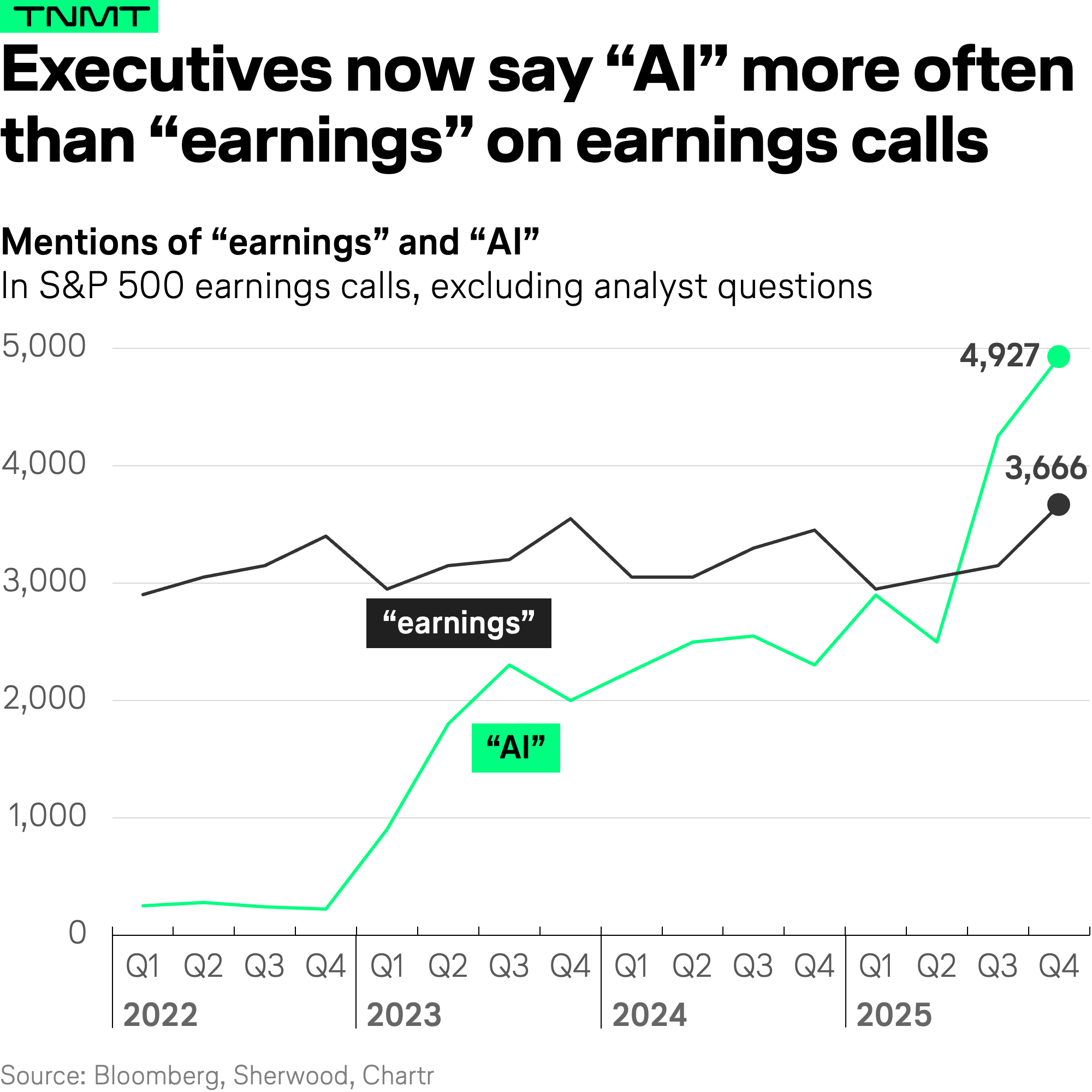
It’s definitely a telling signal.
Because at this point, AI has become a boardroom narrative.
- Every company is trying to position itself as “AI-ready.”
- Partly to prepare for what’s coming.
- Partly to signal to investors that they’re not being left behind.
And let’s be honest: Wall Street seems to like what it hears.
After all, AI promises one thing investors love above all else: higher productivity (and, inevitably, lower costs).
From Wall Street to the flight deck
Seeing how dominant “AI” has become in corporate earnings calls, we asked ourselves the following question:
What would this chart look like for airlines?
So we got to work.
We pulled 150+ earnings call transcripts from 10 publicly listed airline groups globally, based on their most recent annual revenue.
One quick note on the methodology: We excluded state-owned carriers and airlines without accessible or English-language transcripts
The final dataset includes:
- Four U.S. carriers: Delta Air Lines, United Airlines, American Airlines, Southwest Airlines.
- Three European legacy groups: Lufthansa Group, IAG, and Air France-KLM.
- One European low-cost carrier: Ryanair.
- One Middle Eastern/European hybrid: Turkish Airlines.
- And one Latin American carrier: LATAM Airlines Group.
In other words, a fairly representative snapshot of the global airline industry.
So… how does the chart look?
Well, here it is.
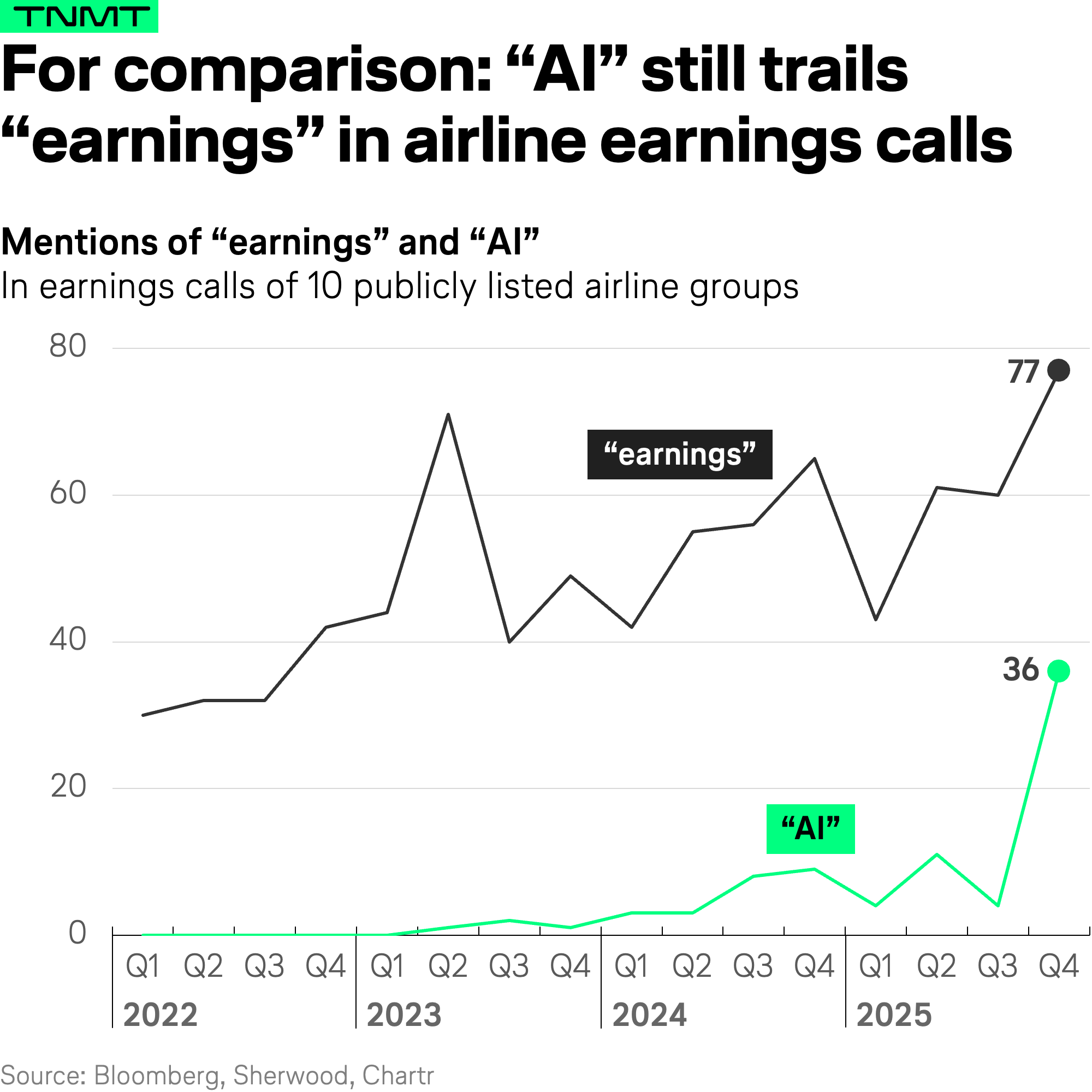
So… what do we make of this?
Two things immediately stand out:
- AI is not (yet) dominating the conversation in airline earnings calls the way it does across the broader corporate landscape.
- The AI narrative only entered the airline industry very recently (essentially in Q4 of last year). Before that, it was barely measurable.
So what’s going on here?
At first glance, the easy explanation would be: airlines are late again.
That would fit our familiar TNMT narrative, claiming that aviation often lags in adopting new technologies and transforming business models.
And yes, there may be some truth to that.
But in this specific case, the situation is likely more nuanced.
In fact, two recent data points suggest that the slower “AI talk” in airline boardrooms may be less about lagging behind and more about structural constraints unique to the travel industry and the airline sector.
The first one: trust.
Recent research from McKinsey and Phocuswright shows that roughly 55% of travelers already use tools like ChatGPT for travel planning today.
However, when it comes to the actual booking moment, the picture changes dramatically.
Only a tiny minority of travelers (around 2%, according to Skift) would feel comfortable letting AI handle the transaction itself.
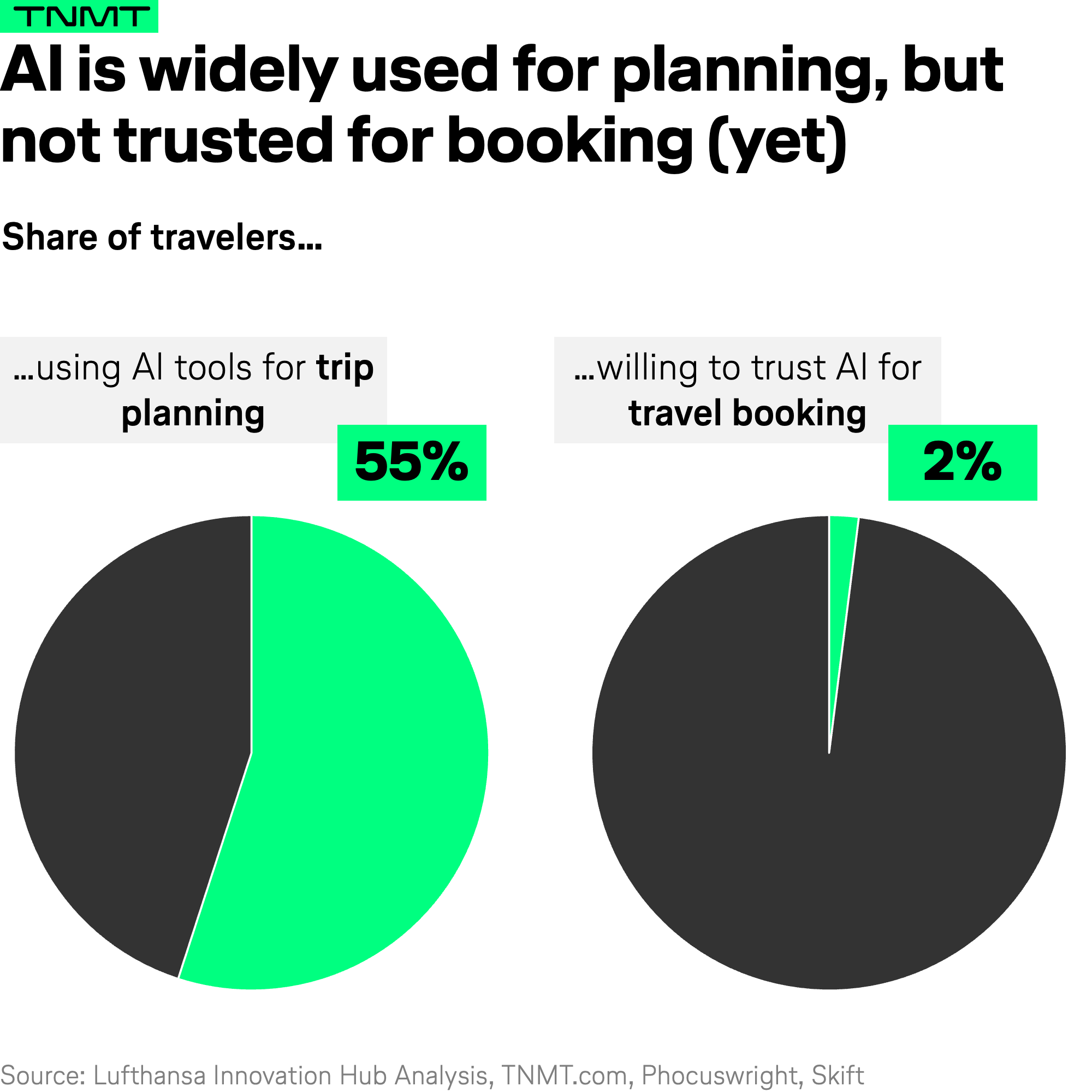
That’s a massive gap between usage and trust.
Now, some might argue that this resembles the early days of online travel booking 25 years ago, when skepticism was high, but ultimately temporary.
And that may well be true for AI.
But for now, this trust gap remains a very real bottleneck.
And in aviation, that gap matters even more.
- Airlines operate in what is essentially a zero-defect industry.
- There’s very little room for “almost correct” recommendations, whether that’s pricing, scheduling, routing, or operational decision-making.
- And that, in turn, likely slows down not only AI adoption, but also how aggressively executives talk about it in front of investors.
But trust is only part of the story.
There’s another, arguably even more important reason behind this pattern.
Reason #2: It’s about where AI actually works best
Recent data from VC powerhouse Andreessen Horowitz sheds light on where AI is actually delivering most adoption and ROI inside large enterprises.
The result is surprisingly concentrated.
Enterprise AI usage today is dominated by three core use cases:
- Coding
- Customer support
- Search
And within that group, coding is the clear outlier, driving adoption at an entirely different scale.
This explains a lot.
- Industries where the core product is software naturally see the highest AI impact.
- Tech companies are built around the workflows AI improves most.
Airlines, on the other hand, are not tech companies.
Yes, they rely on software and coding (think websites, apps, operational systems, etc.), but these are enablers, not the core product.
The core business is still physical: moving people and assets through complex, real-world environments.
(To be fair, this doesn’t mean airlines wouldn’t benefit massively from stronger digital capabilities, see our Airline Digital Index, but that’s a different story.)
Interestingly, this doesn’t mean AI is only relevant for software-driven industries.
Sectors like Legal and Healthcare are among the most advanced adopters of AI, despite not being “tech-first.”
Why?
Because their core workflows are highly compatible with AI strengths:
- In the case of Legal: dense, text-heavy work → perfect for AI’s ability to parse, reason, summarize, and draft.
- For Healthcare: heavy administrative load → ideal for automation (e.g., medical scribes) and augmentation of expert work.

So where does that leave airlines?
Somewhere in between.
- The reality is: high-impact, scalable AI use cases in aviation are simply harder to find.
- It’s not impossible, but certainly less obvious, less plug-and-play, and less “mass-market ready.”
This essentially explains why the boardroom narrative lags the hype cycle…
In any case, what’s your experience with AI inside your organization?
Send an email to newsletter@tnmt.com and let us know.
We’d love to compare notes.