At TNMT, we tend to celebrate companies that build for the long term.
Think about disruptive innovation, unique products and experiences, and relationships that customers genuinely value.
But here’s the uncomfortable truth about the airline industry:
More often than not, our sector does the exact opposite.
Too often, airline leaders prioritize short-term financial gains, regardless of what travelers actually think or value.
And the result is visible: an industry where airlines increasingly look, feel, and behave alike, despite serving millions of highly diverse travelers.
This is why today’s analysis is so important to us.
It’s not about an airline that never figured it out.
It’s about one that did.
- One that built something rare in this industry: real customer affection, earned over decades.
- And then, under pressure, it chose to dismantle exactly the things that made it special.
So which airline are we talking about?
We’re talking about Southwest Airlines
For the past decade, Southwest has been one of the most consistently admired airlines in the U.S., largely because it built something most airlines struggle to achieve: genuine customer affection.
Here is the data to back it up.
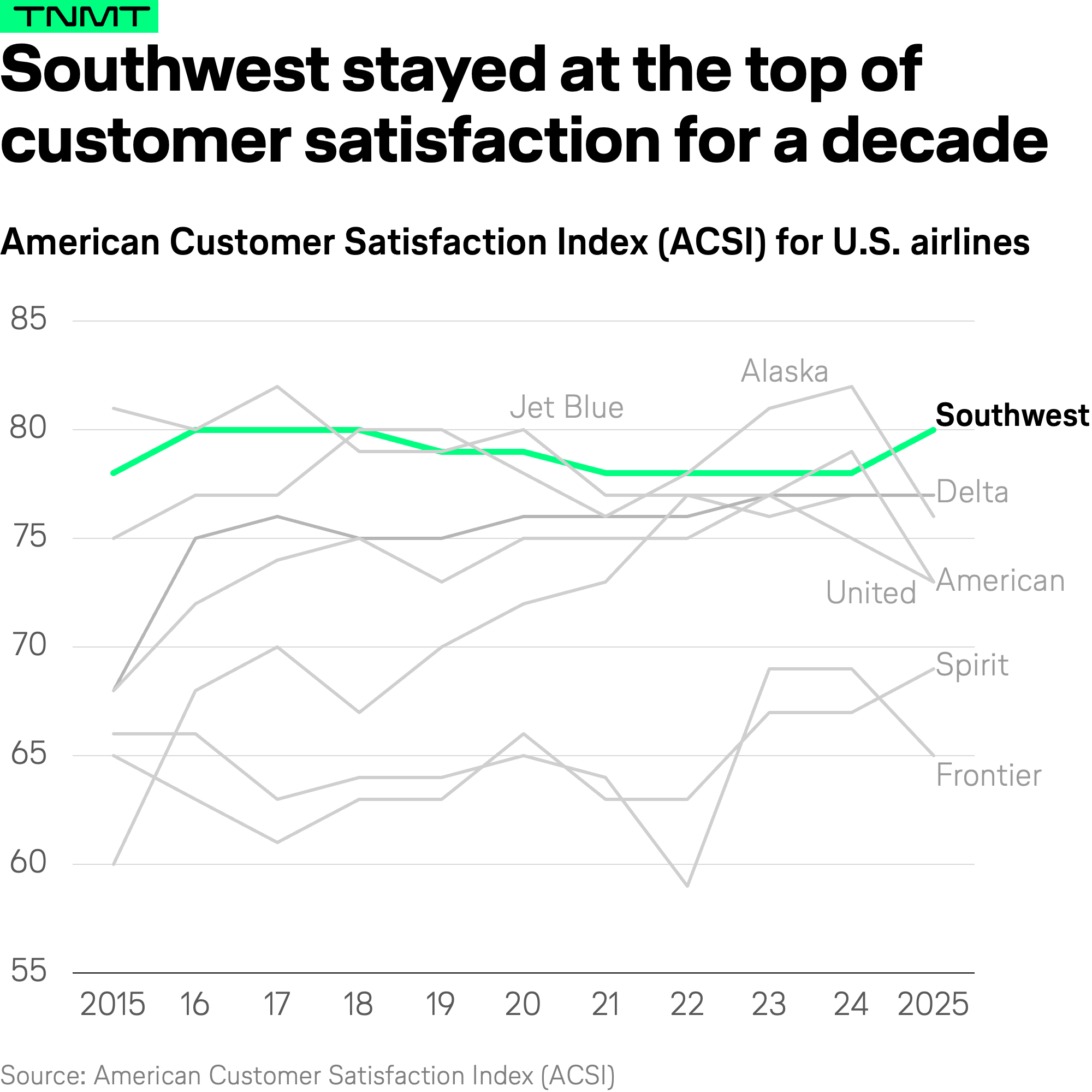
- The American Customer Satisfaction Index (ACSI) shows Southwest scoring between 78 and 80 from 2015 through 2025, consistently ranking among the top two or three U.S. carriers for more than a decade.
- In 2025 (based on April 2024 to March 2025 results), Southwest achieved the highest score in the market, ahead of JetBlue and Delta (and well above American and United).
The same pattern shows up across other benchmarks.
In May 2025, Southwest ranked #1 in Economy Class customer satisfaction in the J.D. Power study (for the fourth consecutive year) and also led in staff quality and customer trust.
There’s nothing accidental about this.
Southwest built its brand by doing something deceptively simple: removing the things customers hate.
- No baggage fees.
- No opaque pricing.
- Flexible cancellation policies.
- And free seating.
Each of these choices meant giving up short-term revenue in exchange for long-term brand value and customer loyalty.
And it worked.
- Southwest delivered 47 consecutive years of profitability until the pandemic. This was an almost unmatched track record in aviation.
- Even under investor pressure to monetize more aggressively, the airline held its ground. In 2013, Southwest estimated that introducing baggage fees alone could cost up to $1 billion USD in lost customers over time.
In other words: customer satisfaction wasn’t a side effect. It was the business model.
But then, something changed.
When Southwest started changing the playbook
Then came the pandemic.
Like every major airline, Southwest was hit hard. While Southwest recovered operationally, the crisis changed the general conversation around its business model.
Pressure on leadership started to build.
- For years, Southwest had defended its refusal to adopt the industry’s favorite revenue levers.
- But coming out of COVID, that restraint started to look different, especially to investors.
Competitors were generating billions in ancillary revenue. Southwest wasn’t. And what used to be seen as discipline increasingly looked like money left on the table.
Investors saw an opportunity.
In June 2024, Elliott Investment Management disclosed a $2 billion USD stake in Southwest, launching a classic activist campaign.
- The fund pushed for sweeping changes, including leadership reshuffling and a fundamental rethink of the airline’s commercial strategy.
- By October 2024, Elliott had secured five board seats as part of a settlement with the airline.
From that moment on, the pressure wasn’t manageable anymore.
What followed was arguably the most sweeping commercial reset in the airline’s five-decade history.
- Effective May 2025, Southwest ended its iconic “Bags Fly Free” policy, introducing a $35 USD fee for a first checked bag and $45 USD for a second, aligning with the rest of major U.S. carriers.
- Effective 2026, Southwest moved ahead with assigned seating, extra-legroom options, new fare bundles, and a redesigned boarding process.
Now, let’s be clear: none of these changes are unusual by industry standards.
- Every major U.S. airline charges for checked bags.
- Every major U.S. airline assigns seats.
- Alaska, JetBlue, American, United, Delta, and Hawaiian have all been doing this for years.
What made Southwest’s decision so significant was not what it adopted.
It was what it gave up.
These amenities were the clearest symbols of what made Southwest feel different in the eyes of its most loyal customers. And once those symbols started disappearing, a more fundamental question became hard to ignore:
What exactly was left of the airline that people had learned to love?
What customers had to say
It turns out: not much. Customers reacted immediately.
We analyzed thousands of Southwest reviews on TripAdvisor, and here’s what we found out:
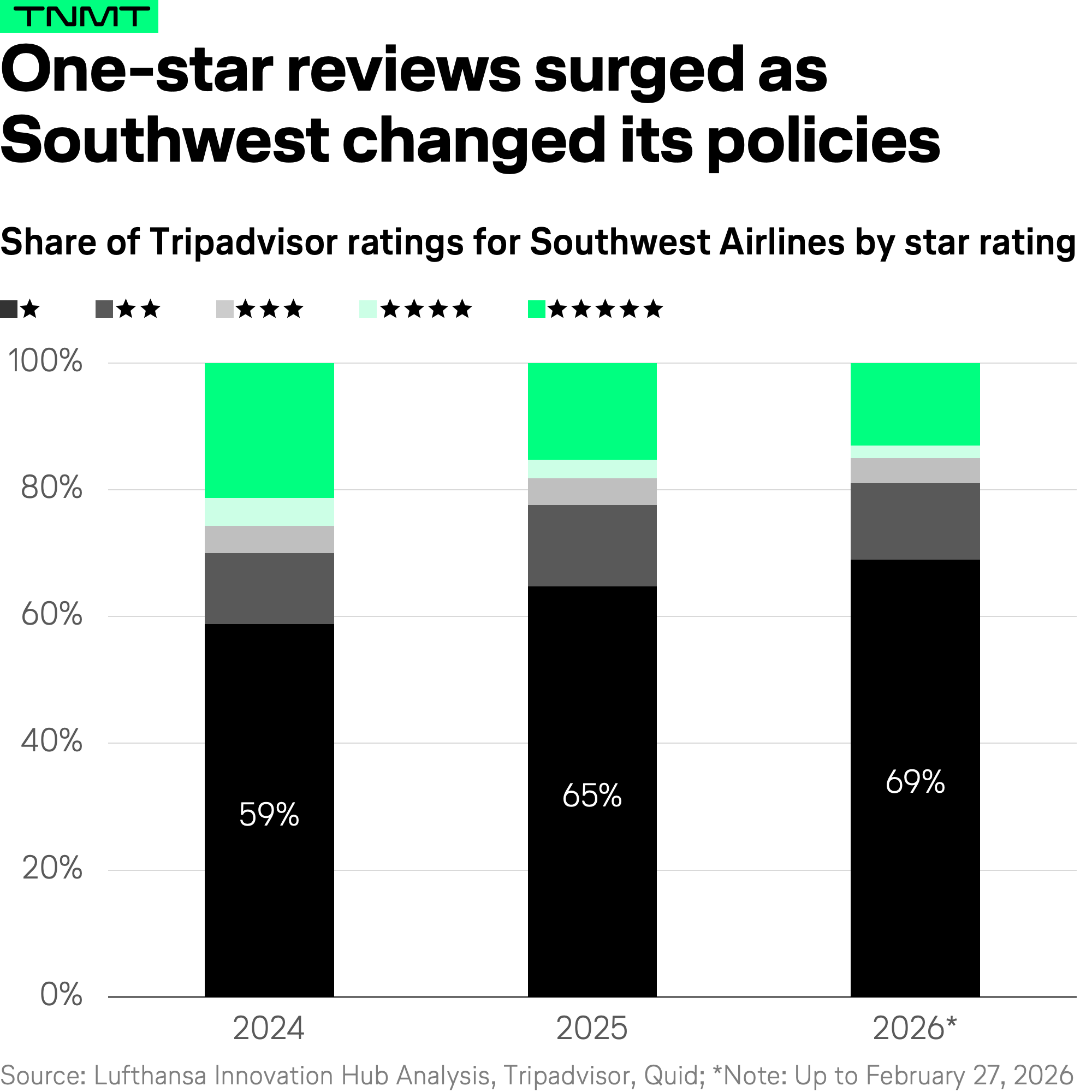
The share of one-star reviews (the lowest possible rating) spiked to record highs following the commercial changes.
What’s driving this shift?
Undoubtedly, the policy changes, especially the end of open seating.
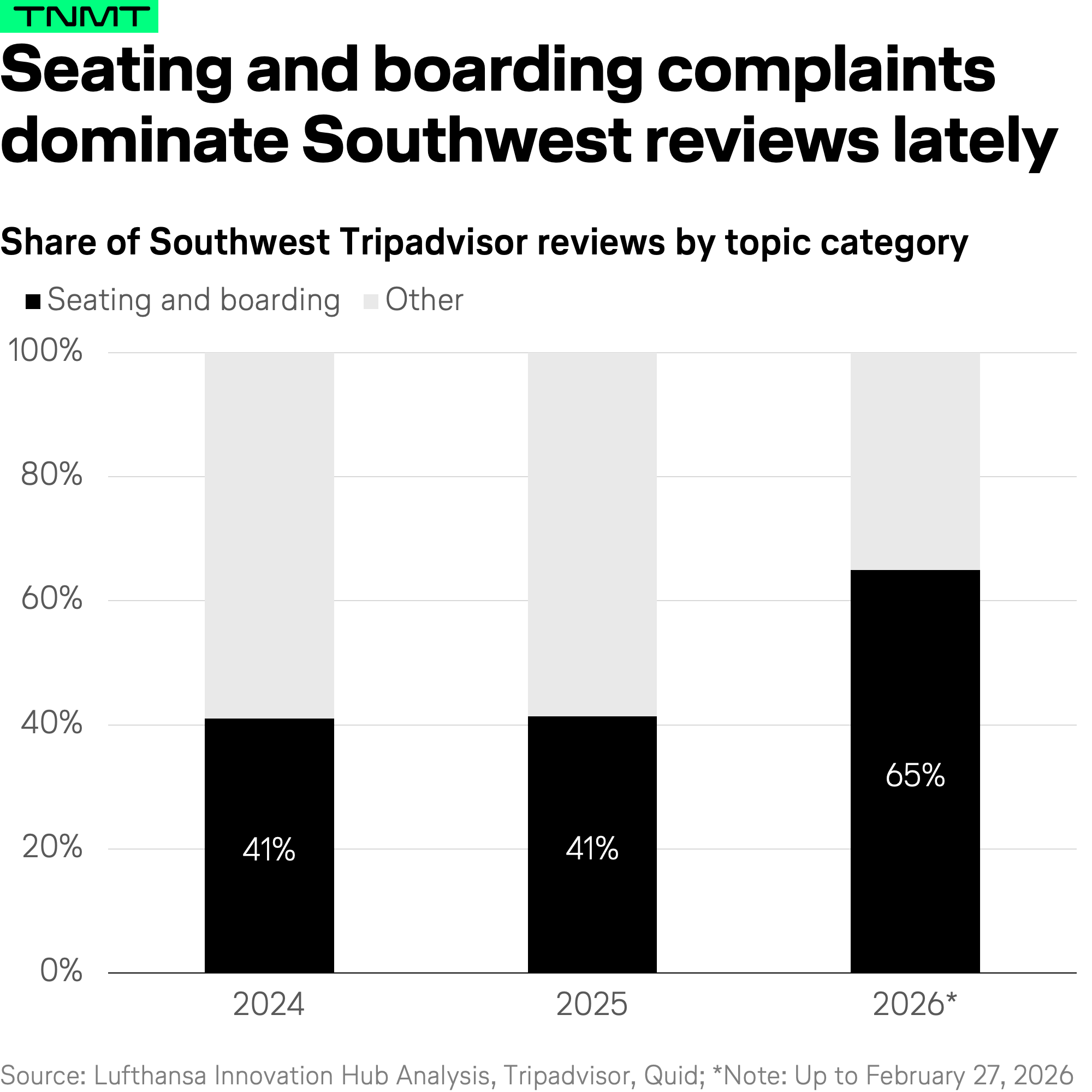
When we clustered review content, nearly two-thirds of all reviews in 2026 directly reference frustrations around seating and boarding.
And when you read those reviews in detail, the stories are remarkably consistent.
- Families are complaining about being split across rows by automated seat assignments
- Passengers unable to move to empty seats (even on half-full flights)
- And growing frustration around overhead bin access, with travelers reporting chaotic boarding and uncertainty over where to store their luggage
Together, these issues created a level of rigidity that felt unfamiliar to longtime Southwest customers.
To be fair, Southwest did respond.
Last month, the airline announced a series of adjustments, including revising the boarding group logic to improve overhead bin access, retrofitting larger bins across 70% of the fleet, and installing new signage to designate bin space for premium seats.
But here’s the thing: None of these changes gave customers back what they originally valued.
What markets had to say
However, if you look at a different kind of “reaction”, the picture looks very different.
Unsurprisingly, Wall Street loved it.
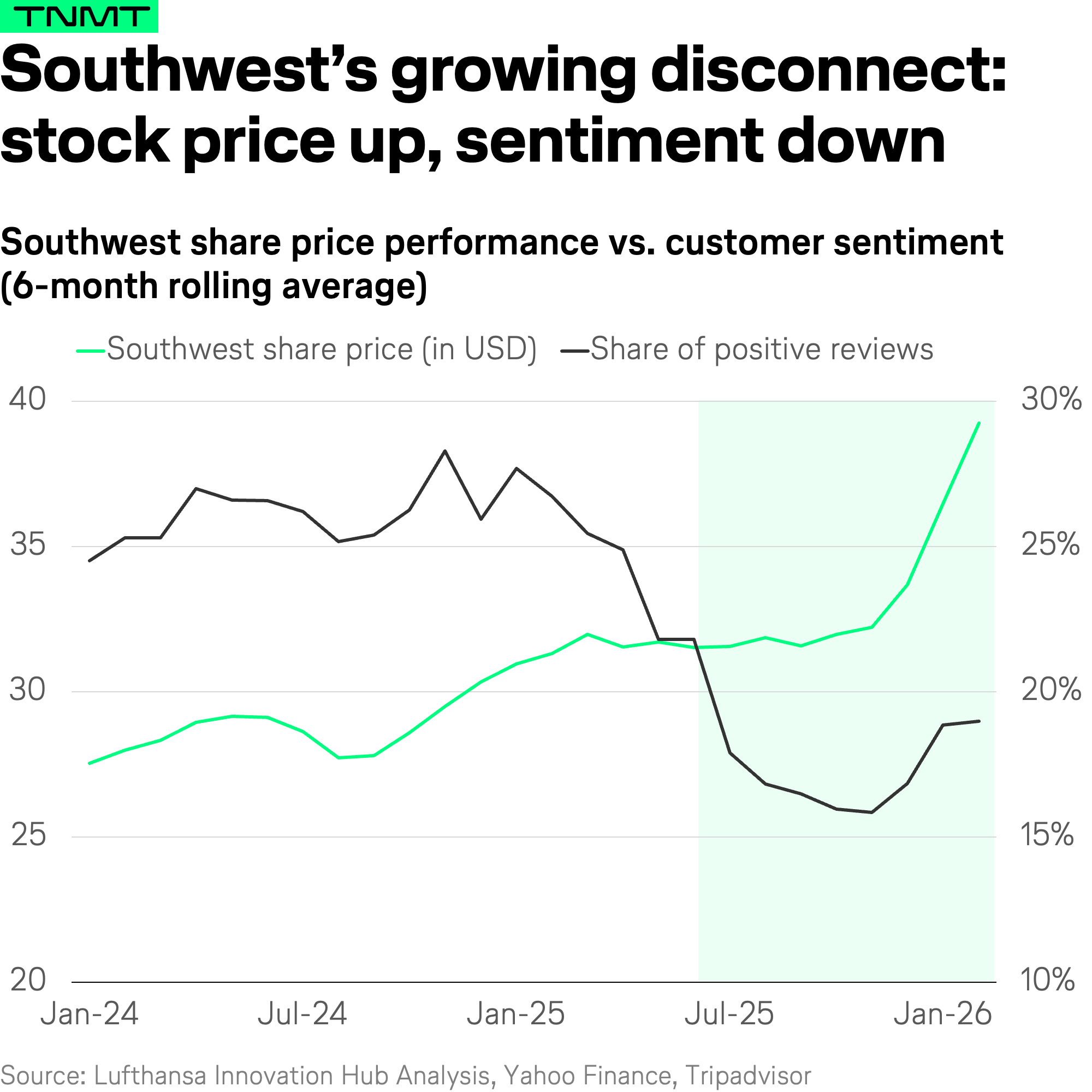
- Following its January 2026 earnings call, Southwest’s stock surged, up 23% year-to-date.
- Management guided EPS to more than quadruple in 2026, significantly beating expectations.
- At its peak in early 2026 (before geopolitical impacts), Southwest’s share price was roughly 2x its three-year average.
In other words:
- Customers pushed back. Investors leaned in.
- Or put differently: The product got worse. The stock got better.
With that chart in front of us, it’s tempting to say: maybe the strategy is working. Because, ultimately, every executive’s #1 job is to create shareholder value, right?
Well, not so fast.
The wrong scoreboard
For a more nuanced assessment, we need to zoom out.
One quarter of stock performance is a dangerous basis for judging a strategy.
- If there’s any environment where sentiment can flip overnight, it’s the stock market.
- Today’s rally can quickly become tomorrow’s correction.
In our view, the more important question is this:
How much long-term customer value did Southwest trade away to boost short-term earnings?
Because this pattern isn’t unique.
Across the airline industry, many leaders tend to prioritize immediate financial gains over long-term differentiation and innovation.
One example you’ll be familiar with if you regularly read TNMT: the limited use of startup investments as a strategic tool.
- Yes, these technology bets take years to materialize.
- But once they do, they can create a true competitive moat (one that defends and differentiates your business for years).
When it comes to customer experience, the same long-term dynamic applies.
And while the impact of startup investing is often hard to measure, the link between customer experience and financial performance is not. According to Watermark Consulting, airlines that lead in customer experience significantly outperform those that don’t.
Looking at a 13-year period from 2011 to 2023:
- Customer experience leaders delivered a +92% cumulative stock performance.
- Customer experience laggards saw their performance decline by 43%.
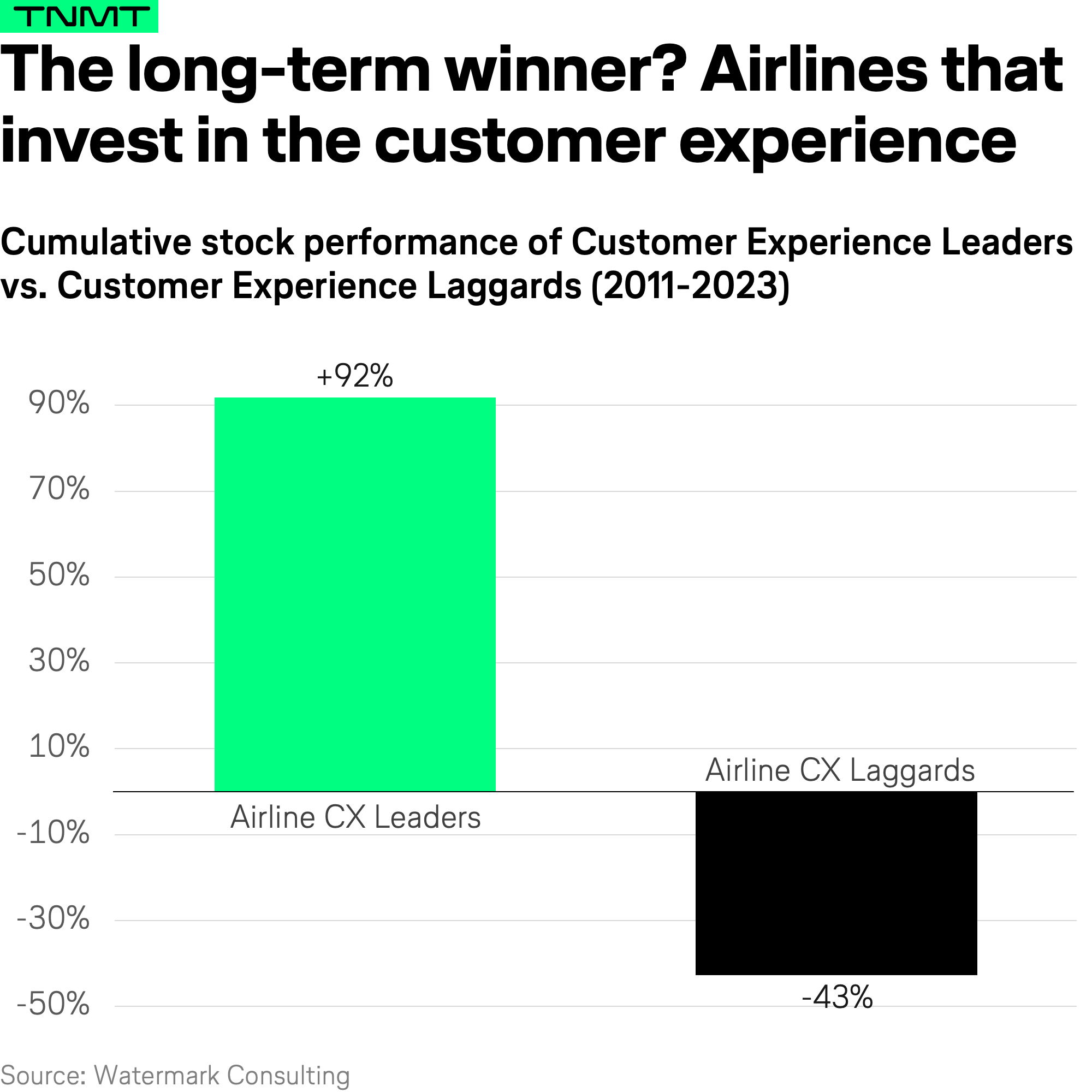
That’s the real benchmark. Not one quarter. Not one earnings call. But sustained performance over time.
And it puts Southwest’s current strategy into perspective.
- Because the real test isn’t whether the stock goes up today.
- It’s whether customers still care tomorrow.
This is ultimately a story much bigger than Southwest.
Too many airline decisions today are driven by short-term optimization, especially when it comes to product, experience, and innovation.
And that’s one of the reasons the industry increasingly looks like a commoditized market.
Revenue might show up this quarter. But the true impact (positive or negative) often takes years to unfold.
And by then, it may already be too late to reverse course.