
It’s October 1st.
Which means Q4 has officially begun.
That makes this the perfect moment to continue the performance review of our 10 Wishes for Travel in 2026.
A quick reminder for anyone who missed the original report:
- At the beginning of the year, we deliberately published wishes, not predictions, for this year.
- Predictions ask what we think will happen. Wishes force us to take a position on what the travel industry should deliver, where its potential remains unrealized, and which gaps have become too important to ignore.
In our last edition, we revisited Wish #1: that airlines should treat in-flight connectivity as more than faster Wi-Fi and start viewing the connected cabin as a platform.
In case you missed it, you can catch up here.
Today, we’re moving on to the second wish we consider particularly critical:
Wish #2: The industry should treat agentic commerce not as a competitor to NDC, but as a new supply-side infrastructure.
Our hypothesis:
The winners in future flight distribution will build both layers in parallel.
- NDC and ONE Order create structured, dynamic airline offers.
- Agentic infrastructure makes those offers discoverable, comparable, and bookable by AI agents.
In other words: modern airline retailing is not competing with agentic flight booking. It is what makes agentic flight booking possible.
So how much has the industry progressed over the past nine months? Let’s break the wish into several parts, starting with the most foundational question:
Is AI becoming relevant enough in travel for any of this to matter?
That one is easy to answer.
- Travel is already one of the sectors experiencing the fastest growth in AI-driven traffic.
- According to Adobe, visits from AI sources to travel websites increased 119% year over year in July 2026, compared with 62% in retail and 31% in financial services.
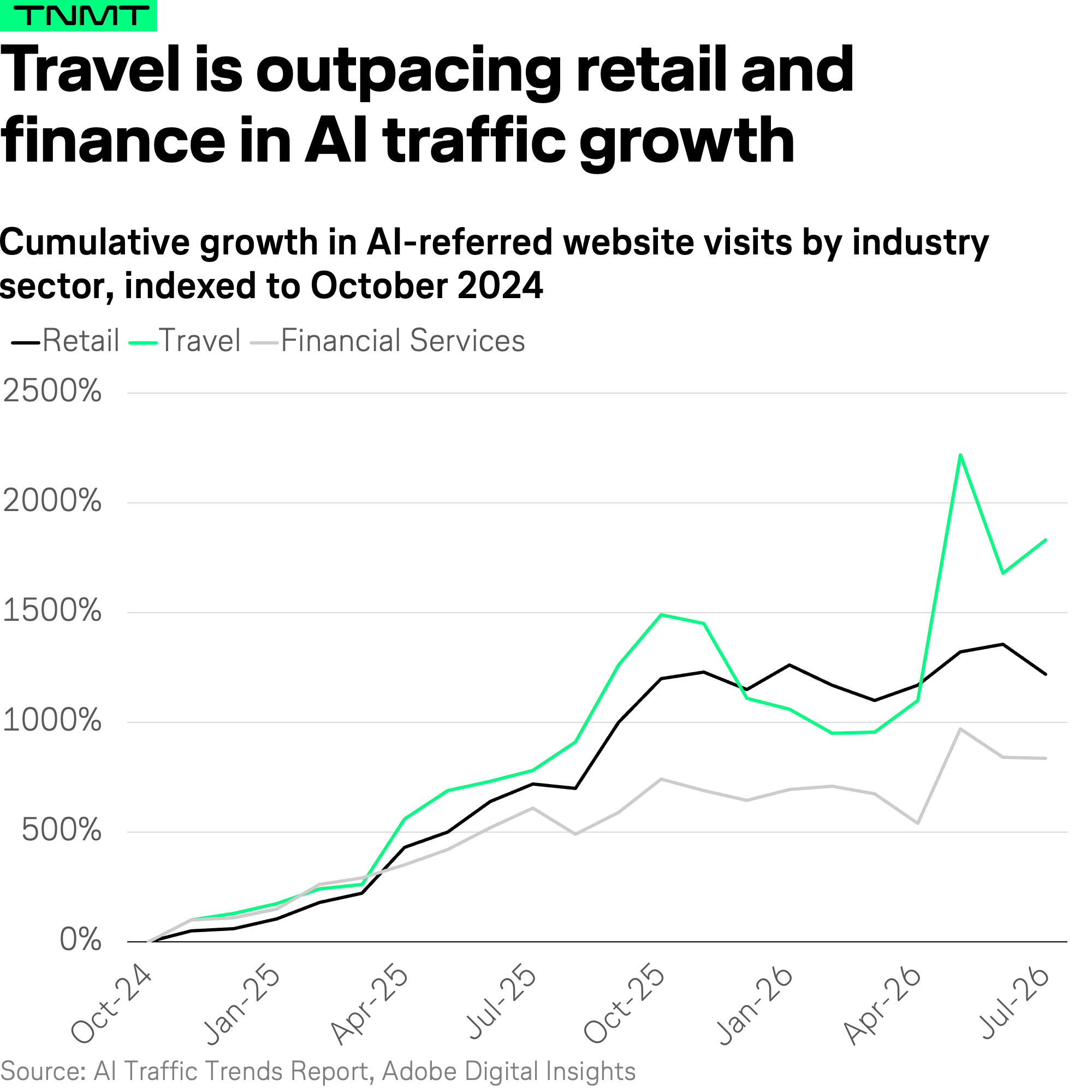
This does not mean that travelers are already completing most bookings through autonomous agents.
But it does show that AI is rapidly becoming an important discovery layer between consumers and travel brands.
- Travelers increasingly use AI assistants to research destinations, compare options, plan transportation, and narrow down their choices before arriving on a supplier or intermediary website.
- Adobe also found that 84% of surveyed travelers felt AI assistants improved the trip-planning experience.
So the demand side is definitely moving!
How about the supply side
The harder question is whether the industry’s supply-side infrastructure is keeping up.
Here, the progress report gets trickier. Regular TNMT readers may already anticipate the point we are about to make.
We have referenced Bain’s research before, but it remains one of the clearest real-world tests of airline readiness for AI-driven discovery and booking.
- Bain prompted three major LLMs to search for flights across ten important European markets.
- The models accessed airline websites directly only around 5% of the time.
- OTAs appeared far more often, and even when an airline ranked among the best options, travelers were often sent to an intermediary rather than the airline’s website.
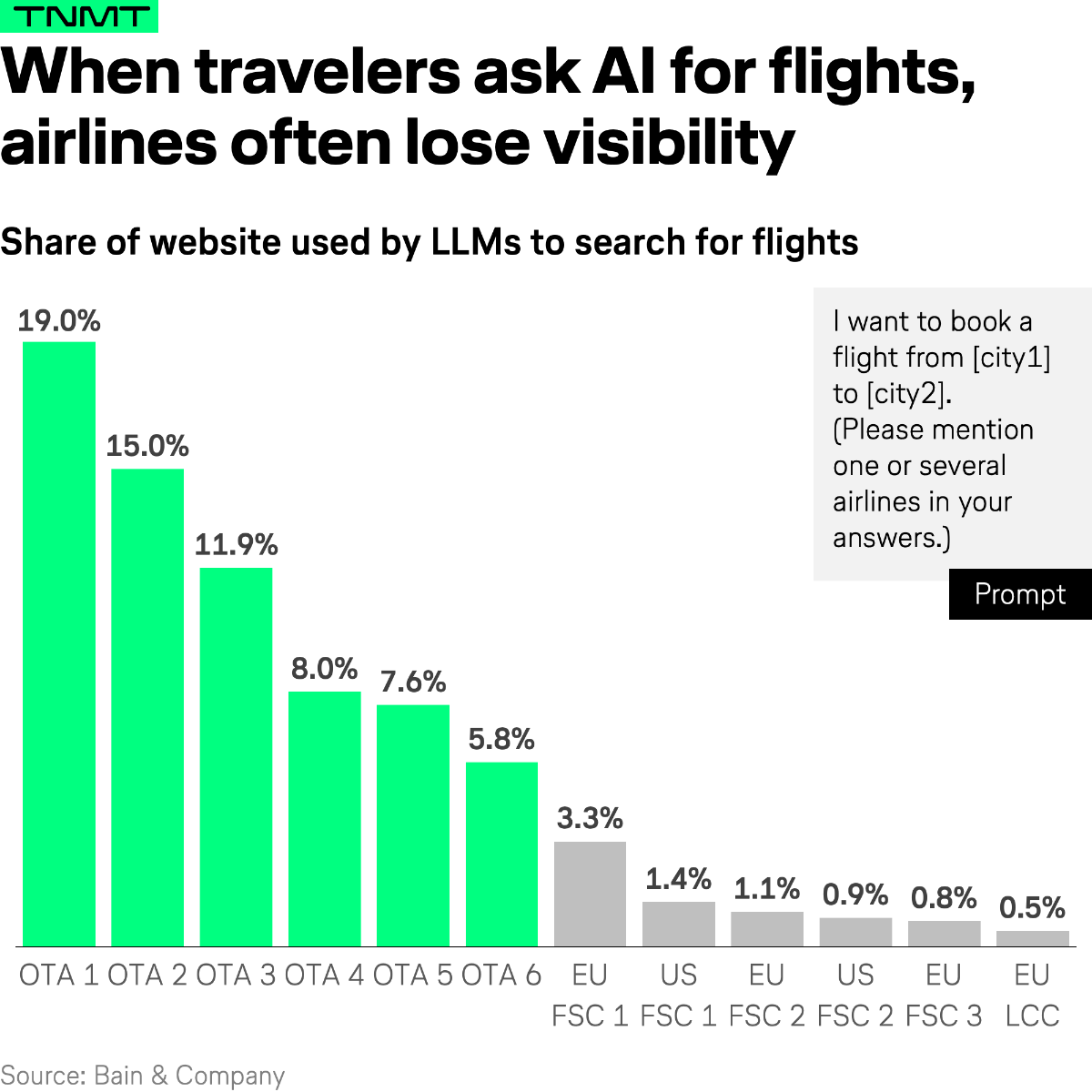
The reason?
OTAs currently provide cleaner, more structured, and more agent-readable information. Airline websites remain only partially visible to AI systems.
Adobe’s latest research confirms the same pattern from a different angle. Its AI Citation Readability score measures how easily AI models can understand and surface website content.
- Airline homepages scored just 42%, compared with 71% for hotel homepages.
- Airline flight and route pages perform somewhat better at 59%. But the score drops to only 37% for airline booking and reservation pages.
What that means: airlines become the hardest for AI to read precisely where the transaction begins.
That is the supply-side bottleneck.
Travelers are increasingly beginning their journeys inside AI interfaces, while most airline digital stacks remain optimized primarily for humans.
OTAs have a structural advantage, as standardized inventory, comparison logic, and transaction layers are their core product.
Airlines, meanwhile, often expose only fragments of the full offer to machines. Think of a schedule here, a fare there, but not always the seat, baggage allowance, ancillary bundle, or servicing logic needed to evaluate the complete product.
Which brings us back to our wish.
Connecting NDC with AI
Modern airline retailing may create structured offers. Agentic infrastructure must make those offers understandable and transactable for machines.
Sabre’s latest announcement provides a concrete example of how those two layers can work together.
- The company provocatively frames MCP as “the new NDC.” But its actual approach supports our hypothesis: NDC and agentic commerce are being developed in parallel, not as competing roadmaps.
- NDC and Sabre Mosaic structure airline content, offers, and orders. Sabre’s MCP server then acts as the connective layer that allows AI agents to shop, book, and increasingly service that content.
Sabre says nearly 80 customers are already piloting or using its MCP server in production.
Based on these publicly visible deployments, Sabre appears to be among the travel-tech players furthest along in connecting modern airline retailing with agentic commerce.
The question is whether the rest of the industry has started connecting those two layers.
The uncomfortable truth: airlines, as a group, are still lagging behind. Instead, tech companies are mostly building the rails that let AI agents discover products, access live inventory, and eventually complete transactions.
Google is one of the clearest examples.
- Its Universal Commerce Protocol is an open standard that lets AI agents discover products, check availability, and transact across merchants.
- Google has since expanded that logic into lodging, and by late August, travelers in the U.S. could book hotels inside AI Mode through partners including Booking.com, Expedia, Hilton, Marriott, and IHG.
Meta has entered the same race with Muse, its new personal AI agent. Two details make it particularly relevant:
First, it reached consumers remarkably fast.
- Muse climbed to the top of the U.S. App Store within its first two weeks.
- Apptopia estimates that it generated 1.8 million iOS downloads in the U.S. and Canada during its first 12 days, compared with 1.3 million for ChatGPT over the same period after its mobile launch.
Second, its flight-booking model combines APIs with browser automation.
- Where possible, Muse books through Duffel’s flight API. Where that connection is unavailable, it navigates the airline’s own website, completes the booking flow, and adds loyalty details along the way.
- The upside is reach: almost any airline with a functioning booking page can theoretically become bookable from day one.
The downside is fragility.
- Muse only knows what the website exposes, so browser flows can break, and suppliers can close the door entirely.
- Amazon demonstrated exactly that when it blocked Muse from accessing its marketplace.
So Muse offers a useful live comparison of two agentic paths: structured, permissioned API access versus broad but fragile browser automation.
Beyond those tech companies, hotel groups are also moving quickly towards agentic booking.
- Accor launched an ALL Accor app inside ChatGPT in January, giving users access to hotel information, public rates, and loyalty-member pricing before handing them over to Accor to complete the reservation.
- Marriott followed with Ask Bonvoy, a conversational search experience embedded in its website and app, which is powerful because Marriott uses AI to improve discovery while keeping customers in an owned channel.
- Radisson launched a ChatGPT app with Accenture that provides live rates, availability, amenities, and property information across more than 1,000 hotels, then directs users to Radisson’s booking flow.
- And Wyndham has connected its inventory to Claude, ChatGPT, and Google’s AI Mode. Its CEO put the technical connection cost at less than $100,000 USD. Compared with the commissions hotels routinely pay OTAs, the direct-booking logic is fairly easy to understand.
A couple of travel intermediaries have moved even further:
- Skyscanner now brings conversational flight search into ChatGPT, while Sabre, PayPal, and Mindtrip announced what they called the industry’s first end-to-end agentic travel-booking experience.
- Mindtrip handles the customer interaction, Sabre supplies travel inventory, and PayPal manages identity and payment.
In all fairness, we should notice the pattern, though.
Most of these examples still stop short of a fully agentic transaction. The AI helps travelers search, compare, and narrow down options, but then hands them over to a website to finish.
But one of these initiatives promised to connect the entire journey, from conversation to payment, without that handoff.
It deserves a closer look.
The Mindtrip AI case
That initiative is Mindtrip Flights, the flight-booking layer Mindtrip launched in May.
- The company had already built a conversational AI trip planner.
- Flights extended that experience into live flight search, comparison, and checkout.
In other words, Mindtrip was promising something most AI travel tools still cannot deliver: a continuous journey from natural-language request to payment.
Naturally, we put it to the test.
Our brief was this: “Berlin to Lisbon. A long weekend in October. One adult. Nonstop preferred. Best value, including a checked bag.”
- Nine seconds later, Mindtrip returned a clear recommendation: Eurowings nonstop in both directions, including baggage, for €724.
- It also presented a cheaper alternative via Stuttgart for €541 and framed the trade-off in plain English: “Nonstop no matter what, or the lowest total price with a bag?”
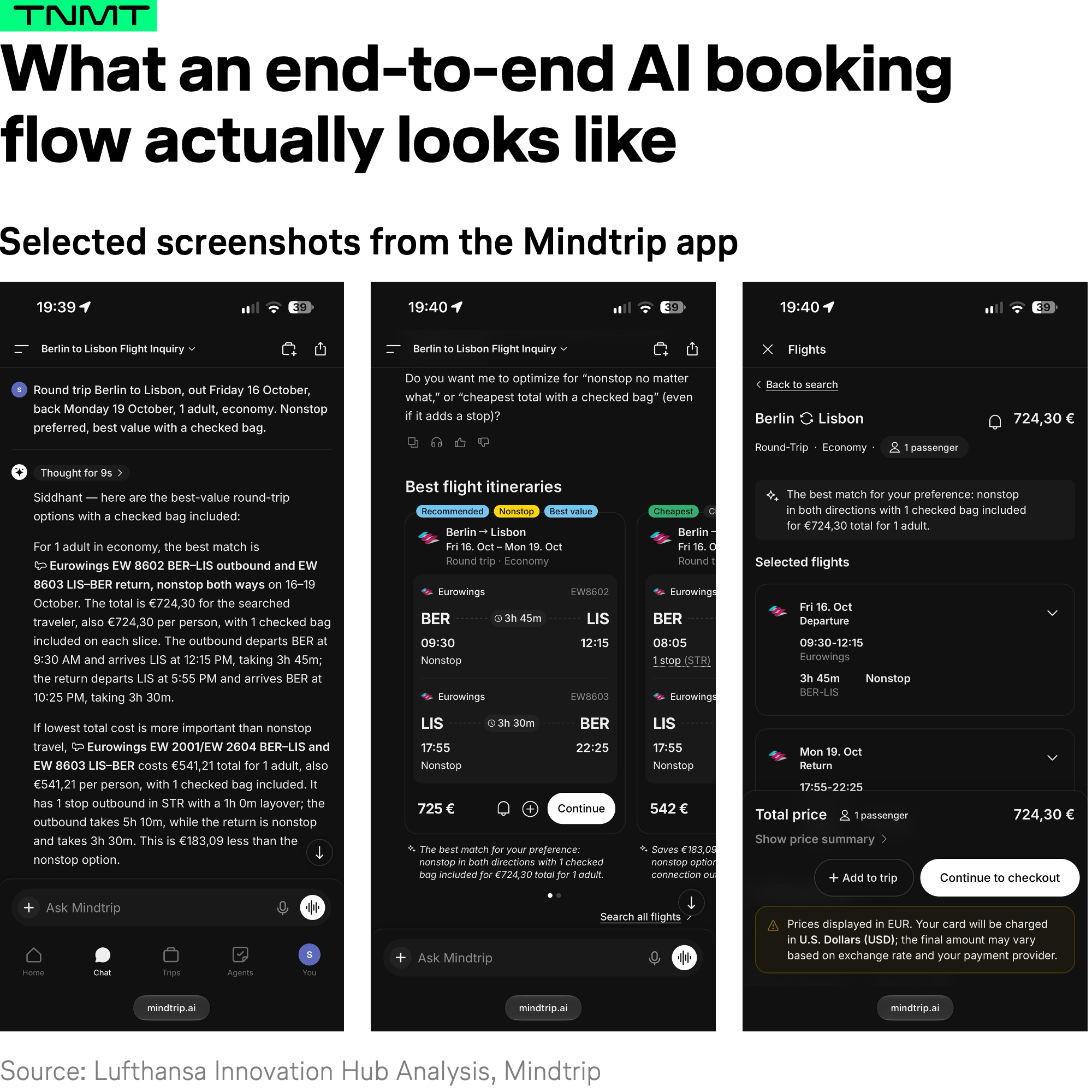
That is the key difference.
Instead of presenting a hundred-row results page and asking us to do the work, Mindtrip interpreted the request, narrowed the options, and asked the follow-up question a good travel agent would ask.
Then came the part most AI travel tools still avoid: checkout.
- The flow allowed us to add special service requests and loyalty details before moving directly to payment.
- Fewer than five minutes after entering the original prompt, we were ready to complete the transaction.
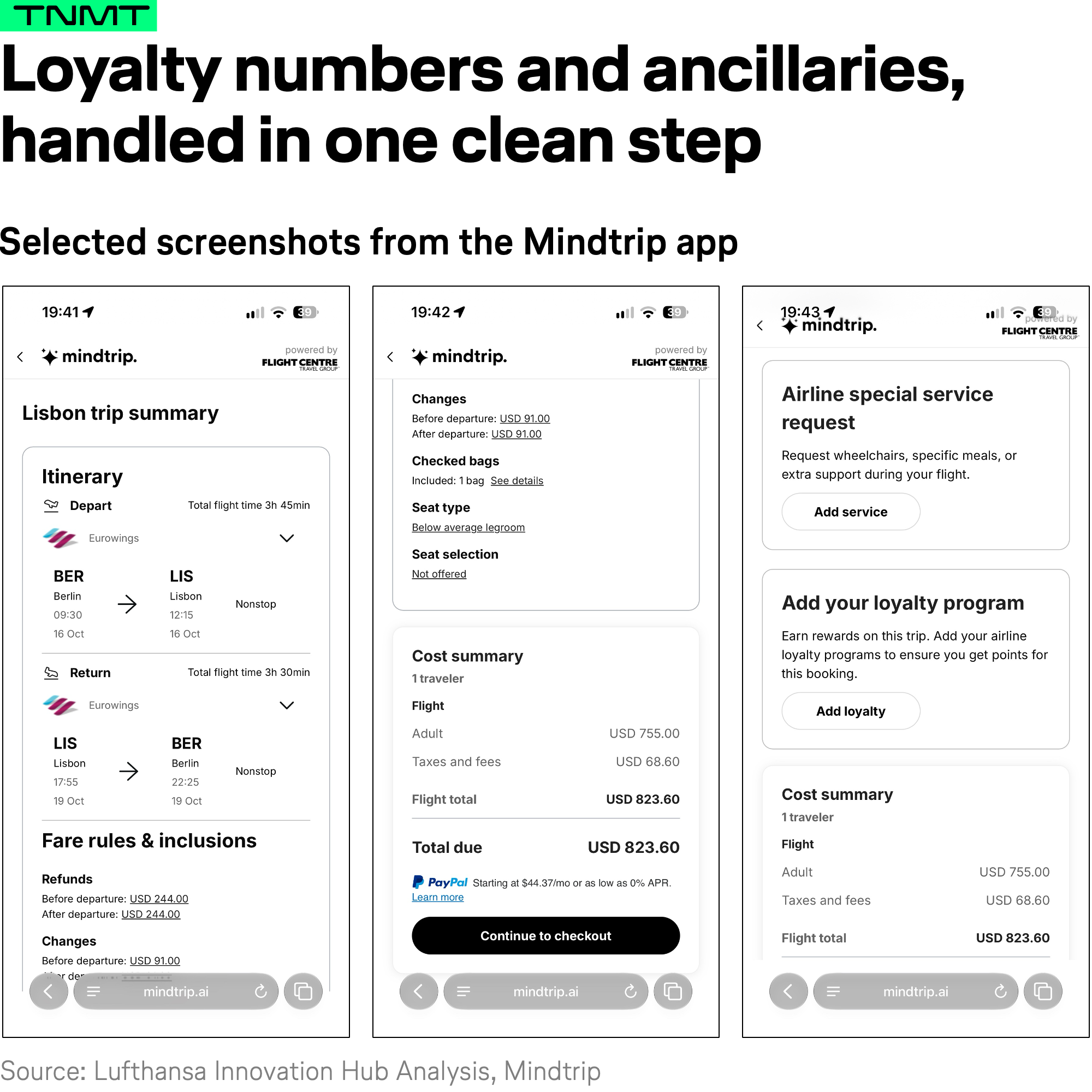
Overall, it felt seamless and surprisingly close to a modern e-commerce checkout.
This is the most complete agentic flight-booking flow we have seen so far.
And travelers appear to respond positively.
- Mindtrip told us that conversational engagement among registered users has increased by 50% since Flights launched.
- New users arriving through Flights are also twice as likely to engage and twice as likely to return after 30 days.
With flight-price alerts and the launch of its brand-new personal travel assistant now live, the loop is becoming increasingly complete:
- First you search. Then you compare. Then you book, or, if not, monitor the fare.
- It is essentially the traditional OTA playbook rebuilt around a conversation.
And for now, Mindtrip may be the closest thing travel has to an AI-native OTA.
Which brings us back to airlines.
Airlines need to become agent-ready fast
The honest conclusion from our progress review is that airlines are not moving fast enough for an interface that could fundamentally reshape the customer relationship.
Yes, hotels arguably have an easier starting point. A room is a simpler product than a flight itinerary involving fare rules, seats, baggage, ancillaries, connections, loyalty benefits, interline partners, and post-booking servicing.
But complexity is an explanation. It is not a strategy.
If tech platforms, hotel groups, and intermediaries become agent-ready first, airlines risk remaining difficult to find, understand, and book precisely as travelers move toward AI-driven discovery.
Fortunately, there are a couple of exceptions.
- Virgin Atlantic became the first airline to launch an app inside ChatGPT in April. Travelers can search through natural-language requests before being handed over to Virgin Atlantic’s website or app to complete the booking.
- Sabre says its MCP server is already powering agentic shopping, booking, and servicing capabilities for customers including Virgin Australia, with applications live inside ChatGPT and Claude.
Progress is also visible deeper in the supply stack.
- Our parent company, Lufthansa Group, committed nine airlines to Amadeus Nevio’s modular Offer, Order, and Delivery infrastructure in January.
- Finnair created the world’s first native Order and later became the first airline to implement a fully Offer-and-Order-based NDC solution through Nevio.
These are all important signals.
But they are not yet an industry-wide response.
So what should airlines do?
We won’t pretend the full answer fits inside the final section of a newsletter.
But our recent scenario analysis on the future of agentic flight booking points toward three immediate priorities.
First, own the doorway.
- Build an airline-controlled access layer, using MCP or an equivalent standard, that connects AI agents to authoritative NDC and Offer-and-Order capabilities.
- This way, agents can read the airline’s actual fare rules, availability, seat maps, and servicing logic, rather than an intermediary’s incomplete rendering of them.
Second, decide who gets in.
- Airlines need policies governing which agents are authorized, what they may access, how traveler identity and loyalty status move through the interaction, and which actions require explicit customer approval.
- Opening the door does not mean leaving it unlocked.
Third, fix AI visibility.
- An MCP server will not solve the problem if the airline’s public content remains difficult for models to interpret.
- Web pages, route information, fare conditions, loyalty rules, and product descriptions must become structured and machine-readable.
- If AI systems cannot understand the airline’s offer, the offer may as well be invisible.
The definition of a direct channel is therefore changing. Airlines may not own the conversational interface through which travelers begin shopping. But they can still own the offer and the transaction.