We need to talk more about robotics in aviation.
How come?
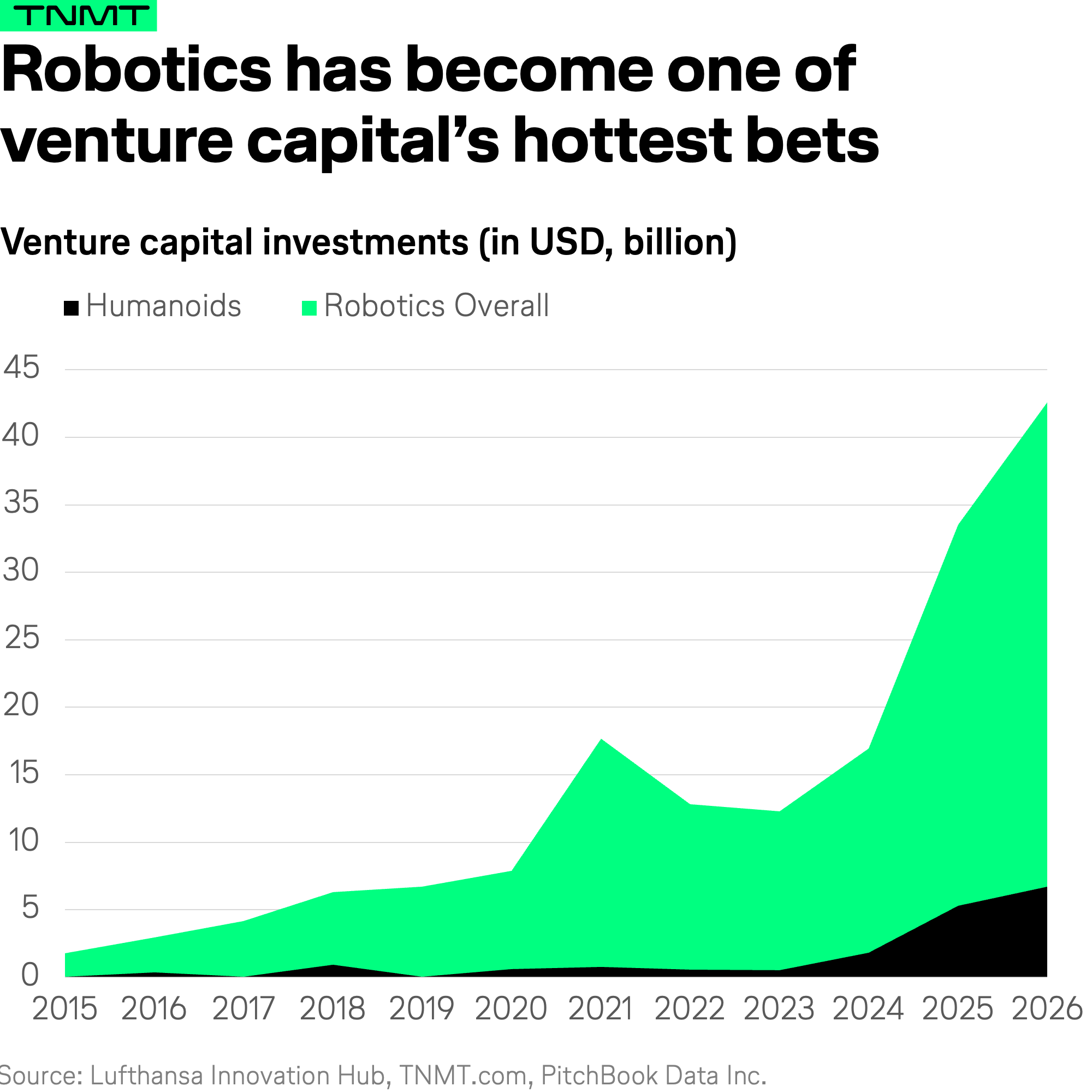
Across the broader startup ecosystem, investor appetite for robotics has grown rapidly. Venture capital funding in 2026 has already reached record levels, driven by advances in physical AI, falling hardware costs, and the growing pressure to automate physical work.
One recent proof point comes from China.
- Hangzhou-based Unitree Robotics (known for its agile robot dogs and high-speed humanoids) raised roughly $900 million USD in its Shanghai IPO last week.
- Its shares closed more than 460% above their offer price on the first day of trading.
Now, if all this sounds like speculative money chasing humanoid scenarios years into the future, let’s look at actual deployment.
- More than 540,000 industrial robots were installed worldwide in 2024, more than twice the annual number recorded a decade earlier.
- Annual deployments have now exceeded half a million units for four consecutive years.
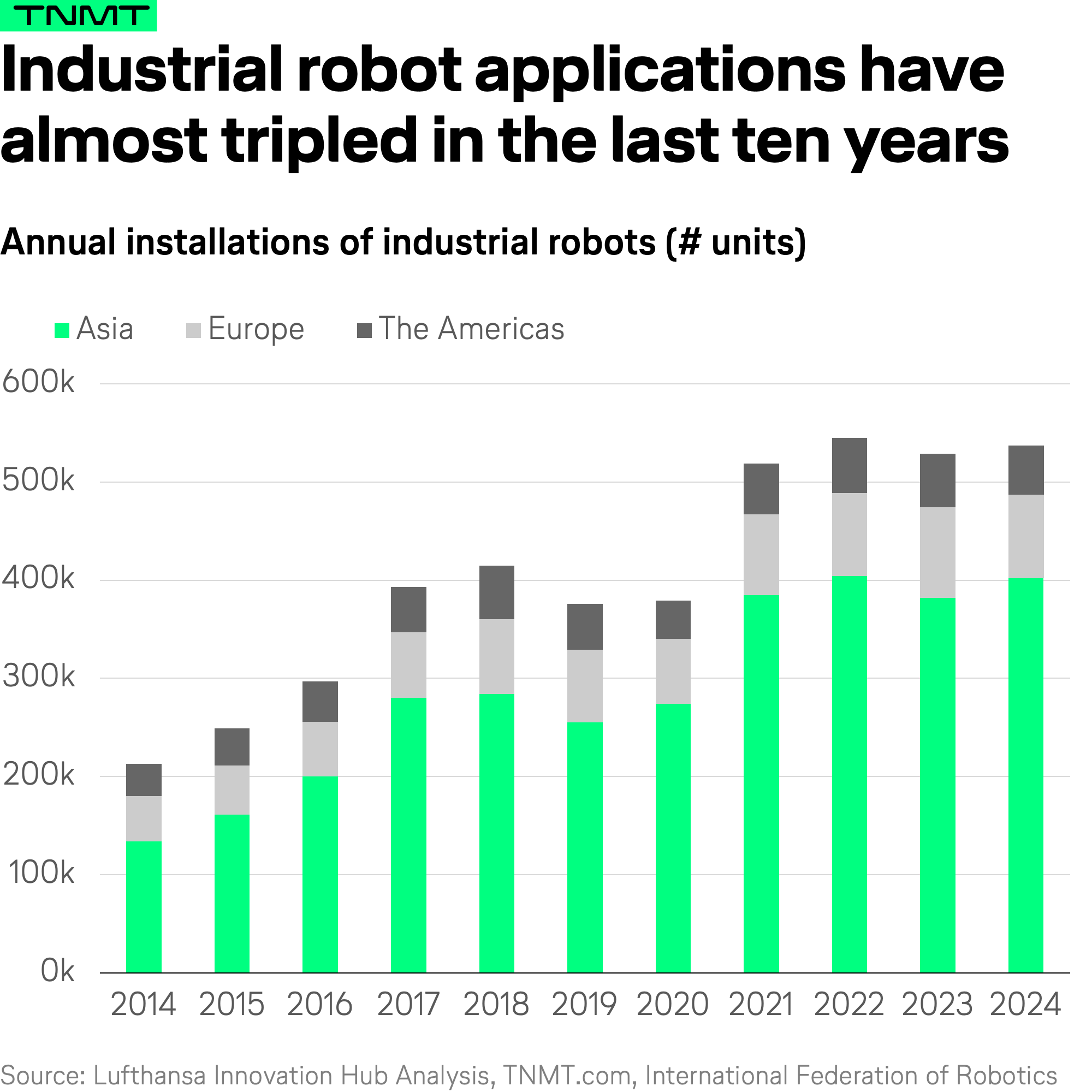
The key insight here: Robotics has moved from technology showcases to factory floors at remarkable speed.
So how does aviation compare?
Much less enthusiastically.
- The last comparable SITA benchmark found that only 18% of airlines planned major programs involving robotics and autonomous machines this year.
- Robotics ranked near the bottom of the industry’s technology priorities, far behind AI and business intelligence.
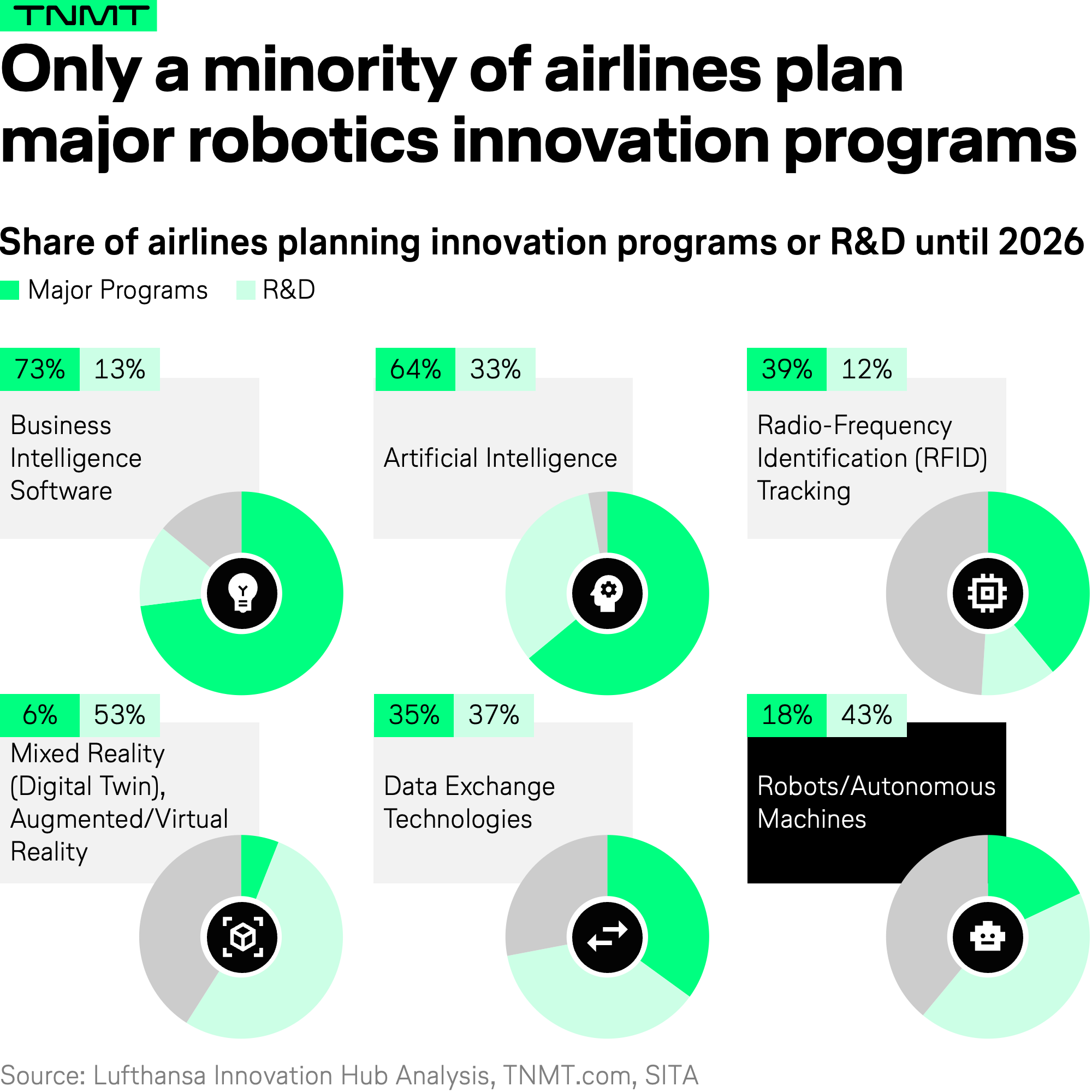
We think that gap deserves much more attention.
Airline and airport operations face a structural workforce challenge, particularly across physically demanding ground activities.
The aviation industry is trying to accomplish all of this with a workforce already under pressure:
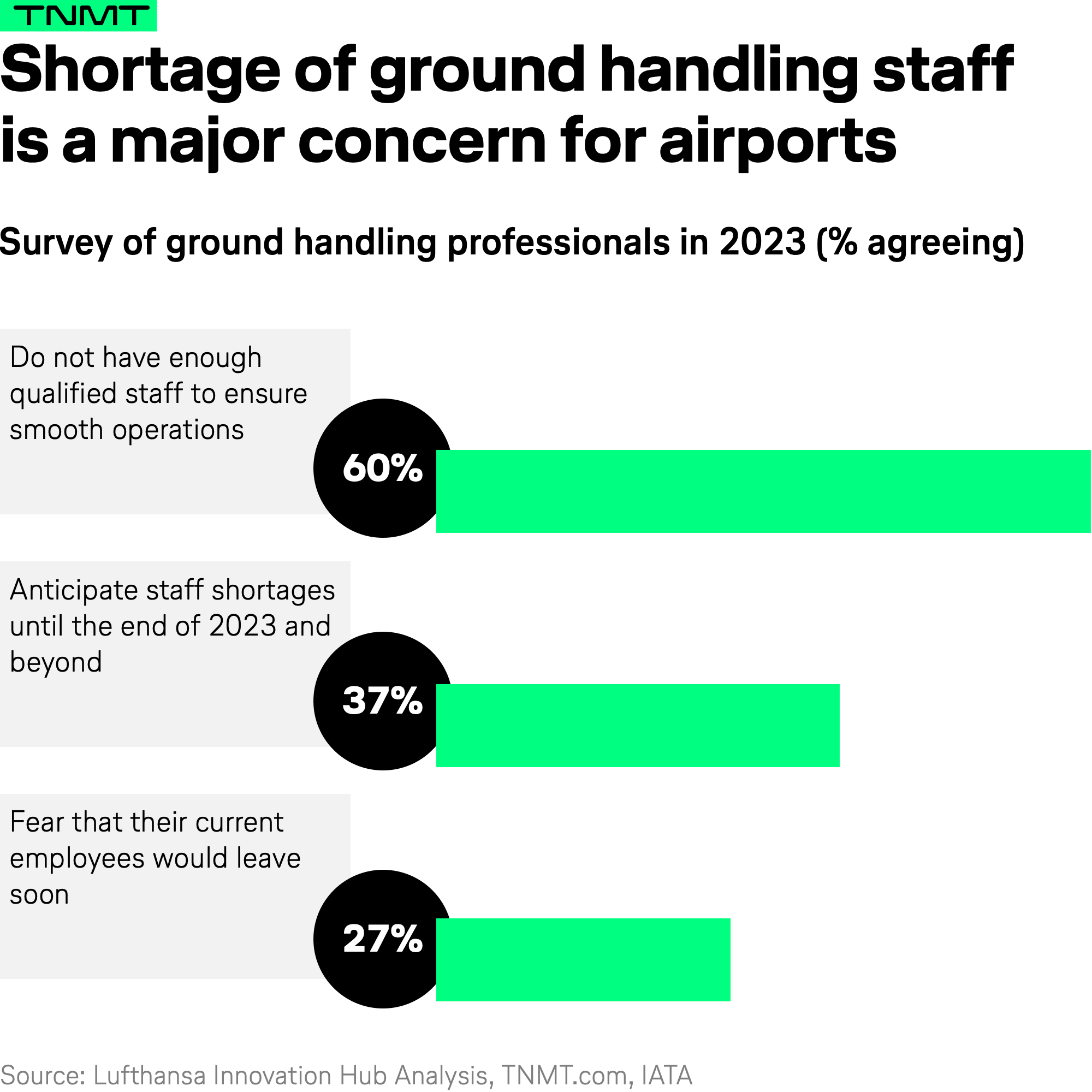
- OAG estimates a current shortfall of roughly 32,000 skilled aviation workers, with further retirements expected to widen the gap.
- IATA reported in 2023 that 60% of airports lack sufficient qualified personnel to ensure smooth operations.
Now, let’s be clear. Robotics will not remove the need for human personnel.
But it can support them, take over repetitive or physically demanding work, and allow scarce skilled employees to focus on tasks that genuinely require human judgment.
It is increasingly difficult to imagine aviation solving its workforce problem without significantly more automation.
So which robotics applications could matter most for airline operations?
It depends on which time horizon you look at.
Before we jump into the more long-term examples, we should give credit where it is due.
Aviation has already deployed several meaningful robotics applications, particularly across Asia’s airport ecosystem.
The important distinction is that most of these systems perform narrow, repetitive tasks in very controlled environments.
- Hong Kong International Airport is one of the frontrunners. It reportedly operates more than 70 driverless vehicles, including baggage and cargo tractors, patrol vehicles, and staff shuttles.
- Changi Airport has also deployed fully driverless autonomous tractors for airside operations, following nearly a year of trials and more than 5,000 test trips.
- And at Lanzhou Zhongchuan International Airport in China, 86 autonomous, remotely operated boarding bridges have been deployed across the facility, reportedly improving docking efficiency by 65%.
These examples show that the first wave of airport robotics is already real.
But adoption remains very concentrated in a limited number of airports, regions, and clearly defined tasks.
Our five examples today look further ahead.
They are deliberately bold, visually impressive, and perhaps slightly optimistic.
None belongs on an airport-wide procurement list for next quarter.
But that is precisely why we selected them.
Consider this our slightly futuristic robotics wish list (not an immediate deployment guide).
1. Humanoids adapt to the airport, not the other way around
Our first example comes from Japan Airlines, which began testing humanoid robots for ground-handling work at Tokyo Haneda Airport in May.
- During the two-year trial, Chinese-made robots supplied by GMO AI & Robotics are initially being used to load and unload cargo containers.
- JAL ultimately hopes to expand their role into areas such as cabin cleaning and the operation of ground-support equipment.
The motivation is easy to understand. Japan’s aviation sector is facing rising passenger volumes alongside a rapidly shrinking working-age population.
JAL alone employs around 4,000 ground-handling workers, making any technology that can reduce the physical workload increasingly relevant.
But the most interesting part is not what these robots can do today.
Judging by the early footage, that still appears fairly limited and rather slow.
Their real advantage is their form.
Airports and aircraft were designed around human bodies.
- Humans walk up ramps, climb stairs, move through narrow aircraft aisles, pick up irregular objects, and operate equipment built for hands.
- A humanoid robot can theoretically work within that existing environment without requiring airports to redesign every process around a specialized machine.
In other words: if you cannot change the infrastructure, change the robot.
Will JAL’s trial prove that humanoids are ready for meaningful ground operations?
That is much harder to say. Two years is not a particularly long window for solving a robotics challenge that engineers have been working on for decades.
For now, the machines still seem better at waving slowly to their human colleagues than replacing them.
But they can also dance, so clearly the foundation for airline operations is there.
2. The vacuum cleaner enters baggage handling
Our second example comes from Journey Robotics, a Pittsburgh-based startup testing its robotic baggage-handling platform through Pittsburgh International Airport’s xBridge program.
The company was also selected for IAG’s accelerator and received $250,000 USD to expand its prototypes.
Its first target is unloading baggage.
The robotic arm uses what CEO Reeg Allen calls “vacuum like a hand” technology: suction combined with gripping mechanisms and computer vision.
The prototype can handle bags weighing between 5 and 80 pounds and currently unloads around six per minute from cargo containers.
That may sound straightforward. It is anything but:
- Bags come in different shapes, sizes, materials, and weights.
- Robots then need to move them between containers, belts, carts, and aircraft holds.
- Robots perform best in standardized environments. The baggage journey is definitely not one of them.
Journey Robotics is one of several startups, alongside Azalea Robotics and Cobot Lift, betting that suction could finally solve this problem.
After decades of robotics research, the breakthrough may have been sitting in the household vacuum aisle all along.
Perhaps we would have found it sooner if more engineers had helped with the housework. Male engineers, take note.
3. The robot you wear
Our third example takes a different approach: instead of replacing baggage handlers, it gives them robotic support.
Since July, Maastricht Aachen Airport has equipped cargo handlers with German Bionic’s AI-powered EXIA exoskeleton.
Sensors analyze lifting movements in real time and provide adaptive back support of up to 38 kilograms, while still allowing employees to move naturally across the apron and cargo warehouse. Think less Iron Man, more highly intelligent back brace.
That may sound less spectacular than a humanoid robot, but it tackles a very real problem.
A large Copenhagen Airport study found that baggage handlers face an elevated risk of lower back pain, with the risk increasing with years on the job.
The category is also gaining momentum.
- IAG recently invested in Verve Motion and plans to test an aviation-specific exosuit focused initially on shoulder support for baggage handlers.
- JAL has experimented with comparable wearable devices since 2019.
Of our three examples so far, this may be the least futuristic.
It may also be the closest to broad deployment, because the goal is not to remove humans from ground operations but to help them perform physically demanding work more safely and for longer.
4. Change the infrastructure, or change the robot?
Our fourth example comes from Schiphol, KLM, and NEURA Robotics.
Together, they developed A.R.C., short for Autonomous Robot for GPU Connecting, to automate the connection of aircraft to ground power.
The task sounds simple: pick up a cable and plug it into the aircraft.
In reality, it really isn’t.
- A.R.C. must navigate a busy apron, avoid moving obstacles, identify the correct aircraft panel through computer vision, operate its buttons, drag a cable weighing up to 45 kilograms, and insert it precisely into the socket.
- Even the cable’s position created problems during testing. Because it initially entered the robot’s safety zone, A.R.C. refused to move. The team eventually suspended the cable from above, creating enough clearance for the robot to drag it safely.
For now, this is still a proof of concept.
But the physical pain point is real.
Large hubs connect dozens of aircraft to fixed or mobile ground-power units during peak periods, requiring handlers to repeatedly move extremely heavy cables across the apron.
Interestingly, maritime operators have been working on a similar challenge for years.
- ABB introduced an automated shore-power connection robot for ferries as early as 2016.
- The shipping sector, however, has generally focused more heavily on standardizing the shore-side infrastructure and designing harmonized charging stations that vessels can easily plug into after docking.
That brings us back to a recurring robotics question:
Do you redesign the infrastructure, or build a robot capable of navigating the existing infrastructure?
At Schiphol, A.R.C. is clearly a bet on the second option.
And given the cost and complexity of standardizing aircraft and airport infrastructure globally, changing the robot may ultimately prove the more pragmatic route.
5. The aircraft car wash, scaled up
Our final example concerns a less glamorous but unavoidable task: washing aircraft.
And this is about more than keeping the livery Instagram-ready.
- Dirt, oil, insects, and other residue can increase drag, fuel consumption, and corrosion.
- Manual cleaning is also labor-intensive. At AISATS, the Air India–SATS ground-services joint venture in India, washing one aircraft traditionally required close to ten employees working for several hours, using elevated platforms and more than 1,000 liters of water.
Robotic systems from companies such as Aerowash and Nordic Dino turn the process into something resembling a car wash on a ten-times-larger scale.
Aerowash uses a telescopic arm, microfiber brush, and near-waterless cleaning process, with minimal human intervention.
Since introducing the system in 2023, AISATS says it has completed more than 2,000 aircraft cleans, saved over 5,000 working hours, and conserved 4.2 million litres of water.
For anyone who enjoys washing their car every Sunday, this is effectively the IMAX version.
Commercial momentum has not been entirely smooth though.
IAG selected Aerowash for a planned British Airways deployment at Heathrow in March, but abandoned the agreement in August as rising fuel prices squeezed investment budgets. A useful reminder that even proven automation can lose to the short-term cost-cutting cycle.
Still, existing deployments with Air India, AISATS, and the former Vistara operation show that this category is already real.
Of our five examples, this may be the least futuristic.
It may also be the easiest to deploy.