The impact of AI on travel booking seems to be everyone’s favorite topic these days.
Hardly a week goes by without a new hot take on what ChatGPT, Claude, Gemini, and co. will supposedly do to how people search, plan, and book travel in the future.
Now, if you’re like us and prefer data over opinion, you’ve probably looked for answers to one of the most basic questions in the whole debate:
How many travelers actually use AI tools for trip planning today?
Sounds simple enough, right?
Turns out, it really isn’t.
Over the past two years, dozens of companies, research firms, booking platforms, and consultancies have published “definitive” survey data on AI adoption in travel.
The problem?
When you compare the actual numbers, the results are all over the place.
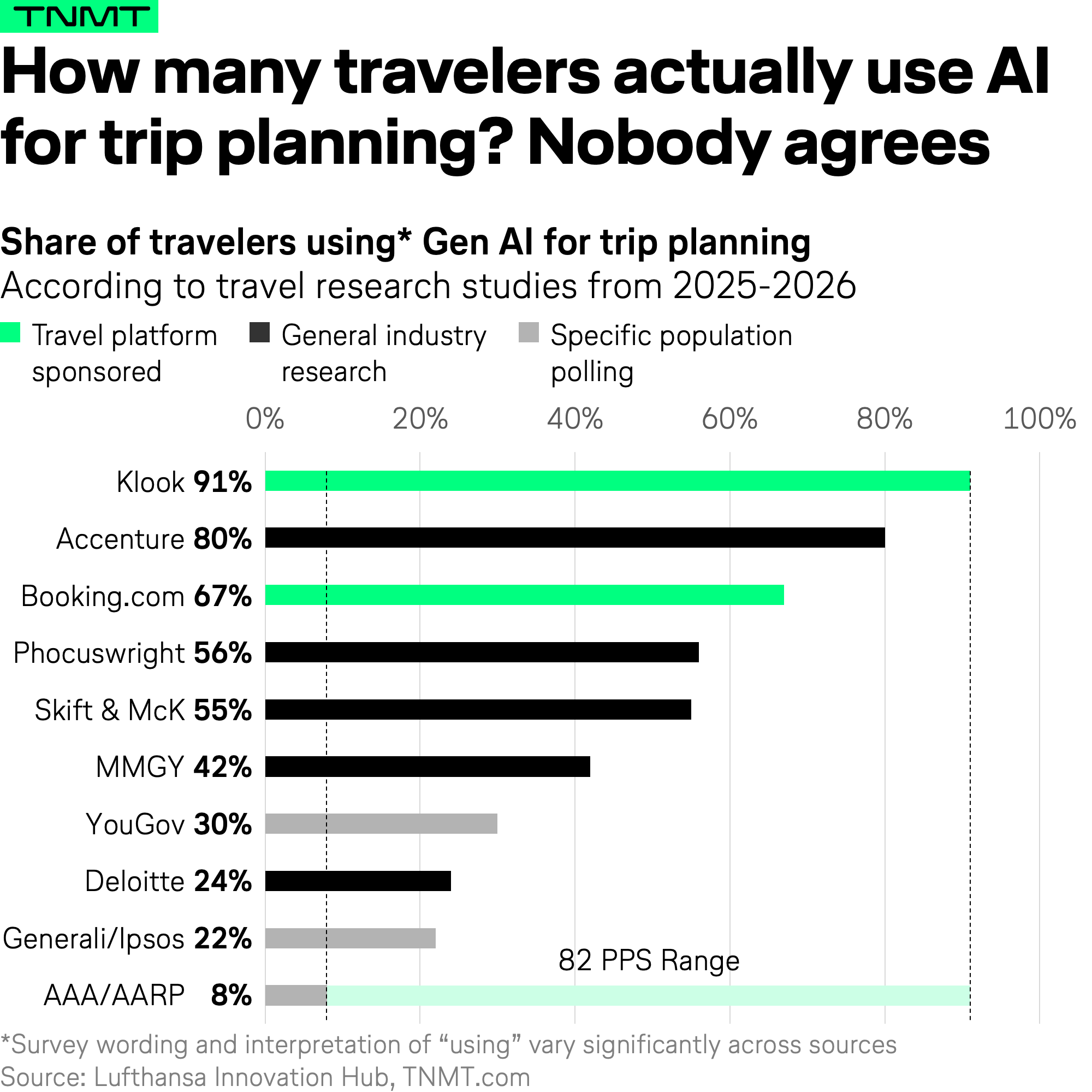
- Some studies claim more than 90% of travelers already use AI for travel planning.
- Others put the number below 10%.
So what’s going on?
The short answer: data never speaks in one voice.
It depends heavily on where the data comes from, who gets surveyed, and how the question is phrased.
- Booking platforms like Klook, for example, usually survey their own user audiences that tend to be more digitally engaged and AI-curious than the broader travel population.
- The lower-end figures in our chart mostly come from polling specialists focused on narrower demographics. AAA, for instance, surveyed Americans aged 50+, so not exactly the same audience as a Gen-Z-heavy OTA user base.
Meanwhile, travel-focused research firms like Phocuswright or Skift are probably the closest thing we have to a neutral middle ground for understanding mainstream travel behavior.
But even there, wording matters enormously:
- “Have you used AI?”
- “Do you feel comfortable using AI?”
- “Do you plan to use AI?”
Those are three very different questions, and they produce very different answers.
In other words: the devil is in the methodology.
And unfortunately, many media headlines and LinkedIn hot takes care more about a punchy opening statistic than the methodological nuance sitting quietly in the footnotes.