Almost exactly one year ago, we asked a simple but powerful question:
What single trend would shape the travel industry the most in 2025?
This question has become something of an annual tradition for us at TNMT: a moment to zoom out and reflect on the forces truly shaping the future of Travel and Mobility Tech.
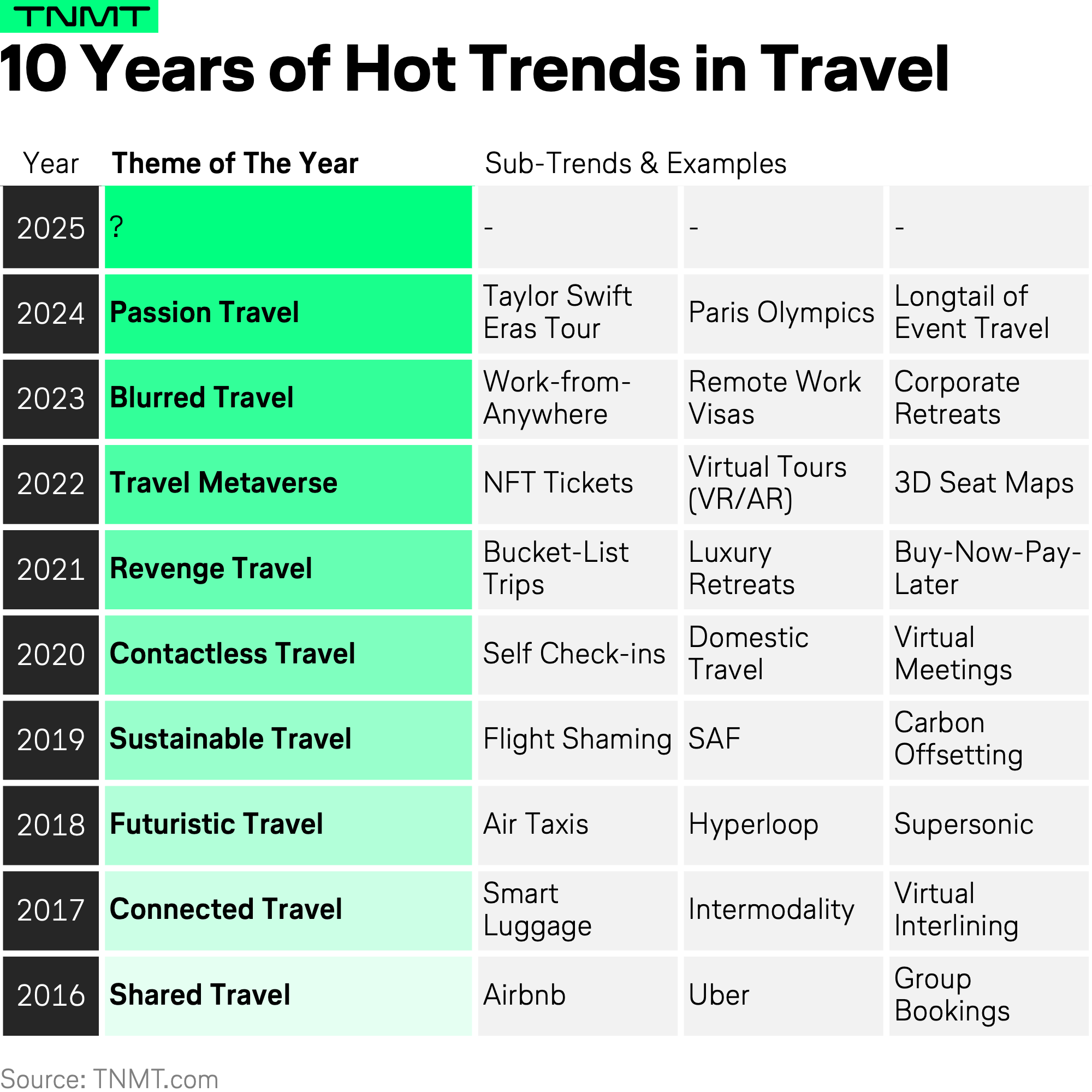
Over the past decade, our retrospective theme chart has tracked how each year left its mark, from the rise of Shared Travel via Airbnb and Uber back in 2016 to the Passion-Travel era fueled by Taylor Swift and others in 2024.
For 2025, we laid out four bold scenarios.
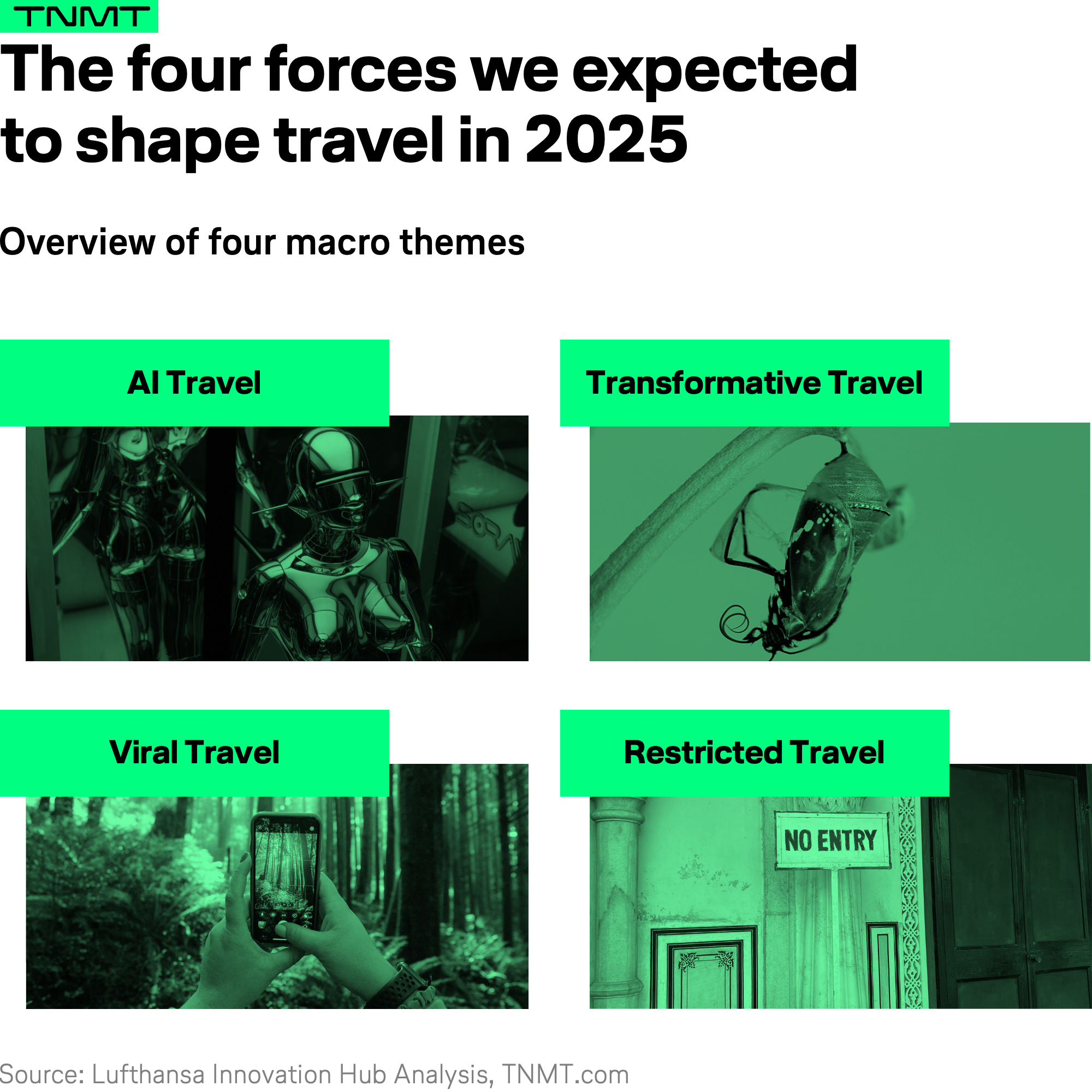
Each one captured a distinct force with the potential to reshape the industry:
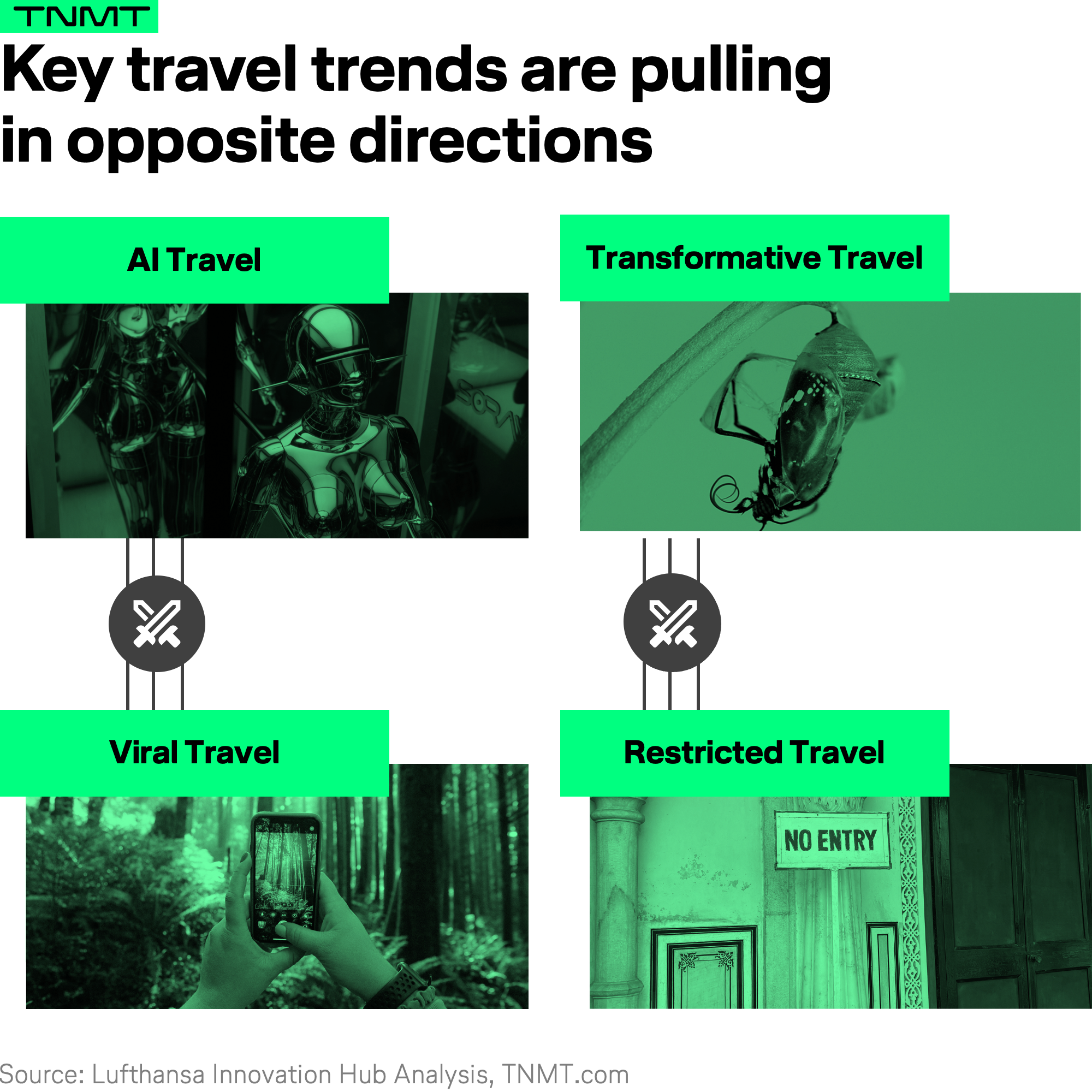
- AI Travel (aka Agentic Travel): The belief that 2025 would be the tipping point for GenAI in travel, powering everything from trip planning to automated bookings via intelligent agents.
- Viral Travel: A scenario where social media platforms like TikTok and Instagram move from inspiration engines to full-blown travel marketplaces, with social commerce reshaping booking behavior.
- Transformative Travel: The next evolution of the wellness wave, where travel becomes a vehicle for health, healing, and self-improvement. Think longevity escapes, psychedelic retreats, and sober tourism.
- Restricted Travel: A more sobering vision, where rising geopolitical tensions, overtourism backlash, and stricter visa rules begin to redraw the boundaries of global mobility.
You might also remember: we didn’t choose a single winner.
We asked you (our readers) to vote. The results were pretty clear: 55% believed 2025 would be the year of AI Travel.
But now that the year is fully behind us, it’s time for a reality check.
- Which of these four trends actually defined the travel industry the most in 2025?
- As always, we’re not here to speculate. We’re here to analyze.
- Let’s take a data-driven look at what really happened.
Data View #1: What the Media Says
To move beyond gut feelings, we turned to two distinct data perspectives, starting with a comprehensive media analysis of how 2025 travel trends were actually covered throughout the year.
Using our proprietary data tool stack at the Lufthansa Innovation Hub, we scraped thousands of mainstream media articles published in 2025 that focused on key innovation shifts in the travel industry.
Then, we applied AI-powered classification to sort each article by its dominant theme, mapping them to one of the four scenarios we outlined last year.
The results?
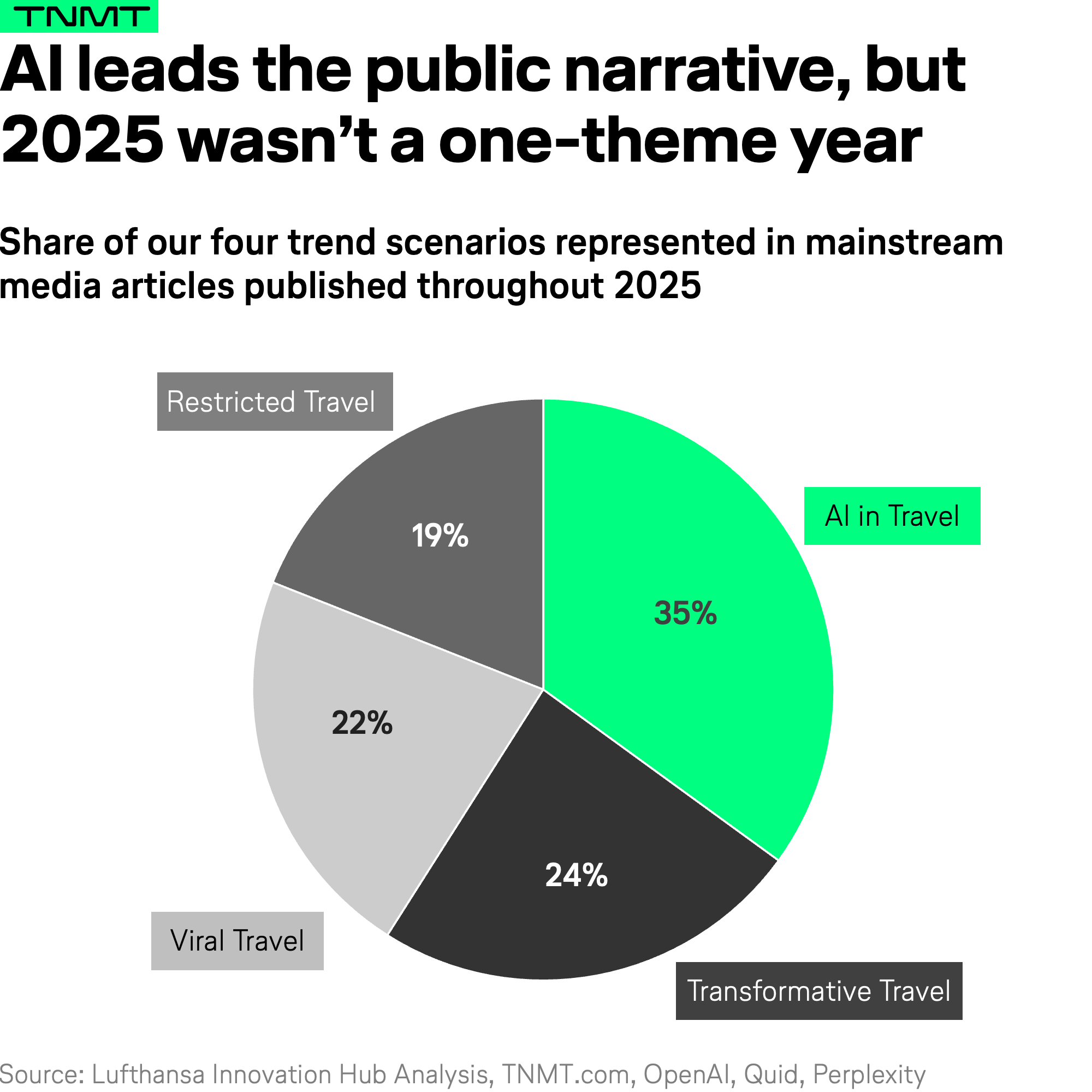
- AI did come out on top, just as many of you predicted.
- But the margin was much narrower than expected.
- Roughly 35% of all media trend articles positioned AI as the primary force shaping travel in 2025.
Here are a couple of major AI headlines from last year:
- Google quietly began testing autonomous travel search and booking flows with six major partners.
- Booking.com launched its first fully AI-powered production assistant, reportedly boosting partner satisfaction by 73%.
- Meanwhile, Expedia’s AI agent handled (apparently) 143 million customer conversations, pushing its self-service rate above 50%.
- But with scale came scrutiny: Amazon’s lawsuit against Perplexity kicked off the first legal battle over AI-driven commerce, raising urgent questions about who owns the (travel) customer when an AI system intermediates the transaction.
That said, each of the other themes claimed a meaningful share of coverage as well:
Transformative Travel came in second, as 2025 saw a surge in travelers pursuing health, not just holidays. Two examples:
- Sweden became the world’s first prescription destination. Visit Sweden launched “The Swedish Prescription”, a campaign offering downloadable medical referrals that officially recommended travel to Sweden as wellness therapy. Backed by researchers from the Karolinska Institute and endorsed by doctors in four countries, the initiative promoted forest bathing, cold-water plunges, and sauna sessions as science-backed mental health treatments.
- Meanwhile, in South Korea, K-beauty went biomedical. Seoul’s booming $2 billion USD medical tourism sector found a breakout star: salmon sperm facials. Known as “Rejuran” (derived from salmon DNA), the procedure involves up to 700 micro-injections promising “glass skin.” Clinics reported fully booked appointment blocks for American tourists pairing stem cell therapy, fat-dissolving injections, and facial rejuvenation treatments.
Viral Travel followed close behind, with creators and social platforms continuing to shape demand.
- TikTok and Booking.com launched in-app hotel reservations, turning scrolls into bookings.
- Expedia’s Travel Shops expanded globally, with 100+ creator storefronts reshaping how travelers discover and purchase experiences.
- But the biggest social moment of 2025 was an unintentional meme. Jet2’s holiday jingle “Nothing Beats a Jet2 Holiday” went wildly viral, racking up 80 billion+ views across 12 million social posts. Ironically, travelers stitched the tune onto “holiday disaster” videos, but the attention translated into real results: Jet2 welcomed 750,000 more passengers year-over-year in H1 2025, and myJet2’s loyalty program jumped 62%, topping 8.4 million subscribers. Many Tourism strategists called it “marketing gold.”
And (obviously) Restricted Travel generated a steady stream of headlines as well, often tied to shifting visa policies, border entry concerns (especially in the U.S.), and anti-tourism tactics initiated by leading destinations.
- Barcelona, for example, executed Europe’s most aggressive overtourism crackdown to date as the city banned all 10,000 short-term rentals and capped cruise ship arrivals, cutting cruise capacity by 16% to reclaim livability for residents.
- Meanwhile, two cultural superpowers introduced “differentiated pricing” based on nationality: France raised Louvre ticket prices by 45% for non-EU visitors and extended this policy to landmarks like Versailles and Sainte-Chapelle. Just weeks later, the Trump administration announced a $100 surcharge for international visitors to 11 major U.S. national parks, including Yellowstone, the Grand Canyon, and Yosemite.
The bottom line?
AI may have won the attention game, but not by a landslide.
In the media’s eyes, 2025 wasn’t defined by a single trend.
It was shaped by several parallel forces, all fighting for relevance.
Data View #2: What the Experts Say
Mainstream media tends to amplify the loudest narratives. But what happens when you zoom in on the voices closest to the industry?
To build a second, more grounded perspective, we turned to a different dataset:
- We looked at all the 2026 travel outlook reports released over the past few weeks by consultancies, think tanks, startups, and media brands.
- In total, we reviewed 62 trend reports, each published at the end of 2025.
- Rather than manually cherry-pick themes, we fed the entire corpus through our AI-powered trend analytics stack.
The result?
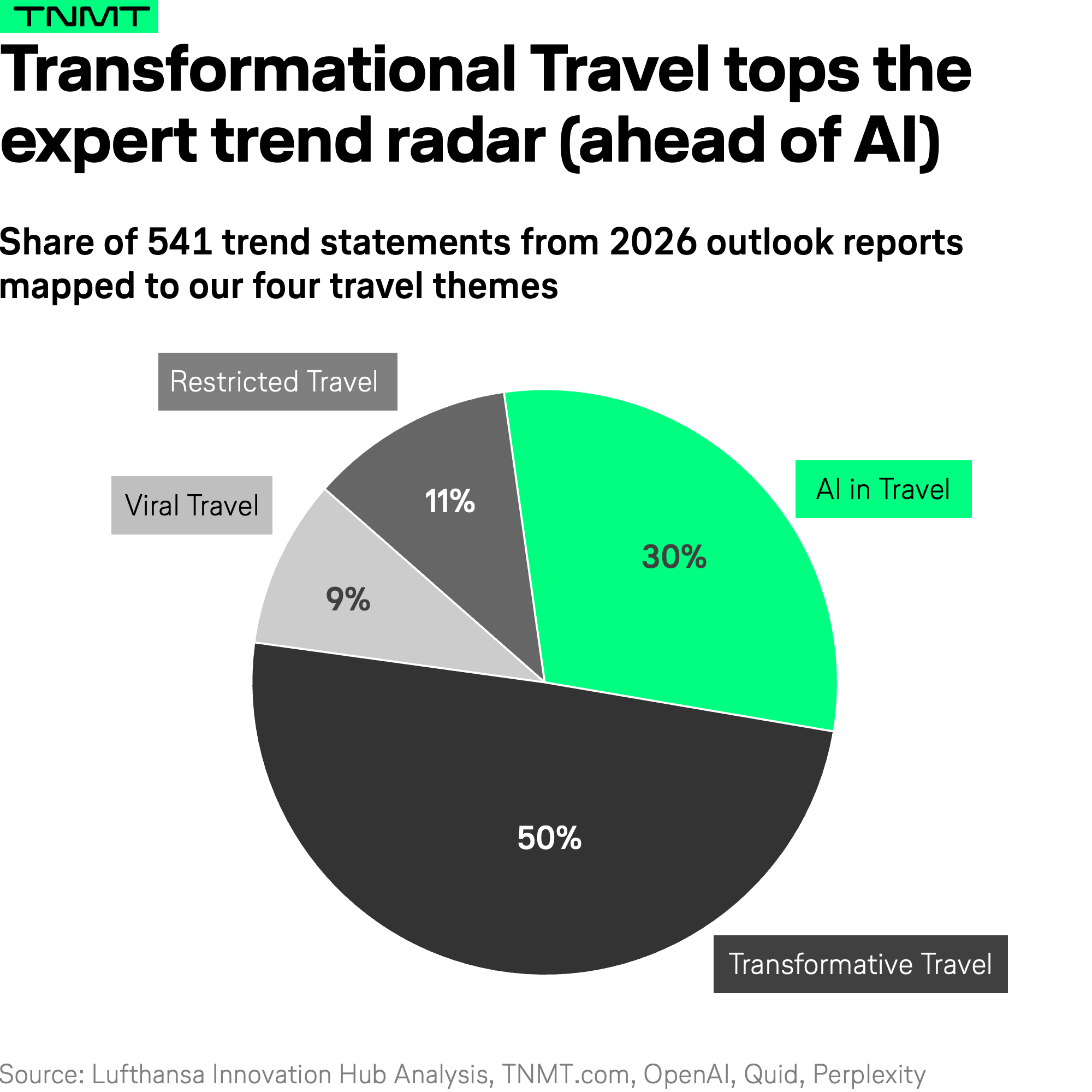
A total of 541 individual trends are covered in all these reports.
Once identified, we mapped each of these 541 trend signals to our original four 2025 scenarios, adding an “Other” category for those that didn’t cleanly fit.
Now, you might say: Isn’t it a bit unfair to evaluate 2025 by looking at 2026 predictions?
Fair. But here’s why we think it works:
- These 2026 outlooks were published after the close of 2025.
- Which means they’re actually reflections (not necessarily forecasts).
- A mirror of what actually played out over the past 12 months.
So, what did we find?
Roughly half of all 541 trend signals mapped cleanly to one of our four original 2025 scenarios.
And the biggest surprise? Transformational Travel came out on top.
- That’s right. Wellness-led, value-driven, and self-optimizing experiences beat AI to the top spot.
- The message from industry experts is pretty clear: We’re deep in the health meets experience economy.
So, what does this all tell us?
It’s a powerful reminder for innovation professionals across travel and mobility: AI may be the tech trend of the moment, but travel is still a deeply human product.
True innovation is about crafting more meaningful journeys (not only smarter systems).
2025 Wasn’t a Race. 2026 Won’t Be Either.
After analyzing thousands of headlines and 62 trend reports, one finding stands out:
There’s no single trend winner.
- The travel industry in 2025 wasn’t defined by one dominant trend.
- It was shaped by a convergence of forces.
It was a multi-front shift, happening across parallel dimensions.
- Yes, AI reshaped how we plan and book.
- Yes, social platforms drove viral demand.
- Yes, wellness and longevity turned travel into therapy.
- And yes, geopolitics and regulation redefined where we could go, when, and how easily.
But it’s not just that all four trends proved valid and relevant.
It’s that they increasingly overlap, intersect, and in some cases, compete with one another.
Take AI Travel vs. Viral Travel:
- As AI agents begin to automate the search and booking process, trust becomes more critical than ever. And where do travelers still turn for trust? Creators.
- The rise of “human-first” travel inspiration on TikTok and YouTube (often raw, unfiltered, and personal) might become the very counterweight to AI-generated discovery.
Or take Restricted Travel vs.Transformational Travel:
- More than a million international football fans will visit the U.S. this summer to experience the 2026 FIFA World Cup live, for many a once-in-a-lifetime, emotionally charged event.
- But at the same time, the current U.S. administration is creating a climate that feels, at best, unwelcoming. For context: foreign visitor arrivals to the U.S. dropped 6% in 2025 alone.
- So the Restricted Travel narrative isn’t going away, and it’s directly slowing down the aspirations of Transformational Travel.
In short: we’re not just watching four trends unfold. We’re watching the push and pull of competing forces that are actively redefining travel in real-time.
So if 2025 was shaped by layered shifts, 2026 may be the year of collisions.
And how the industry responds could define the next decade.