If one technology has dominated the conversation in 2026, it is Artificial Intelligence.
From generative AI to autonomous agents, seemingly every industry is trying to figure out how AI will reshape its business. And for good reason. Few technologies have attracted this much investment, executive attention, and public excitement so quickly.
But while everyone talks about AI, another technology movement is quietly gaining serious momentum.
We're talking about robotics. Real machines that move around, interact with their physical surroundings, and increasingly take over tasks humans used to do.
Think about your own home for a moment.
Have you recently considered buying one of those robotic vacuum cleaners that can now even mop your floors, preferably while you’re out doing something more enjoyable?
Well, you’re certainly not alone.
Here is an interesting indicator of how consumer interest in robotics is evolving.
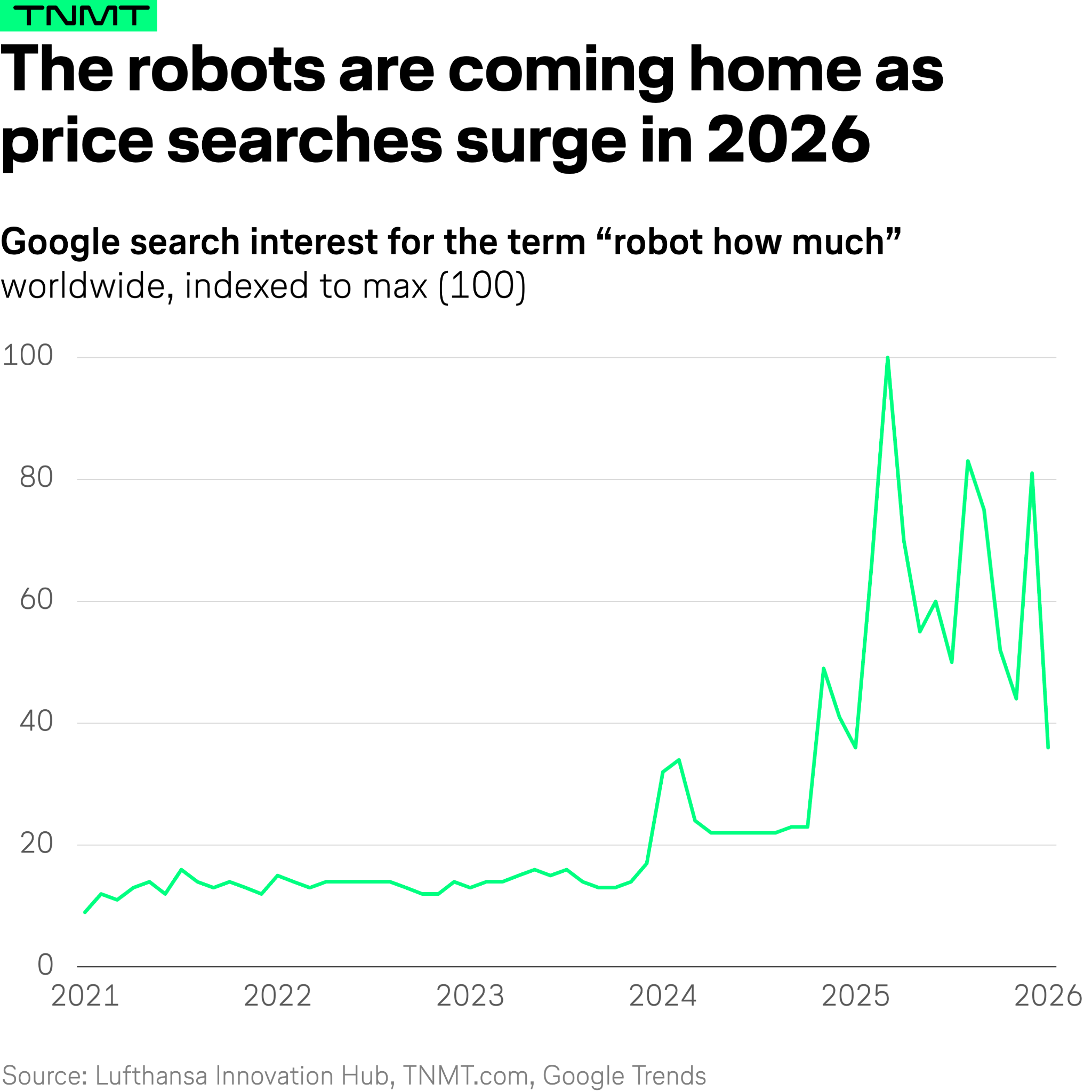
- Take a look at the following Google Trends data, tracking searches for the phrase “robot how much” over the past five years.
- Unlike general searches for robots, these price-related queries suggest something more commercially relevant: people are not just curious about robots anymore. They’re increasingly asking what it would cost to own one.
The real robotics revolution is happening on factory floors
While having a robot clean your home is certainly convenient, the much bigger robotics story has been unfolding in the industrial world for many years.
In modern manufacturing, robots have become practically indispensable. From welding car bodies and assembling electronics to moving heavy components across production lines, industrial robots have taken over many repetitive, physically demanding, precision-intensive tasks that once required human labor.
And their adoption has reached remarkable scale.
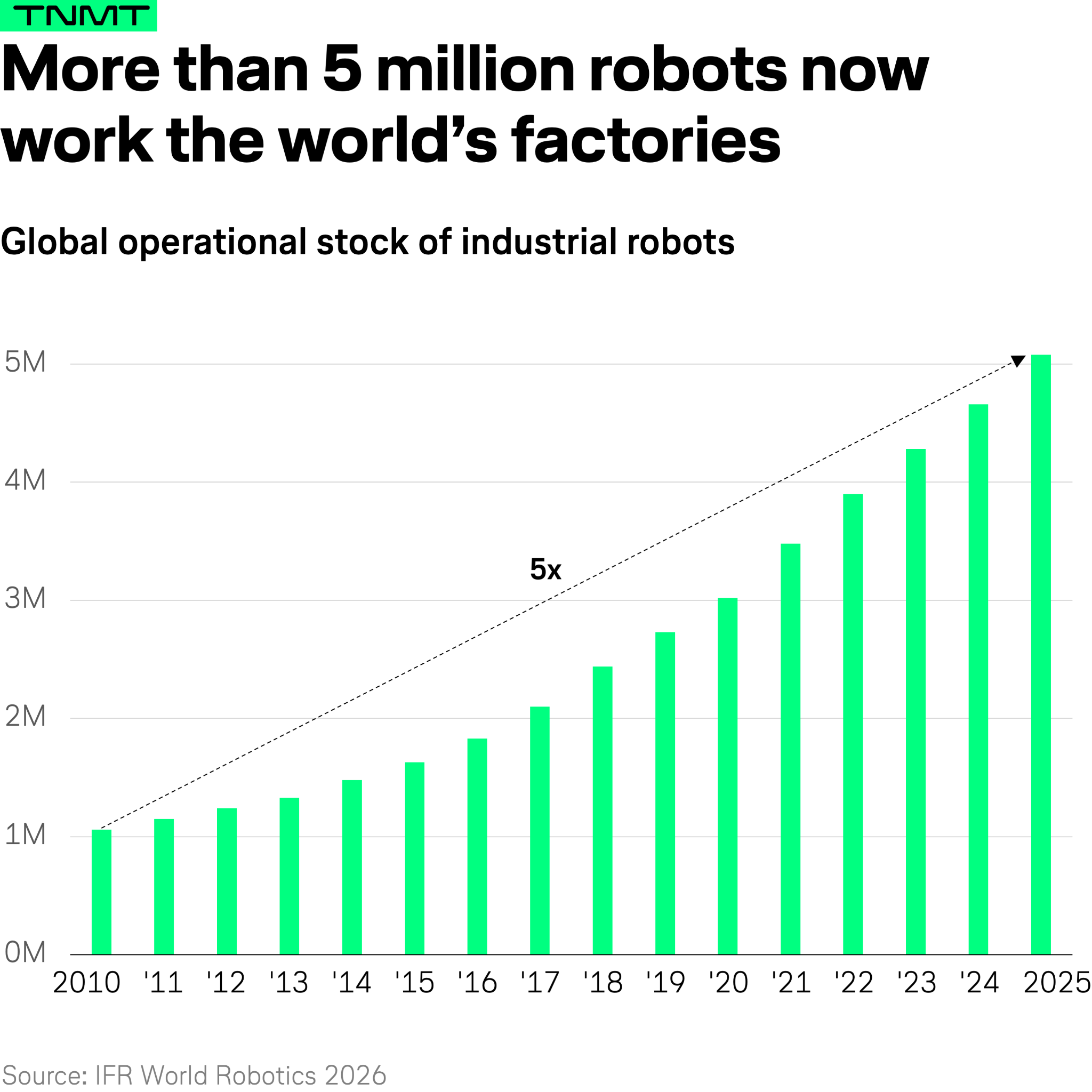
- According to data from the International Federation of Robotics (IFR), the number of industrial robots in operation worldwide has increased fivefold since 2010, surpassing five million units by the end of 2025.
- The takeaway: while consumers are only beginning to discover the convenience of having robots around, entire industries have already made them a fundamental part of how they operate.
Transportation leads in robotics, but not the kind you think
So where is robotics already making the biggest impact beyond factory floors?
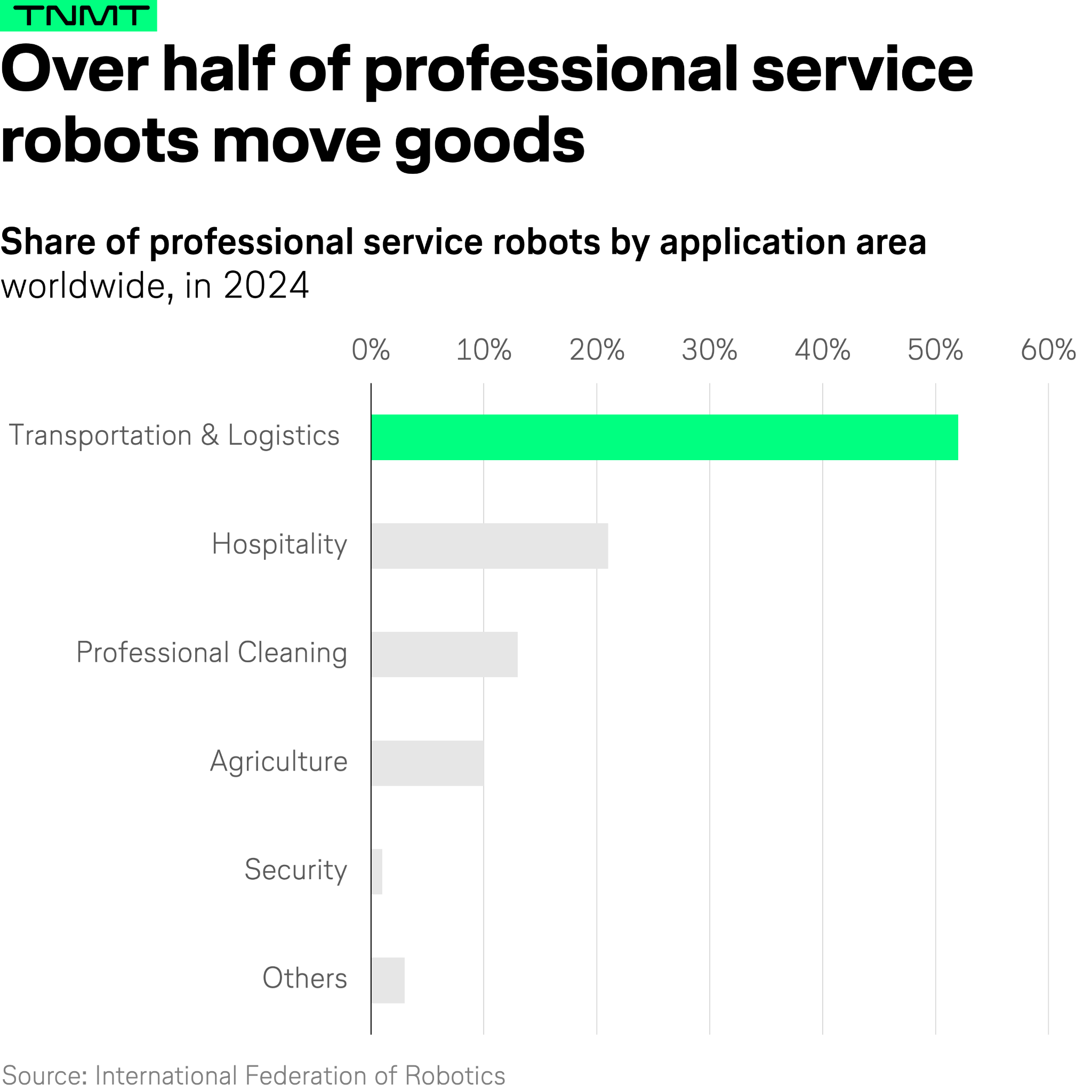
The International Federation of Robotics (IFR) provides an interesting breakdown. And at first glance, the numbers look very promising for our travel and mobility industry.
As it turns out, “Transportation and Logistics” account for nearly half of all professional service robots applied worldwide, making this by far the largest application area.
But before we celebrate, we need to make an important distinction.
- Much of this demand comes from logistics environments, where autonomous machines transport goods, move materials, and automate warehouse processes.
- Automotive manufacturing is another major robotics stronghold.
When we narrow the focus to the actual travel industry, particularly airlines and airports, the picture looks very different.
Unfortunately, no comprehensive figures show how many robots are already operating across the airline and airport ecosystem. But we can look at another indicator: where the industry’s established players are investing.
Our analysis of more than 1,900 investment deals by travel and mobility incumbents, including airlines and airports, reveals that fewer than 4% of these investments over the last few years went into robotics companies.
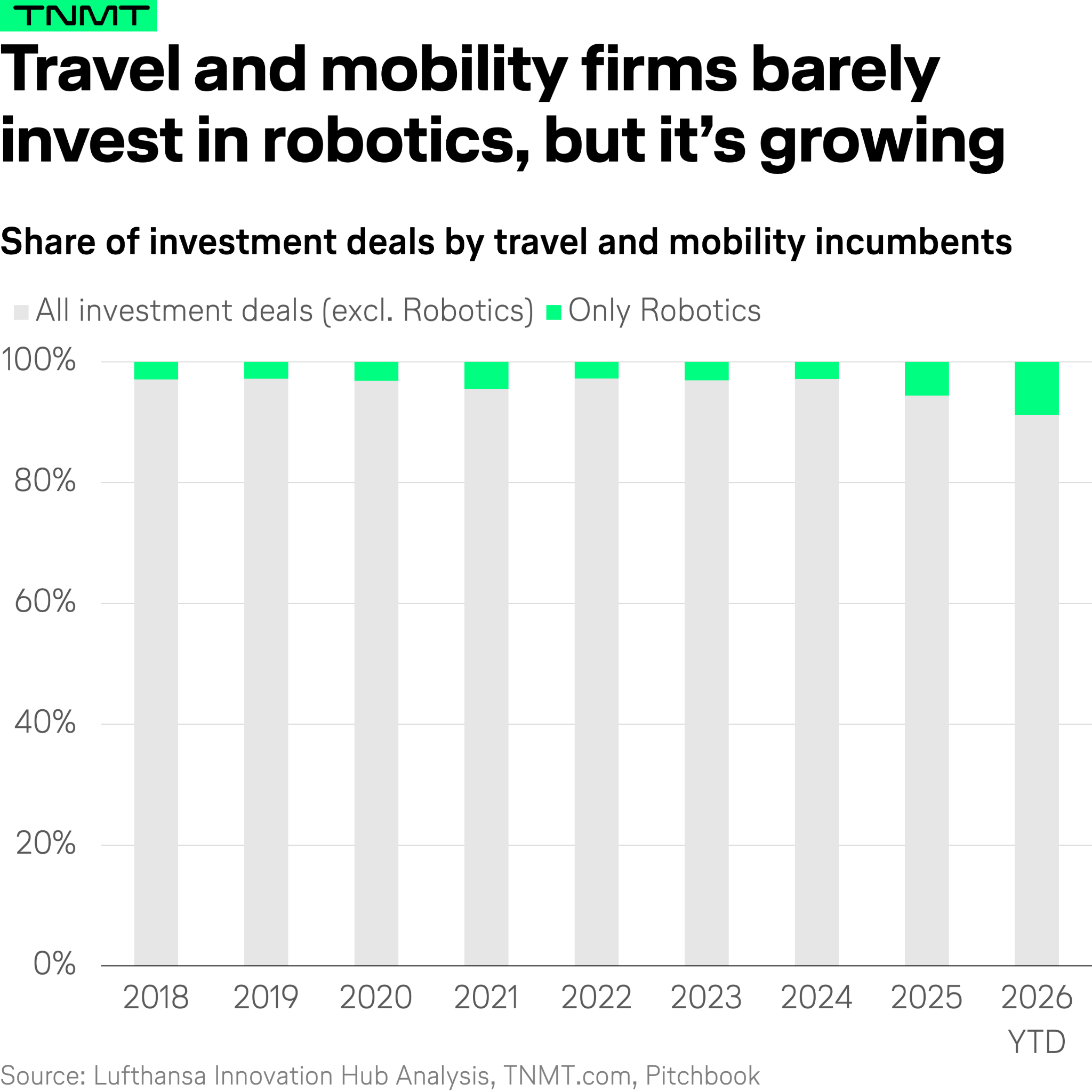
Of course, company investments are not the same as actual technology adoption. Airports and airlines can deploy robots without investing directly in the companies building them.
Still, the numbers suggest that robotics remains a relatively small part of the industry’s innovation investment agenda. And that leaves us with an interesting contrast.
While robotics has become standard in manufacturing and logistics, airlines and airports appear to be only scratching the surface of what physical automation could do for their ground operations.
Introducing our Ground Operations Robotics Hot 25
This brings us to the heart of today’s research.
Over the past few months, we’ve scanned the robotics landscape, spoken with companies developing these technologies, and visited airline ground operations facilities to better understand where physical automation could make the biggest difference.
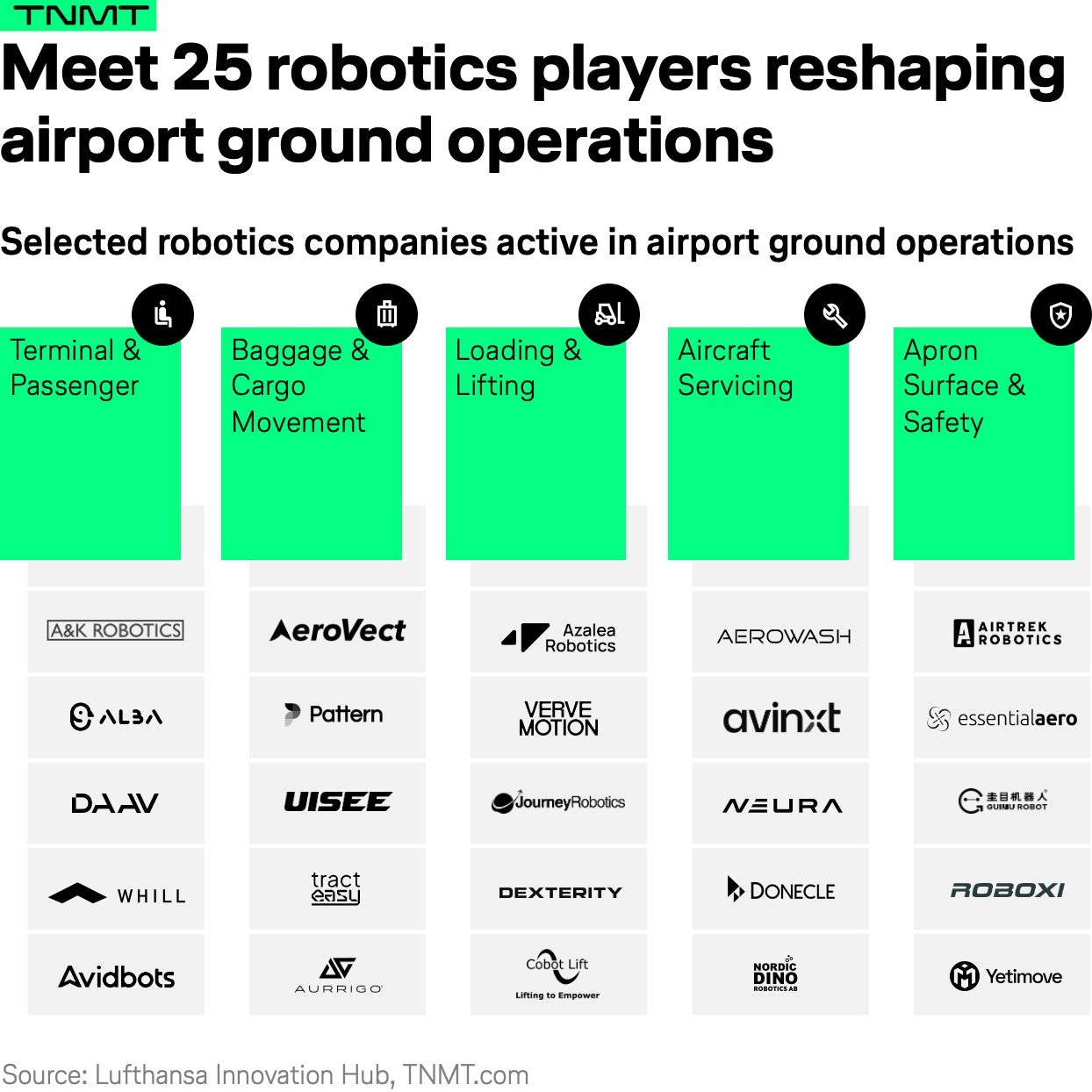
The result is our Ground Operations Robotics Hot 25, a selection of 25 companies we believe are developing some of the most promising robotics solutions for the airline and airport industry.
To make sense of this emerging landscape, we’ve grouped the companies into five distinct categories, covering everything from passenger-facing robotics inside terminals to heavy-duty automation around aircraft.
Together, these five areas provide a comprehensive picture of where robotics could transform airport operations in the years ahead.
But we didn’t stop at mapping the landscape.
We went one step further and selected one standout company in each of the five categories, highlighting the solutions we find particularly exciting and believe deserve more industry attention.
Curious which five companies earned our personal top picks?
Let’s take a closer look.
1) Terminal & passenger
Robots that serve the terminal rather than the aircraft, including autonomous wheelchairs and pods for passengers with reduced mobility, gate and lounge delivery, floor cleaning, and security patrol.
A&K Robotics, Alba Robot, DAAV, WHILL, Avidbots
Our pick: A&K Robotics
Vancouver-based A&K Robotics builds Cruz, a self-driving pod that takes a passenger with reduced mobility from check-in to the gate. The passenger picks a destination on screen; the pod navigates the crowd on its own. The company was part of a pilot project at Vancouver International in 2024, and in October 2025, Aena signed up for a pilot at Madrid-Barajas. In April 2026, it announced a CAD 8 million Series A funding round co-led by BDC Capital and Vantage Futures.
2) Baggage & cargo movement
Driverless movement of bags and freight between the terminal and the aircraft, including self-driving baggage tractors, dolly and ULD transporters and cargo tugs.
AeroVect, Pattern Labs, UISEE, TractEasy (now part of TLD Robotics), Aurrigo
Our pick: Pattern Labs
Colorado-based Pattern Labs is building the complete technology stack for a driverless ramp. Pulse OS plans and simulates the fleet, a driver co-pilot gives human tug drivers turn-by-turn directions, and Pathfinder, an autonomous tug and cart in one, runs missions on its own with a remote operator. At Purdue University Airport, Pattern Labs and Ericsson have partnered to test handling plane-side baggage for commercial flights in a real-world deployment and to build the case for FAA certification and operational validation. Founded in 2021, Pattern Labs has raised roughly $10.8 million USD, including a $9 million USD Series A in April 2025.
3) Loading & lifting
The lifting and placing of bags and pallets, including container loading cells in the baggage hall, mobile robot arms working the cart and the hold, and the exoskeletons that take the strain off the crew.
Azalea Robotics, Verve Motion, Journey Robotics, Dexterity, Cobot Lift
Our pick: Verve Motion
Massachusetts-based Verve Motion makes the SafeLift exosuit, a soft, motorised vest whose sensors detect a lift, bend or twist and includes an artificial-muscle ribbon that adds up to 240 newtons of assistance, working with the body’s movement. In July 2026, IAG invested through IAGi Ventures, taking total funding past $55 million USD with a pilot of an aviation-specific exosuit, starting with shoulder support for baggage handlers. Verve says the suit takes roughly 40% of the strain off the back and hips and claims injury reductions of up to 85% in warehouse settings.
4) Aircraft servicing
Work done to the airframe itself while it is parked, including de-icing, exterior washing, engine washing, inspection, and GPU connection.
Aerowash, Avinxt, Neura Robotics, Donecle, Nordic Dino
Our pick: Neura Robotics
Germany’s Neura Robotics builds cognitive robots. It developed A.R.C., the Autonomous Robot for GPU Connection in partnership with KLM and Schiphol under Future Travel Experience’s Smart Ramp initiative. It drags the ground power cable to the aircraft, navigates the stand, finds and opens the access panel with a vision-guided gripper, and plugs in a cable. Connecting ground power is one of the heaviest, most repetitive jobs on the ramp, and it happens on every single turn. In June 2026, Neura announced a Series C of up to $1.4 billion USD led by Tether, with Nvidia, Amazon, Qualcomm, Bosch and the European Investment Bank alongside, at a reported valuation of around $7 billion USD.
5) Apron surface & safety
Keeping runways, taxiways, and aprons safe to use, including debris detection and collection, surface and lighting inspection, snow clearance and wildlife deterrence.
Airtrek Robotics, Essential Aero, Guimu Robot, Roboxi, Yeti Move
Our pick: Roboxi
Founded in 2018, Roboxi builds AI-driven airport automation technologies that do four airfield jobs at once: it detects and physically collects foreign object debris, laser-scans runway and taxiway surfaces in 3D, flags defective airfield lighting, and detects and deters birds. The technology was developed together with Norwegian airport operator Avinor and the Norwegian Civil Aviation Authority, which has received approval to operate its multifunctional airfield technology. In May 2026, it closed a €13 million funding round.